Épisodes

  • The Fitness Bank Account: Why the Boring Weeks Are the Ones That Change You
    Sep 27 2026

    The Fitness Bank Account


    Why the Boring Weeks Are the Ones That Change You


    Why is it that some people seem to stay fit for years, while others repeatedly go through the cycle of starting, stopping and starting again?


    It usually isn’t because they’re more motivated.


    In this week’s Consistency Club Guided Run, Adam talks about the thing this entire community is built around:


    Consistency.


    And importantly, consistency doesn’t mean being perfect.


    Using the idea of a fitness bank account, we look at how every run, walk, strength session, decent meal and sensible recovery decision is another small deposit — and why those seemingly insignificant deposits can eventually add up to something massive.


    In this episode:


    💰 The Fitness Bank Account – Why individual workouts rarely transform you, but hundreds of small deposits eventually can.


    🏃 Consistency beats intensity – Why three sensible sessions every week can achieve far more than smashing yourself for a month and then stopping.


    🛰️ Recalculate, don’t quit – Missed a run? Had a bad week? Been on holiday? Treat it like missing a turn on the sat nav. Recalculate and carry on.


    🔄 Become brilliant at restarting – You don’t need to become someone who never falls off track. Become someone who doesn’t stay off for very long.


    📉 Your minimum viable week – Why doing a smaller version of your normal routine during busy periods can be far better than doing nothing because you can’t do everything.


    ❌ Don’t make up missed sessions – Training isn’t homework. If you miss Monday’s run, you don’t necessarily need to cram it into Tuesday and throw the rest of the week out.


    🌴 Holidays don’t destroy your fitness – Enjoy your holiday. Run if you want to. Don’t if you don’t. The important bit is simply getting back into your routine afterwards.


    🔥 Why motivation isn’t enough – Motivation comes and goes. Routines reduce the number of times you have to convince yourself to get started.


    🚪 Reduce the friction – Sometimes consistency isn’t about having more willpower. It’s putting your trainers by the door, taking your gym kit to work or making the good choice easier to make.


    🧠 Identity – How enough small actions eventually change your language from “I’m trying to run” to “I’m a runner.”


    📈 Compound interest for fitness – How one positive habit can make the next one easier, creating momentum that builds over months and years.


    🪨 The boring middle – Transformations don’t really happen in the before-and-after photos. They happen during the hundreds of ordinary Tuesdays nobody takes a picture of.


    The biggest message


    Consistency doesn’t mean:


    Never miss a run.


    It doesn’t mean:


    Never eat a takeaway.


    And it definitely doesn’t mean:


    Be perfect.


    It means keep coming back.


    One missed session doesn’t empty your fitness bank account. One bad week doesn’t erase months of work. And a holiday doesn’t send you back to square one.


    Make the next deposit and carry on.


    Because one fairly average week of training might not look particularly impressive…


    But fifty fairly average weeks?


    That can completely change somebody.


    Key takeaway:


    I’d take somebody who’s 80% consistent for five years over somebody who’s 100% consistent for five weeks — every single time.

    Afficher plus Afficher moins
    20 min
  • When Running Feels Harder Than It Should
    Sep 19 2026

    When Running Feels Harder Than It Should

    Why One Bad Run Means Absolutely Nothing

    Ever gone out for a run at a pace that normally feels comfortable… only to suddenly feel like you’ve got two bags of cement attached to your legs? 😂

    Your breathing feels harder. Your heart rate is higher. Your pace is slower. And within about ten minutes you’ve convinced yourself that you’ve somehow lost all your fitness since Tuesday.

    In this week’s Consistency Club Guided Run, Adam talks about why bad runs happen, what might be causing them, and why one difficult session tells you very little about how fit you actually are.

    In this episode:

    😴 Sleep – Why eight hours in bed doesn’t necessarily mean eight hours of good recovery, and how poor sleep can show up in your running.

    🪣 The stress bucket – Your body doesn’t separate running stress from work, family, poor sleep and everything else going on in life. It all goes into the same bucket.

    ⛽ Fuel & glycogen – Why the exact same pace can suddenly feel much harder when you haven’t fuelled particularly well.

    💧 Hydration, heat & weather – How temperature, wind and hydration can completely change the effort required to run your usual pace.

    🏋️ Training fatigue – Sometimes your legs feel heavy because your training is doing exactly what it’s supposed to do. Training creates fatigue before recovery creates adaptation.

    📈 Why progress isn’t linear – Fitness doesn’t go up in a perfectly straight line. Good weeks, bad weeks, PBs, holidays, illnesses and rubbish runs are all part of the process.

    🔍 Look for patterns, not individual numbers – One bad run probably means very little. Several difficult runs alongside poor sleep, elevated resting heart rate, low HRV and persistent fatigue might be worth paying attention to.

    🏁 Bad races happen too – Fitness is what you’ve built; race performance is what you manage to express on one particular day. One bad race doesn’t erase months of training.

    ⌚ Stop analysing everything – Sometimes there isn’t a perfect explanation. You can sleep well, eat well and prepare properly… and still have a crap run 😂

    🧠 The experienced-runner mindset – Becoming a better runner isn’t about eliminating bad days. It’s learning not to panic when they happen.

    Zoom out

    One run is one coin toss.

    One match isn’t the season.

    One jigsaw piece isn’t the whole picture.

    Instead of judging your fitness from what happened today, zoom out.

    How has the last month gone? What can you do now that you couldn’t do six months ago? Is there actually a pattern developing, or have you simply had a rubbish Tuesday?

    Sometimes there’s something useful to learn from a bad run.

    Sometimes there isn’t.

    Either way, don’t allow one difficult session to rewrite the story of all the work you’ve already done.

    Key takeaway:

    Your worst run doesn’t define your fitness any more than your best run does. They’re both individual pages — we’re interested in the whole book. 👊🏃


    Afficher plus Afficher moins
    19 min
  • Slow Down to Speed Up: Why Your Easy Runs Should Actually Feel Easy
    Aug 26 2026

    Ever been given an easy run… only to finish it absolutely knackered because you couldn’t resist trying to beat last week’s pace? 😂

    You’re definitely not alone.

    In this week’s Consistency Club Guided Run, Adam explains why one of the best things you can do to become a faster, fitter and more resilient runner is surprisingly simple:

    Slow down.

    We look at why not every run needs to be a test, what easy running is actually doing inside your body, and why finishing a session feeling like you could have done more can be a sign that you’ve got it exactly right.

    In this episode:

    🏃 Why easy running matters – How slower running helps build the aerobic foundations that eventually allow you to run faster.

    🏠 Stop testing and start training – Why trying to beat your previous pace on every run is like attempting your one-rep max every time you go to the gym.

    ❤️ What happens inside your body – A simple explanation of mitochondria, capillaries, cardiovascular adaptations and why easy running helps develop your aerobic engine.

    80️⃣ The 80/20 principle – Why successful endurance training generally involves considerably more easy running than hard running — without becoming obsessed with the exact percentages.

    🗣️ How easy should “easy” actually feel? – Why the conversation test and perceived effort can sometimes be more useful than obsessing over your pace.

    🚶 Why walking isn’t cheating – How strategic run/walk intervals can help newer runners build fitness and spend longer moving without unnecessarily exhausting themselves.

    ⌚ Heart rate & Zone 2 – Why heart-rate data can be useful, but you don’t need to panic because Garmin says you’ve drifted a few beats into Zone 3.

    🐢 “Running slower feels harder!” – Why deliberately slowing down can initially feel awkward and why that’s completely normal.

    💥 Hard sessions still matter – Intervals, tempo runs, track sessions, parkrun and races absolutely have their place. The key is not making every run one of them.

    💰 Your weekly energy budget – Why every hard session has a cost and how constantly overspending can eventually leave you in “fatigue debt.”

    📱 The Strava trap – Why training to impress the people looking at your activity can be completely different from training to improve the person wearing the trainers.

    🧠 Learning patience – Why the individual easy runs that don’t feel particularly impressive can become some of the most important sessions when you stack enough of them together.

    The biggest message

    Training isn’t about proving how fit you are today. It’s about creating a body that’s fitter tomorrow.

    Some sessions are there to test you.

    Some are there to push you.

    But a huge amount of your running is simply there to quietly build the foundations.

    So if today’s plan says easy 5K, you don’t need a PB.

    Slow down.

    Relax.

    Forget what the pace looks like on Strava.

    And if you finish thinking…

    “I could’ve done more.”

    Good.

    You probably got it right.

    Key takeaway:

    “Stop testing your fitness and start training it. We’re not trying to win Tuesday — we’re trying to build a runner who can keep improving for years.” 👊🏃


    Afficher plus Afficher moins
    22 min
  • What Do All Those Numbers on Your Running Watch Actually Mean?
    Aug 19 2026

    VO₂ max. HRV. Resting heart rate. Training readiness. Body Battery. Heart-rate zones. Recovery time…

    Your smartwatch gives you an incredible amount of information — but what does any of it actually mean? And more importantly, which numbers should you genuinely care about?

    In this week’s Consistency Club Guided Run, Adam breaks down the most common running-watch metrics in plain English, using simple stories and analogies to explain what your watch is actually trying to tell you.

    No sports-science degree required 😂

    In this episode:

    ⌚ VO₂ Max – What it actually measures, why a bigger aerobic engine can help your running, and why your watch’s number is still only an estimate.

    ❤️ HRV (Heart Rate Variability) – Probably the most confusing number on your watch, explained simply. Why more variability can actually be a good thing and why you should compare HRV against your own baseline, not somebody else’s.

    💓 Resting Heart Rate – How endurance training can make your heart more efficient and why a sudden change from your normal resting HR can sometimes be useful information.

    🏃 Heart-Rate Zones – What Zones 1–5 mean, why Zone 2 gets so much attention, and why you shouldn’t panic every time your watch tells you you’ve drifted into Zone 3.

    🔋 Body Battery & Training Readiness – How watches combine different information to estimate recovery — and why your watch still doesn’t know everything happening in your life.

    😴 Sleep Scores – Why sleep absolutely matters, but obsessing over whether you scored 68 or 82 probably doesn’t help.

    😰 Stress – How your watch can detect signs of physiological stress and why things like hard training, poor sleep, illness, travel and alcohol can affect your numbers.

    🎒 Training Load & Recovery – Why training is like gradually adding weight to a backpack: enough stress creates adaptation, but too much without recovery eventually becomes a problem.

    👟 Cadence – What steps per minute actually means and why 180 isn’t a magical number every runner needs to chase.

    ⏱️ Pace – Why the same pace can represent completely different efforts depending on hills, heat, wind and fatigue.

    🔥 Calories Burned – Why the number on your watch is an estimate rather than permission to spend exactly 687 calories in Greggs 😂

    The biggest lesson

    Your smartwatch can be an absolutely brilliant training tool — but individual numbers rarely tell the whole story.

    Rather than panicking because your VO₂ max dropped by one point or your HRV was lower this morning, look for patterns and trends.

    Combine the numbers with the most important piece of information your watch doesn’t fully understand:

    How you actually feel.

    Your watch should help you understand your body — not make you frightened to trust it.

    Key takeaway:

    “Your watch is the dashboard. You’re the driver. Use the data to help make decisions, but don’t hand an algorithm the keys.” ⌚🏃👊


    Afficher plus Afficher moins
    25 min
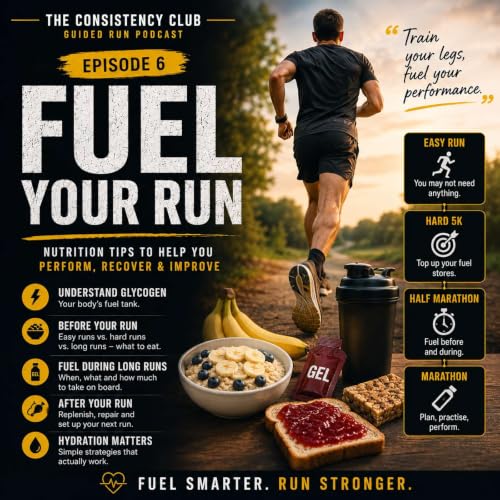
  • What Should I Eat Before a Run? (Guided Run Episode 6)
    Aug 14 2026

    Episode 6 – Fuel Your Run: What to Eat Before, During & After Running

    What should you eat before a run? Do you actually need breakfast before an easy 5K? When should you start using gels? And how should your fuelling change when you go from a short run to a half marathon?

    In this week’s Consistency Club Guided Run, Adam breaks down running nutrition without making it unnecessarily complicated.

    Using simple analogies and relatable examples, we look at how your body stores and uses carbohydrate, what glycogen actually is, and why the duration and intensity of your run should influence how you fuel it.

    In this episode:

    🏃 Why an easy 5K and an all-out 5K require different approaches

    ⛽ Glycogen explained as your body’s fuel tank

    🍌 Whether you actually need to eat before an easy morning run

    ⚡ What to eat before a hard 5K or parkrun attempt

    🥣 How to approach breakfast before a half marathon

    🍬 When gels and mid-run carbohydrates become useful

    ⏱️ Why runners going longer than around an hour may benefit from taking carbohydrate during their run

    🚽 Why you should NEVER experiment with new gels or food on race day 😂

    🏁 How to practise your race-day nutrition during training

    🥔 Why carbohydrate after harder and longer runs helps replenish glycogen

    🥩 The importance of protein for recovery and adaptation

    💧 Hydration, electrolytes and how hot weather changes your requirements

    🧠 Why runners trying to lose weight shouldn’t become frightened of fuelling their training

    The biggest message from this episode is that there isn’t one perfect running diet.

    An easy 30-minute run doesn’t need to be fuelled like a half marathon, and a hard 5K places very different demands on your body than a gentle 5K.

    Learn what you’re asking your body to do, practise your nutrition in training, and gradually build your own running instruction manual.

    Key takeaway:

    “Train your legs. Train your gut. Fuel the work you’re asking your body to do — and don’t wait until the fuel light comes on before looking for a petrol station.”


    Afficher plus Afficher moins
    21 min
  • The Day I Nearly Quit (Guided Run Episode 5)
    Aug 8 2026

    Episode 5 – The Day I Nearly Quit

    In this week’s Consistency Club Guided Run, Adam talks about something every runner, dieter and fitness enthusiast experiences at some point…

    Wanting to quit.

    The bad run.

    The missed PB.

    The injury.

    The week where the scales don’t move.

    The moment where you start wondering whether any of this is actually working.

    Using personal experiences, relatable client stories and simple analogies, Adam explores why failure isn’t the opposite of progress — it’s often one of the most important parts of it.

    In this episode, you’ll hear about:

    • Why one bad run doesn’t mean you’re going backwards
    • Adam’s recent failed 5K PB attempt and what it taught him
    • Why failure is information, not identity
    • How to stop turning setbacks into stories about who you are
    • The importance of patience when progress feels invisible
    • Why injuries and recovery don’t mean you’ve failed
    • The stonemason analogy and why breakthroughs are built on invisible work
    • The ice cube analogy and why people often quit just before the tipping point
    • Why plateaus aren’t always a sign that nothing is working
    • How to stop judging your entire journey from one weigh-in, one run or one bad week
    • The difference between recalculating and catastrophising
    • Why confidence and identity are often changing before you can physically see the results

    This episode is a reminder that progress rarely looks impressive while you’re in the middle of it.

    Sometimes you’re building roots.

    Sometimes you’re laying bricks.

    Sometimes you’re one strike away from the rock breaking.

    You just don’t know it yet.

    Key takeaway:

    “Don’t confuse invisible progress with no progress. The days that feel pointless are often the days quietly building the breakthrough.”

    Afficher plus Afficher moins
    24 min
  • Stop Waiting Until Monday (Guided Run Episode 4)
    Jul 26 2026

    We’ve all said it…

    “I’ll start on Monday.”

    Or after the holiday.

    Or when work calms down.

    Or when the weather improves.

    The problem is, the “perfect time” rarely arrives.

    In this week’s Guided Run, Adam explores why so many of us spend our lives waiting for motivation, confidence or the ideal circumstances before taking action and why that mindset quietly steals years without us even realising it.

    Through relatable stories, practical examples and honest conversations, you’ll discover why consistency has very little to do with motivation and everything to do with becoming the sort of person who simply keeps showing up.

    In this episode you’ll learn:

    🏃 Running

    • Why waiting until you’re “fit enough” is keeping you stuck.
    • How routine beats motivation every time.
    • Why consistency doesn’t mean perfection.
    • The real reason successful runners don’t rely on feeling motivated.

    🍽️ Healthy Habits

    • Why extreme diets rarely last.
    • How small daily decisions shape your future more than occasional big efforts.
    • Why building systems is more powerful than relying on willpower.
    • The difference between being “on a plan” and creating a lifestyle.

    🧠 Mindset

    • Why the perfect time never comes.
    • How every action is a vote for the person you’re becoming.
    • Why “starting again” is often the wrong way to think about setbacks.
    • A simple mindset shift that can completely change how you approach healthy living.

    This episode is for anyone who’s ever found themselves waiting for Monday, next month or New Year before making a change.

    Key takeaway:

    “Don’t wait until life gets easier. Build habits that work even when life gets messy. The people who succeed aren’t the ones who feel motivated every day, they’re the ones who keep showing up anyway.”


    Afficher plus Afficher moins
    24 min
  • Stop Dieting. Start Living. (Guided Run Episode 3)
    Jul 21 2026

    For years we’ve been told that losing weight is all about eating less, counting calories and having more willpower. But what if there’s a better way?

    In this week’s guided run, Adam explains why he moved away from traditional diet culture and why his coaching focuses on building healthy habits rather than chasing short-term weight loss.

    This isn’t about saying calorie counting or Slimming World “don’t work.” It’s about explaining why lasting success comes from creating a lifestyle you actually enjoy, rather than relying on restriction and willpower.

    Throughout the run, Adam shares stories from his coaching, practical nutrition advice and the philosophy that’s helped so many people lose weight without feeling like they’re constantly on a diet.

    In this episode you’ll learn:

    🏃 Running & Lifestyle

    • Why running should support your life, not take it over.
    • The difference between proving your fitness and building your fitness.
    • Why consistency will always beat intensity.
    • How running can become the foundation for a healthier lifestyle.

    🍽️ Nutrition

    • Why Adam doesn’t coach through restriction.
    • The difference between dieting and building healthy habits.
    • Why protein and whole foods help reduce hunger naturally.
    • How simple meals and slow cooker recipes make consistency easier.
    • Why calories matter, but counting them forever doesn’t have to.
    • A simple explanation of blood sugar, insulin and appetite.
    • Why eating more of the right foods is often more effective than simply eating less.

    🧠 Mindset

    • Why successful people don’t just lose weight—they change their identity.
    • The difference between trying to be healthy and becoming a healthy person.
    • Why healthy habits are like planting a tree rather than buying fruit.
    • How to stop chasing quick fixes and start thinking long-term.
    • Why your future self should influence the choices you make today.

    This episode is packed with relatable stories, practical coaching advice and simple analogies designed to make nutrition feel less confusing and far more achievable.

    Key takeaway:

    “Don’t build a diet you can survive for six weeks. Build a lifestyle you’ll still enjoy in six years. When you become a healthier person, the weight loss often becomes a natural by-product—not the only goal.”


    Afficher plus Afficher moins
    21 min