Épisodes

  • Episode 10: Posteromedial Meniscus Root Tears
    Apr 9 2026

    In this episode of Teaching Knee Surgeons with AI, we focus on posterior medial meniscus root tears and their critical role in knee joint biomechanics. We discuss how root tears functionally resemble a total meniscectomy, leading to increased joint contact pressures and rapid cartilage degeneration. The episode covers diagnostic challenges, indications for repair, surgical techniques, and expected outcomes, as well as factors that influence healing and long-term success.An evidence-informed discussion highlighting why timely recognition and appropriate treatment of root tears are essential for preserving joint health. Enjoy listening. 🎧

    Afficher plus Afficher moins
    Moins d'une minute
  • Episode 9: Knee Joint Distraction for Treatment of Osteoarthritis
    Mar 13 2026

    In this episode of Teaching Knee Surgeons with AI, we discuss knee joint distraction (KJD) as a joint-preserving treatment option for knee osteoarthritis. This technique temporarily unloads the joint using an external fixation system, allowing the articular surfaces to separate and potentially stimulate cartilage repair and structural joint improvement. We review the biological rationale, patient selection, clinical outcomes, and the current evidence supporting this emerging treatment strategy. An evidence-informed discussion on whether knee joint distraction may delay the need for joint replacement in selected patients. Enjoy listening. 🎧

    Afficher plus Afficher moins
    Moins d'une minute
  • Episode 8: What affects healing after Meniscus Repair ?
    Mar 7 2026

    In this episode of Teaching Knee Surgeons with AI, we explore healing rates after meniscus repair and the key factors that influence clinical outcomes. We examine whether results differ between medial and lateral meniscus repairs, discuss biological and mechanical determinants of healing, and review patient-, tear-, and technique-related variables that affect success. Why does preserving the meniscus matter, and how can repair strategies optimize long-term joint health? An evidence-informed discussion for surgeons aiming to improve outcomes and protect knee longevity. Enjoy listening. 🎧

    Afficher plus Afficher moins
    Moins d'une minute
  • Episode 7: Genicular Artery Embolization for Knee OA
    Mar 2 2026

    In this episode of Teaching Knee Surgeons with AI, we examine genicular artery embolization (GAE) as a non-surgical treatment option for knee osteoarthritis. This minimally invasive procedure targets abnormal periarticular neovessels associated with inflammation and pain, offering symptom relief particularly in early-stage osteoarthritis. We discuss the proposed mechanisms, patient selection, clinical outcomes, and current evidence supporting this emerging therapy. An evidence-informed overview for clinicians interested in expanding non-operative treatment strategies for knee OA. Enjoy listening. 🎧

    Afficher plus Afficher moins
    Moins d'une minute
  • Episode 6: How tibial Slope matters in ACL injuries ?
    Feb 25 2026

    In this episode of Teaching Knee Surgeons with AI, we explore the role of the posterior tibial slope in ACL injuries and graft failure risk. We discuss why tibial slope matters biomechanically, examine the differences between the medial and lateral slope, and consider which parameter may be more clinically relevant when assessing instability and planning treatment. How should slope measurements influence surgical decision-making? An evidence-informed discussion for surgeons seeking to better understand risk stratification and optimize outcomes. Enjoy listening. 🎧

    Afficher plus Afficher moins
    Moins d'une minute
  • Episode 5: Value of Tranexamic Acid in Sports Orthopedics
    Feb 19 2026

    In this episode of Teaching Knee Surgeons with AI, we examine the use of tranexamic acid (TXA) for bleeding prophylaxis in sports orthopedic procedures, including ACL reconstruction and knee osteotomies. We provide a critical review of the current literature, discuss its impact on perioperative blood loss, complication rates, and cost-efficiency, and highlight important contraindications and safety considerations. When does TXA add real value—and when should caution prevail? An evidence-informed discussion for surgeons aiming to optimize outcomes and perioperative management. Enjoy listening. 🎧

    Afficher plus Afficher moins
    15 min
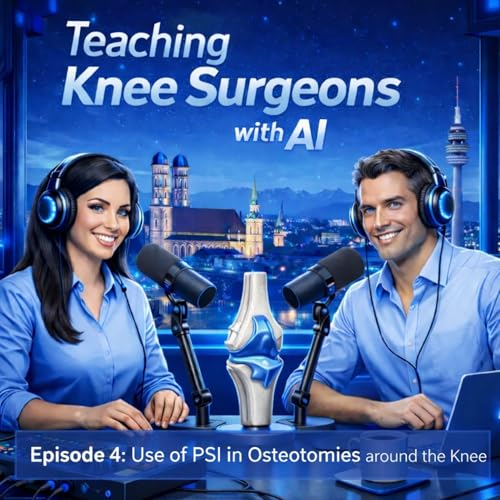
  • Episode 4: Use of PSI in Osteotomies around the Knee
    Feb 15 2026

    In this episode of Teaching Knee Surgeons with AI, we explore the role of patient-specific instrumentation (PSI) in knee osteotomies. We discuss the use of 3D-printed, patient-specific cutting guides based on individualized preoperative planning—typically derived from CT imaging—to enhance surgical precision and alignment accuracy. How much does PSI truly improve intraoperative execution? And what does the current clinical evidence tell us about its benefits and limitations? This episode takes a critical look at the scientific data behind PSI in osteotomies around the knee. Enjoy listening. 🎧

    Afficher plus Afficher moins
    14 min
  • Episode 3: Understanding TTTG Distance
    Feb 8 2026

    In this episode of Teaching Knee Surgeons with AI, we focus on the TTTG distance and its clinical relevance in patellofemoral disorders. The Podcast discusses when the TTTG distance truly matters, where its limitations and sources of error lie, and which anatomical, technical, and imaging-related factors can significantly influence its measurement. Understanding these pitfalls is essential to avoid over- or misinterpretation in clinical decision-making. A practical, evidence-informed discussion for anyone treating patellofemoral instability. Enjoy listening. 🎧

    Afficher plus Afficher moins
    Moins d'une minute