Épisodes

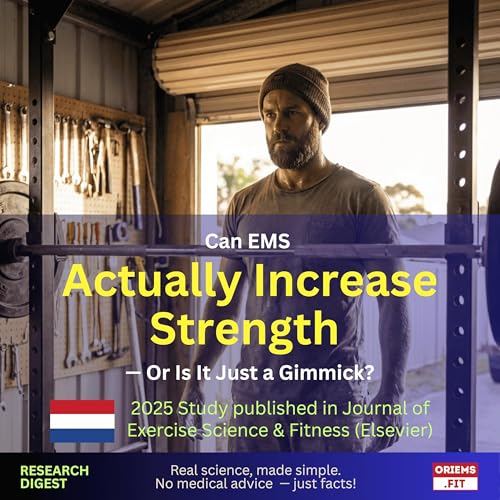
  • Will EMS Help Reduce More Body Fat While I’m Training? 2025 Study published in Journal of Exercise Science & Fitness (Elsevier)
    Feb 21 2026
    Are you training hard but the fat won’t move? Could 25 minutes make a difference? Maybe you lift twice a week. Maybe your knees ache during squats. Maybe your back feels tight after work. And you still want your body fat lower. A 2025 study in the Journal of Exercise Science & Fitness looked at this. Researchers compared 25-minute EMS sessions with 90-minute resistance training. The study lasted 20 weeks. Participants trained twice per week. Both groups reduced body fat. The EMS group went from 25.9% to 20.5%. That’s a measured reduction over time. Strength also showed improvement across major exercises. Traditional lifting reduced more fat overall. But EMS still showed meaningful change. And sessions were much shorter. Why does this matter? Not everyone can train heavy for 90 minutes. Some people deal with joint pain. Some feel muscle weakness after illness or injury. Some are simply time-poor. EMS activates multiple muscle groups together. Muscle activation increases energy demand. Over weeks, that was associated with reduced body fat. It is not a shortcut. It is not magic. It does not replace disciplined training. But it may add extra stimulus. It may support your fat-loss phase. It may help when heavy lifting isn’t possible. The study was randomized and controlled. Participants were followed for 20 weeks. Results were peer-reviewed and published. That gives the findings more weight. If you care about body composition, this matters. If you already use EMS, this may reassure you. If you’re considering it, this gives context. There are more details in the full breakdown. Including strength data and comparison numbers. Read the full breakdown here https://bit.ly/4aEXUyP
    Afficher plus Afficher moins
    15 min
  • EMS vs Traditional Resistance Training: What 20 Weeks of Research Shows | 2025 Study published in Journal of Exercise Science & Fitness (Elsevier)
    Feb 21 2026

    You train almost every day. But are you leaving stimulus on the table?

    You track your lifts. You watch your body fat. You push through sore legs. You care about every rep.

    So here’s something interesting.

    A 2025 study in the Journal of Exercise Science & Fitness compared 25-minute EMS sessions with 90-minute resistance training. It lasted 20 weeks. Participants trained twice per week.

    Both groups showed improvement in strength. Bench press, leg press, shoulder press all increased. Body fat also decreased in both groups.

    The EMS group reduced body fat from 25.9% to 20.5%. Strength showed measurable increase across major lifts. Traditional lifting gained more overall strength. But EMS still showed meaningful progress.

    This matters if you’re serious about training.

    EMS sessions were only 25 minutes. They stimulated multiple muscle groups together. Intensity progressed over 20 weeks.

    For someone obsessed with progression, this suggests something simple. Additional neuromuscular stimulus may support adaptation. Especially during busy weeks. Or when joints feel overloaded. Or during deload phases.

    It is not a replacement for heavy lifting. It does not outperform progressive overload. But it was associated with measurable strength and fat improvements.

    The study was randomized and controlled. It was peer-reviewed and published. Participants were followed for five months.

    That gives the data weight.

    If you already train daily, this isn’t about shortcuts. It’s about stacking smart stimulus.

    There are more details in the full article. Including exact strength numbers and fat changes.

    Read the full breakdown here →

    https://bit.ly/4kMQs9D

    Educational content only. Not medical advice.

    Afficher plus Afficher moins
    17 min
  • Does Combining Methods Beat Using One Alone? Blood Flow Restriction + EMS
    Feb 21 2026

    What if strength gains did not always require heavy lifting? And what if your muscles could be activated differently?

    Maybe you train hard. But your legs still feel weak. Or your knees cannot handle heavy loads anymore. You want progress, but not more joint stress.

    A 2023 randomized controlled study looked at this. It was published in Frontiers in Physiology. Researchers from Chengdu Sport University conducted it.

    They tested low-intensity squats at only 25% of max load. Some groups added electrical muscle stimulation (EMS). Some added blood flow restriction. One group combined both.

    After six weeks, the combined EMS group showed improvement in measured muscle strength. They also showed increased muscle activation on EMG testing. The changes were greater than training alone.

    EMS alone was associated with higher muscle activation. Blood flow restriction was associated with increased muscle size. The combined approach supported both pathways.

    Why does this matter?

    It suggests muscle strength is not only about lifting heavier. It may also involve how well your muscles are activated. And how consistently you train.

    For someone with pain, fatigue, or joint limits, low-load training supported by stimulation may offer another option. Not a shortcut. But a structured tool.

    This was a controlled, randomized trial. Forty healthy men trained five days per week for six weeks. Outcomes were measured before and after intervention.

    It does not mean EMS replaces traditional training. It does not guarantee results. But it adds evidence to how muscles respond to stimulation.

    There is more detail in the full breakdown. Including how EMS differs from TENS.

    Read the full breakdown here → https://bit.ly/3OpWdxX

    Educational content only. Not medical advice.

    Afficher plus Afficher moins
    18 min
  • Can EMS Improve Recovery Between High-Intensity Sessions? | Sprint Swimming Recovery Study (California State University)
    Feb 21 2026

    Can your muscles recover faster without moving at all? What if resting isn’t the only option between hard sessions?

    Maybe you’ve felt it before. That heavy, tight feeling after a tough workout. Or that burning sensation that lingers longer than expected. You want recovery. But you also feel too tired to keep exercising.

    A published study from California State University looked into this. It was printed in the Journal of Strength and Conditioning Research. Researchers studied competitive swimmers after maximal sprint efforts.

    They compared three recovery methods. Passive rest. Light swimming. And electrical muscle stimulation (EMS).

    After 20 minutes, swimming reduced lactate the most. But EMS also showed improvement compared with resting. Blood lactate was significantly lower with EMS than passive rest. The difference was statistically meaningful.

    EMS was associated with reduced remaining lactate levels. It did not outperform active swimming. But it performed better than doing nothing.

    Why does this matter?

    Because sometimes you cannot keep moving. Maybe the pool is unavailable. Maybe your legs feel too heavy. Maybe pain or weakness limits active recovery.

    EMS creates gentle muscle contractions. Those contractions may support circulation. Circulation helps move metabolic byproducts. That may support recovery between hard sessions.

    The study used low-frequency stimulation. It was controlled and randomized. Participants were trained athletes. Measurements were taken objectively.

    This does not mean EMS replaces exercise. It does not guarantee performance gains. But it suggests EMS may be a practical recovery support tool.

    If you already use EMS, this is reassurance. If you are considering it, this is perspective.

    There is more detail in the full breakdown. The numbers are interesting.

    Read the full breakdown here → https://bit.ly/4cDd8Hc

    Educational content only. Not medical advice.

    Afficher plus Afficher moins
    17 min
  • Can EMS Recruit Muscle Fibers My Normal Training Might Miss? | Neural Adaptation Study (University of Groningen & Zurich)
    Feb 21 2026

    Can EMS activate muscle your normal training misses? What if strength gains start in your nervous system?

    Maybe you train consistently. But one side still feels weaker. Or your legs feel strong, yet unstable. Or pain made you stop pushing hard.

    You try to reconnect with the muscle. But it does not always respond.

    A published study in the European Journal of Applied Physiology looked at this. Researchers from the University of Groningen and Zurich reviewed EMS strength training research.

    They found something interesting.

    Early strength gains from EMS were associated with neural adaptation. Not immediate muscle growth.

    In several studies, maximal voluntary strength showed improvement. But muscle size did not increase at first.

    This suggests the brain-muscle connection changed first. The nervous system may have activated muscle differently.

    Why does this matter?

    Because strength is not only about bigger muscles. It is also about better activation.

    If pain limited your effort before, or if one side feels slower to respond, this kind of stimulation may support muscle engagement.

    It does not replace exercise. It does not replace medical care. It is a tool that works through neural pathways.

    The research reviewed controlled and peer-reviewed trials. It compared EMS with voluntary training.

    The findings were cautious. But they were consistent.

    Strength improved. Without early hypertrophy.

    That may reassure people already using EMS. And it may interest those still considering it.

    There are more details in the full article. Including how EMS differs from TENS. And what realistic expectations look like.

    Read the full breakdown here → https://bit.ly/3OSeUKG

    Afficher plus Afficher moins
    19 min
  • Can 4 Weeks of EMS Improve Jump Performance in Trained Athletes? | Study by University of Burgundy
    Feb 19 2026

    Can four weeks of muscle stimulation change performance? Or does it only feel intense in the moment?

    Maybe you train hard already. But your legs still feel heavy. Your jump feels lower than before. Or your strength plateaus despite effort.

    That frustration feels familiar.

    A published study in the Journal of Strength and Conditioning Research explored this. Researchers from the University of Burgundy and Italian institutions followed 12 regional volleyball athletes.

    They added high-frequency EMS three times per week. Each session lasted about 12 minutes. No extra weight training was added.

    After four weeks, repeated jump performance showed improvement. Mechanical power showed a measured increase. Single jumps improved after continued sport-specific practice.

    The changes were not instant. They were gradual. They appeared after structured training and recovery.

    Why does this matter?

    EMS stimulates motor nerves directly. That creates controlled muscle contractions. It may help recruit muscle fibers differently than voluntary effort alone.

    For someone with muscle weakness, this is interesting. For someone already training, it may support performance. For existing EMS users, it reinforces consistency matters.

    The study was peer-reviewed. It used repeated measurements. It followed a structured training protocol.

    It did not claim miracles. It observed measurable changes.

    That is the important difference.

    If you want to understand how EMS was used, what parameters were applied, and what realistic expectations look like, there’s more detail in the full article.

    Read the full breakdown here → https://bit.ly/4aF4buC

    Educational content only. Not medical advice.

    Afficher plus Afficher moins
    31 min
  • What a 12-Week EMS Study Found in Elite Rugby Players | French study published in the American Journal of Strength and Conditioning Research
    Feb 19 2026

    What If Your Muscles Could Get Stronger Without Adding More Gym Hours? Could A Small Electrical Signal Change Strength Over 12 Weeks?

    Maybe you feel weaker than before. Maybe your jumps are lower. Maybe sprinting feels harder than it used to.

    A published study looked at this closely. It was printed in the Journal of Strength and Conditioning Research in 2007. French researchers studied elite rugby players for 12 weeks.

    They added EMS to normal training. EMS stimulates muscles to contract.

    After 6 weeks, squat strength showed improvement. After 12 weeks, strength increased further. Knee torque measured higher at certain speeds. Squat strength increased about 15%. Some jump tests also showed improvement.

    Sprint speed did not change. Scrummaging strength did not improve.

    So what does that mean?

    EMS was associated with measurable strength increases. It did not improve every performance skill. It supported specific muscle strength outcomes.

    That matters if you feel muscle weakness. It matters if you train but feel stuck. It suggests consistent stimulation may support strength adaptation.

    This was a controlled, peer-reviewed study. The control group showed no similar improvements.

    Results appeared stronger at 12 weeks. Consistency seemed important.

    If you already use EMS, this may reassure you. If you are considering EMS, this gives context.

    There are more details in the full breakdown. Including how often they trained and exact settings used.

    Read the full breakdown here → https://bit.ly/3MDKkE3

    Educational content only. Not medical advice.

    Afficher plus Afficher moins
    17 min
  • Hidden in 89 Studies: What German Researchers Found About EMS and Strength
    Feb 19 2026
    Can muscle strength really improve without heavier weights? What if the answer has been sitting in research since 2011? You train hard. But sometimes progress feels slow. Plateaus happen. Recovery takes longer. . They analysed decades of data on strength and performance.In 2011, researchers from the German Sport University Cologne reviewed 89 EMS studiesUnlocking the German Secrets of… Across those studies, EMS training was associated with measurable improvements in strength. Isometric strength increased by up to 32%. Dynamic strength showed similar changes. Power output showed noticeable gains in several trials. Jump height and sprint performance also improved in trained participants. The researchers also identified common training parameters. Around 17 minutes per session. Three sessions per week. Used consistently over 4–6 weeks. Why does this matter? Because EMS stimulates muscle fibres directly. It may activate fibres that are harder to recruit voluntarily. This does not replace training. It does not replace professional care. But the data suggests EMS can be a structured training tool. If you are considering EMS, parameters and consistency matter. If you already use EMS, intensity and regular sessions matter. There is much more detail in the full breakdown. Including the exact stimulation frequencies identified. Read the full breakdown here → https://bit.ly/4aEIWcm Educational content only. Not medical advice.
    Afficher plus Afficher moins
    31 min