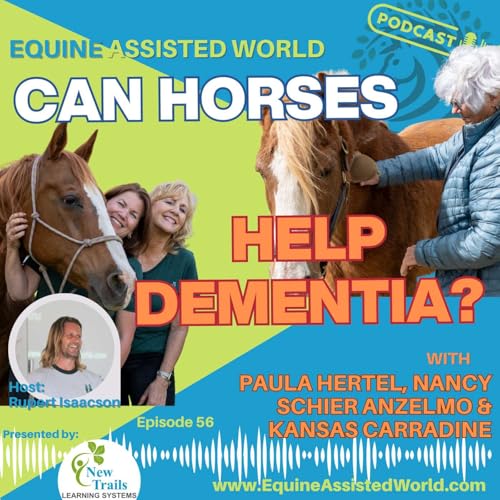
Couverture de Equine Assisted World with Rupert Isaacson

Equine Assisted World with Rupert Isaacson

Equine Assisted World with Rupert Isaacson

De : Rupert Isaacson
Écouter gratuitement

Here on Equine Assisted World. We look at the cutting edge and the best practices currently being developed and, established in the equine assisted field. This can be psychological, this can be neuropsych, this can be physical, this can be all of the conditions that human beings have that these lovely equines, these beautiful horses that we work with, help us with. Your Host is New York Times bestselling author Rupert Isaacson. Long time human rights activist, Rupert helped a group of Bushmen in the Kalahari fight for their ancestral lands. He's probably best known for his autism advocacy work following the publication of his bestselling book "The Horse Boy" and "The Long Ride Home" where he tells the story of finding healing for his autistic son. Subsequently he founded New Trails Learning Systems an approach for addressing neuro-psychiatric conditions through horses, movement and nature. The methods are now used around the world in therapeutic riding program, therapy offices and schools for special needs and neuro-typical children.  You can find details of all our programs and shows on www.RupertIsaacson.com.Horse Boy LLC Développement personnel Hygiène et vie saine Médecine alternative et complémentaire Réussite personnelle
Épisodes
  • Horses, Dementia, and the Science of Connection | Paula Hertel & Nancy Schier Anzelmo of Connected Horse, with Kansas Carradine | EAW 56
    Jun 11 2026
    ✨ "They come in with a cane and feeling disabled, and then they say, 'Here, take the cane, honey. I'm gonna walk this horse.' We've seen this so many times we can't even number it." – Nancy Schier AnzelmoDescription Paula Hertel and Nancy Schier Anzelmo are the co-founders of Connected Horse, a California-based program that brings equine-assisted experiences to older adults living with dementia or memory loss — alongside their care partners. Backed by research conducted with Stanford University and UC Davis, Connected Horse is one of the first programs in the country to specifically serve this population in this way. Kansas Carradine, HeartMath-certified trainer and returning EAW guest, joins to explore the science of heart coherence, entrainment, and why horses may be uniquely suited to reach people that other approaches cannot.Connected Horse's work challenges the assumption that equine-assisted services are only for children or younger adults. Their Stanford and UC Davis pilot studies recorded statistically significant reductions in depression, anxiety, and caregiver burden — with 100% participant return rates at a six-month booster session. Participants regularly go from fearful and withdrawn to walking horses, speaking in full sentences, and feeling activated to change their lives. The program is designed to be failure-free: for the person with the diagnosis, for the care partner, and for the horses.In this episode, Rupert, Paula, Nancy, and Kansas explore the physiology behind what happens when a person leans their heart against a horse's neck, why dementia and autism require similar practitioner responses around pacing and unconditional presence, what ritual and ceremony have to do with cortisol regulation, and how social prescribing may bring programs like Connected Horse into mainstream healthcare. If you want to support the show, you can do so at Patreon: https://www.patreon.com/LongRideHomeIf you want to support the show, you can do so at Patreon: https://www.patreon.com/LongRideHome🔍 What You'll Learn in This EpisodeWhy older adults living with dementia have been largely overlooked by the equine-assisted field — and what Connected Horse is doing to change thatHow Stanford University and UC Davis pilot studies measured statistically significant reductions in depression, anxiety, and caregiver burden in just 15 hours of horse-based interventionWhy Connected Horse works with the person living with dementia and their care partner together — and why separating them misses the pointWhat actually happens during a Connected Horse workshop: herd observation, grooming, haltering, leading, and at-liberty gratitude time in the round penWhy people who entered unable to speak, walk confidently, or engage start doing all three by the third sessionHow emotional memory remains intact even as verbal and cognitive function declines — and how horses help bring it forwardWhat heart coherence and entrainment explain about why people lean their heart against a horse's neck and visibly transformWhy Kansas Carradine connects equine-assisted ritual to shamanic ceremony — and how that connection is measurable in biophoton research and HeartMath scienceHow the failure-free environment Paula and Nancy design creates self-agency for care partners who have lost their sense of controlWhat the social prescribing movement is — and why Connected Horse is part of an early Kaiser Permanente pilot bringing grassroots programs into mainstream healthcareWhy dementia and autism require the same practitioner response: slow down, reduce verbal demands, hold unconditional presence, and let the emotional memory do its workHow Connected Horse trains other barns and facilitators internationally, and what a "prescription to come to the barn" might look like🎤 Memorable Moments from the Episode[00:04:30] Paula describes what Connected Horse does — and why explaining it still falls short [00:15:07] Nancy breaks down the Stanford study design: five measures, three out of five with a P value of .001 [00:16:33] The UC Davis booster session: 100% participant return rate six months later, even after strokes or condition changes [00:22:14] What happens in the round pen: how the horse almost always moves toward the person who breathes, opens, and goes still [00:26:44] Kansas explains how the horse's heart field, VLF emissions, and coherent broadcast create the conditions for entrainment [00:32:00] Nancy: aphasic participants begin speaking; people who arrived with canes put them down to walk the horse [01:00:16] Paula on the grounding meditation that opens every session — and why reducing fight-flight-freeze is the foundation of everything [01:06:04] Paula on self-agency: regulating your own body is power, because "that's not someone doing something to me" [01:12:03] Kansas links equine-assisted facilitation to shamanic ritual — and to the science of entrainment and biophotons [01:29:02] Nancy on "activation":...
    Afficher plus Afficher moins
    2 h et 1 min
  • Your Horse Can Feel Your Heartbeat | Kansas Carradine | EAW 55
    May 28 2026
    ✨ "What is HeartMath doing? They're measuring your care." – Kansas CarradineDescription Kansas Carradine is a HeartMath-certified trainer, acrobatic stunt rider, and equine guided educator based in the Sierra Nevada mountains of California. She spent years performing with the international touring show Cavalia — working alongside 70+ head of horses, many of them stallions — before dedicating her work to heart-based horsemanship and emotional regulation.What makes Kansas's approach distinctive is the bridge she builds between rigorous science and lived horsemanship. HeartMath is not just a breathing technique; it is a research-backed body of work measuring the electromagnetic output of the heart, heart rate variability coherence, and the demonstrable effect of human emotional states on the beings — horse and human alike — around us. For equine-assisted practitioners, that has profound implications.In this conversation, Rupert and Kansas explore how heart coherence can be layered into any equine-assisted modality, why horses are uniquely able to detect incoherent emotional fields, the science behind the toric field and biophoton emission, and how Kansas's own path — from a difficult childhood at a California trick-riding ranch, through Cavalia's global stages, to HeartMath certification — shaped her understanding of regulation, resilience, and the horse as healer. She and Rupert also announce a planned 2027 collaboration. If you want to support the show, you can do so at Patreon: https://www.patreon.com/LongRideHomeIf you want to support the show, you can do so at Patreon: https://www.patreon.com/LongRideHome🔍 What You'll Learn in This EpisodeHow the heart functions as an electromagnetic organ — always broadcasting and receiving — and why this matters in the saddleWhy HeartMath is not a relaxation technique but an adaptogenic one: it balances both over-activated and shutdown nervous systemsWhat heart rate variability (HRV) coherence is, how it is measured, and what a 2025 peer-reviewed study in Global Advances in Integrative Medicine and Health found about its clinical outcomes for anxiety, depression, and traumaHow a 1997 University of Kassel study suggested that heart-centered meditators can emit up to 100,000 photons of light per second — compared with 20 in average individualsWhy horses in fight-or-flight broadcast incoherent fields, and why a calm, coherent horse feels the way it does to be nearHow the toric field — the measurable electromagnetic pulse of the heart — extends roughly arm's-length from the body, carrying a unique energetic fingerprint for each emotional stateWhy a little sympathetic arousal is necessary for engagement and learning, and how HeartMath creates the sweet spot between shutdown and hyperactivationHow trick riding — rooted in Cossack cavalry training — functions as a martial art form requiring zonal focus under high pressure, and what Kansas learned about regulation inside that crucibleHow to use a simple heart-focus breath practice (even mid-session) to set the energetic field before working with horses or clientsWhy HeartMath's research is now extending to plants and trees as the next frontier of measuring human heart-field impactHow Kansas's online courses approach HeartMath from the equestrian's perspective — and how to reach her for one-on-one coaching or in-person clinics🎤 Memorable Moments from the Episode[00:02:20] Kansas defines HeartMath as both a research institute and a practical modality — and walks listeners through a live heart-focus breathing exercise [00:08:18] The toric field explained: the measurable electromagnetic pulse of the heart and what it broadcasts depending on your emotional state[00:17:11] Why HeartMath is not about relaxation — the adaptogenic heart response and why shutdown clients do not need more parasympathetic [00:21:59] Kansas describes running away to Reata Ranch at age 11 and being raised within its highly structured trick-riding world for seven years [00:44:39] Trick riding as martial art: how Cossack acrobatic training shaped Kansas's capacity for high-pressure focus — and the cost of that [01:20:02] Rupert reads aloud the 1997 University of Kassel biophoton study — 100,000 photons per second from heart-centered meditators [01:48:37] Kansas explains how to get started: online courses, one-on-one coaching, and the Inner Balance biofeedback device [01:51:40] Kansas leads a second live heart-coherence practice — breathing gratitude in and out through the heart [02:06:26] Rupert and Kansas announce their planned 2027 collaboration in the Sierra Nevadas and a short-form YouTube series📚 Contact, Projects, and Resources MentionedKansas Carradine – HeartMath-Certified Trainer, Equine Guided Educator https://circuscowgirl.com kansascarradine@gmail.com Facebook: Search Kansas CarradineHeartMath Institute – Research, courses, and Inner Balance biofeedback device https://...
    Afficher plus Afficher moins
    2 h et 16 min
  • What Happens After the Horse? Neuroscience Tools for Home & Beyond | Kim Barthel & Leana Tank | EAW 54
    May 14 2026
    Kim Barthel is an occupational therapist, international educator, and author based in British Columbia, Canada, trained in sensory integration, neurodevelopmental therapy, and holotropic breathwork. Leana Tank is an occupational therapist and consultant working with complex populations including individuals in the criminal justice system, combining equine-assisted practice with deep expertise in movement, trauma, and the nervous system.Together, they bring a rare combination of neurological precision and on-the-ground practicality to one of the most overlooked questions in equine-assisted work: what are you doing with your clients when they are not on — or with — the horse?This conversation digs into the neuroscience of the vestibular system, interoception, bilateral stimulation, and why movement is far more than muscles. Kim and Leana share concrete tools — from saddle stools at home to pickle juice to the long gaze — and explore why the relational environment may ultimately matter even more than the physical one.✨ "The brain can change until you stop breathing." – Kim BarthelIf you want to support the show, you can do so at Patreon: https://www.patreon.com/LongRideHome🔍 What You'll Learn in This EpisodeWhy what happens off the horse — at the barn, at home, in the community — is just as important as the session itselfHow the vestibular system develops in utero and why almost every developmental difference affects itWhat the inner core muscles (diaphragm, pelvic floor, transverse abdominis, multifidus) have to do with regulation, interoception, and feeling safeWhy the horse's three-dimensional movement provides a backdrop the brain cannot easily access in stillnessWhat interoception is, why many autistic individuals experience a blurred boundary between self and world, and how horseback riding supports thisHow to design simple home environments and daily activities that continue the neuroplasticity work between sessionsWhy stimming is not a problem to fix but a movement toward wholeness — and how to support it constructivelyWhat a "sensory diet" is and why individualized approaches work better than generic protocolsHow bilateral stimulation (crossing the midline) integrates the two brain hemispheres and why this matters for both autism and traumaWhy the relational environment — feeling seen and supported — may be the most powerful variable of allWhat the Default Mode Network and Salience Network are, and why nature shifts the brain into restorationPractical at-home tools: the long gaze, saddle-shaped stools, office chair rotation, barefoot movement, pushing/pulling exercises, and foraging tasksHow holotropic breathwork connects shamanic tradition to modern neuroscience through rhythm, movement, and breath🎤 Memorable Moments from the Episode[00:09:44] Kim explains why the horse is "so much more than a horse" — the unappreciated relational variable in equine work [00:16:08] Kim breaks down the inner core system: diaphragm, pelvic floor, and why posture on a horse activates all of it [00:18:43] Kim defines interoception — the internal awareness of "this is me and this is not me" — and how the horse enables it [00:23:02] Leana describes transforming a collapsed young man through intentional off-road nature walks [00:43:00] Kim shares the story of a 13-year-old who hadn't slept more than 20 minutes a night — and how a spinning office chair changed everything [01:00:28] Rupert and Leana discuss what to give overworked care staff when the therapist walks out the door [01:19:00] Leana tells the story of a client who alchemized profound trauma into gratitude — a conversation that happened while walking [01:48:00] Kim's story: sitting silently on the curb beside an unhoused young man, saying "I see you" — and meeting him two years later at Walmart with a job [01:53:47] Kim explains the Default Mode Network vs the Salience Network — why nature restores us [02:00:53] Kim introduces "the long gaze" — how even a screensaver can shift the brain toward restoration📚 Contact, Projects, and Resources MentionedKim Barthel – Occupational Therapist, Educator, Author https://kimbarthel.ca Autism Matters – Kim Barthel's online webinar series https://kimbarthel.ca Leana Tank – OT, Constellations Consulting https://constellationsconsulting.org My Octopus Teacher – Netflix documentary featuring Craig Foster https://www.netflix.com/title/81016226 New Trails Learning Systems – Horse Boy Method, Movement Method & Takhin Equine Integration https://ntls.co Rupert Isaacson / Long Ride Home https://rupertisaacson.com Patreon Support https://www.patreon.com/LongRideHome🌍 Follow UsLong Ride Home https://longridehome.com https://facebook.com/longridehome.lrh https://instagram.com/longridehome_lrh https://youtube.com/@longridehome New Trails Learning Systems https://ntls.co https://facebook.com/horseboyworld https://instagram.com/horseboyworld https://...
    Afficher plus Afficher moins
    2 h et 12 min
adbl_web_anon_alc_button_suppression_t1
Aucun commentaire pour le moment