Épisodes

  • The Mental Game of the World Cup: Lessons Every Young Athlete Should Notice
    Jul 6 2026

    Watch the World Cup Differently: Mental Toughness Lessons for Young Athletes

    Valerie Alston challenges sports families to watch the World Cup by focusing on mindset rather than the ball, using knockout-round moments to teach mental toughness. She highlights how quickly momentum shifts in soccer and the importance of emotional flexibility—responding to the current reality and “playing the score on the scoreboard, not the one in your head.” She explains that pressure doesn’t require rushing, emphasizing deliberate routines and the cue “slow is smooth, smooth is fast.” She also discusses intentional body language after mistakes, composure late in games, and how top teams solve problems together through communication, encouragement, and solution-focused resilience.

    00:00 Watch the Mindset

    01:18 Momentum and Emotional Flexibility

    03:26 Play the Scoreboard

    04:37 Pressure Without Rushing

    06:24 Slow Is Smooth

    07:11 Body Language and Composure

    09:33 Team Resilience Together

    10:52 Watch for the Hidden Skills

    11:53 Family Conversation Prompts

    14:46 Wrap Up and Next Steps

    Discussion questions:

    1. When you watched the World Cup this week, who impressed you the most—not because they scored, but because of how they handled pressure?
    2. After you make a mistake in your sport, what does your body language usually communicate to your teammates?
    3. What's one situation in your sport where slowing down instead of speeding up would actually help you perform better?
    4. If someone watched only your attitude—not your statistics—what would they learn about you as a teammate?

    Thanks for joining me on Confident, Calm, and Clutch Car Ride Conversations! If you found this episode helpful, please subscribe to the podcast so you never miss a moment. Share it with other parents or coaches who could use a little extra inspiration on the go.

    For exclusive tips, tools, and updates join my newsletter at www.confidentcalmclutch.com/newsletter

    For more specific tips on building mental toughness, buy my book Confident, Calm and Clutch: How to build confidence and mental toughness for young athletes using sports psychology

    If you are a coach looking for ways to build mental toughness into your practices then check out my coaching resources (books, assessments, conversation starters, community and more) here.

    Parents join my Facebook group to Help Your Athlete Gain Mental Toughness for Parents

    Have an idea for a topic? Submit your idea here.

    Questions? Comments? Ideas? Email me: valerie.alston@valstoncoaching.com

    Follow Me on:

    Facebook: https://www.facebook.com/valstoncoaching

    Instagram: https://www.instagram.com/valstoncoaching

    YouTube: https://www.youtube.com/@valstoncoaching9666

    Watch every episode of Car Ride Conversations here: https://www.youtube.com/playlist?list=PLOjguEFjF88w5Wl-eA9dlkwLk7f_sI12V

    Afficher plus Afficher moins
    16 min
  • How to Stay Composed When the Game Gets Chaotic
    Jul 13 2026

    Overwhelmed in the Game? Simplify: 3 Ways to Reduce Mental Load and Play Your Best

    Host Valerie Alston explains how chaos in sports can overwhelm athletes by maxing out limited cognitive capacity, leading to slower processing, hesitation, rushed decisions, missed cues, and errors. Instead of trying to think more, she teaches listeners to simplify by focusing on “What’s important now?” and “What is my job for the next five seconds?” She shares three practical tools to reduce mental load: narrowing to a single controllable cue (“the win”), grounding in the present with “feet and breath” or a physical anchor, and using a practiced reset routine—release, refocus, respond. She also advises parents and coaches to avoid adding to athletes’ cognitive load with too many instructions, especially for younger kids, and offers a weekly challenge to build a personalized chaos-to-composure plan plus family discussion questions.

    00:00 Simplify the Chaos

    00:41 Meet the Host

    01:54 Why Overwhelm Happens

    04:23 Cognitive Overload Signs

    06:09 Whats Important Now

    08:45 Grounding in the Moment

    12:22 Reset Routine Steps

    15:48 Parents and Coaches Cues

    18:31 Weekly Challenge Plan

    19:49 Car Ride Questions

    23:03 Wrap Up and Next Steps

    Discussion questions:

    1. What does it feel like in your body or mind when a game starts becoming too chaotic?
    2. What is one situation in your sport where you tend to think about too many things at once?
    3. When that situation happens, what could your ‘What’s Important Now?’ answer be?”
    4. What role do your parents play in adding to the chaos? Are there things they do during games that add to the chaos?

    Thanks for joining me on Confident, Calm, and Clutch Car Ride Conversations! If you found this episode helpful, please subscribe to the podcast so you never miss a moment. Share it with other parents or coaches who could use a little extra inspiration on the go.

    For exclusive tips, tools, and updates join my newsletter at www.confidentcalmclutch.com/newsletter

    For more specific tips on building mental toughness, buy my book Confident, Calm and Clutch: How to build confidence and mental toughness for young athletes using sports psychology

    If you are a coach looking for ways to build mental toughness into your practices then check out my coaching resources (books, assessments, conversation starters, community and more) here.

    Parents join my Facebook group to Help Your Athlete Gain Mental Toughness for Parents

    Have an idea for a topic? Submit your idea here.

    Questions? Comments? Ideas? Email me: valerie.alston@valstoncoaching.com

    Follow Me on:

    Facebook: https://www.facebook.com/valstoncoaching

    Instagram: https://www.instagram.com/valstoncoaching

    YouTube: https://www.youtube.com/@valstoncoaching9666

    Watch every episode of Car Ride Conversations here: https://www.youtube.com/playlist?list=PLOjguEFjF88w5Wl-eA9dlkwLk7f_sI12V

    Afficher plus Afficher moins
    25 min
  • Play to Win, Not Just to Lose
    Jul 20 2026
    Play to Win: How to Compete with Courage (and Beat Fear of Failure)Valerie Alston uses the France–England World Cup third-place match to explore why athletes often play freer once pressure is gone, suggesting fear of failure can lead to playing not to lose, conservative choices, and reduced creativity. She explains how pressure can narrow decision-making and disrupt momentum, and encourages parents and coaches to create psychologically safe environments where mistakes are treated as learning rather than punished. The episode emphasizes staying aggressive, generating momentum through controllables like effort, communication, and celebrating small wins, and adopting a “next play” mindset. Alston provides car-ride conversation prompts for families: when you play your best, what changes under pressure, how momentum shifts, and how you’d play if you weren’t afraid to fail, reinforcing that love and support shouldn’t depend on results.00:00 Pressure Off Peak Play01:11 World Cup Case Study02:44 Fear Of Failure Trap04:24 Parents Reduce The Stakes05:26 Play To Win Mindset07:28 Momentum You Can Create08:41 Pressure Hurts Decisions10:21 Bring Freedom To Big Games10:53 Support The Show11:27 Conversation Rules11:46 Prompt One Best Performances12:44 Prompt Two Under Pressure13:32 Prompt Three Build Momentum14:34 Prompt Four Fearless Play16:50 Closing And Next StepsDiscussion questions: 1. When do you play your best? Think about one of your best games or performances. What made you feel free to play your game? What was different about your mindset compared to days when you feel tight or afraid to make mistakes?2. What changes when the pressure gets high? When the game gets close or the stakes get bigger, what changes first for you? Do you get quieter, rush your decisions, hesitate, overthink, or become more focused? How can recognizing that help you next time?3. How do you create momentum? Can you think of a time when your team changed the momentum of a game? What happened first? Was it a big play, great communication, extra effort, positive energy, or something else? What can you do to help create positive momentum even if you're not the one scoring?4. What would you do if you weren't afraid to fail? Imagine you knew you couldn't be criticized for making a mistake. How would you play differently? Is there one thing you've been holding back from trying that might actually help your team?Thanks for joining me on Confident, Calm, and Clutch Car Ride Conversations! If you found this episode helpful, please subscribe to the podcast so you never miss a moment. Share it with other parents or coaches who could use a little extra inspiration on the go.For exclusive tips, tools, and updates join my newsletter at www.confidentcalmclutch.com/newsletterFor more specific tips on building mental toughness, buy my book Confident, Calm and Clutch: How to build confidence and mental toughness for young athletes using sports psychologyIf you are a coach looking for ways to build mental toughness into your practices then check out my coaching resources (books, assessments, conversation starters, community and more) here.Parents join my Facebook group to Help Your Athlete Gain Mental Toughness for ParentsHave an idea for a topic? Submit your idea here.Questions? Comments? Ideas? Email me: valerie.alston@valstoncoaching.comFollow Me on:Facebook: https://www.facebook.com/valstoncoachingInstagram: https://www.instagram.com/valstoncoachingYouTube: https://www.youtube.com/@valstoncoaching9666Watch every episode of Car Ride Conversations here: https://www.youtube.com/playlist?list=PLOjguEFjF88w5Wl-eA9dlkwLk7f_sI12V
    Afficher plus Afficher moins
    18 min
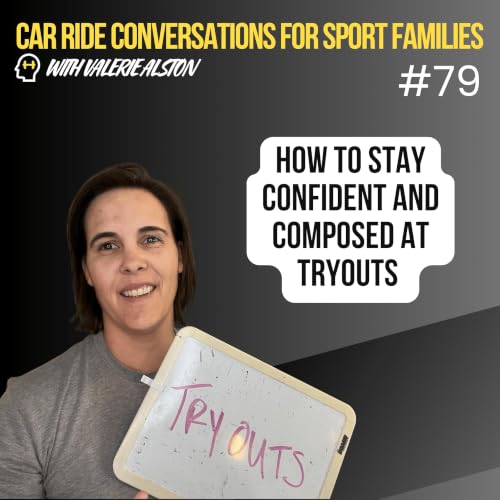
  • How to Stay Confident and Composed at Tryouts
    Jul 27 2026

    Tryout Confidence: Show (Don’t Prove) Yourself + Reset Fast After Mistakes

    Valerie Alston discusses how athletes and parents can approach upcoming school sport tryouts with a healthier mindset by shifting from “I have to prove myself” to “I get to show myself.” Drawing on conversations with coaches at the North Carolina Coaches Association, she emphasizes focusing on controllables—effort, coachability, communication, body language, hustle, decision-making, and how athletes respond to mistakes—rather than outcomes like roster spots or other players’ talent. She explains that coaches build teams and value character and dependability, offers strategies to reset after errors (breathe, use a cue, refocus), and warns against unhealthy comparison. She recommends defining success with three process goals and using a before/during/after mental plan, plus guidance for parents to reduce pressure and ask curiosity-based questions.

    00:00 Tryout Confidence Reset

    00:59 Why Tryouts Feel Heavy

    02:44 Show Yourself Not Prove

    04:32 What Coaches Really Pick

    06:52 Control Your Evidence

    08:12 Reset After Mistakes

    10:29 Comparison Without Spiral

    14:02 Define Success Process Goals

    15:48 Three Part Mental Plan

    19:01 Parent Pressure Off

    20:29 Car Ride Questions

    23:03 Wrap Up Next Steps

    Discussion questions:

    • What part of tryouts usually creates the most pressure for you, and what thoughts tend to show up?
    • What are three things you can control that would help coaches see the best version of you?
    • What will your reset look or sound like after a mistake?
    • How will you define a successful tryout even before you know the final decision?

    Thanks for joining me on Confident, Calm, and Clutch Car Ride Conversations! If you found this episode helpful, please subscribe to the podcast so you never miss a moment. Share it with other parents or coaches who could use a little extra inspiration on the go.

    For exclusive tips, tools, and updates join my newsletter at www.confidentcalmclutch.com/newsletter

    For more specific tips on building mental toughness, buy my book Confident, Calm and Clutch: How to build confidence and mental toughness for young athletes using sports psychology

    If you are a coach looking for ways to build mental toughness into your practices then check out my coaching resources (books, assessments, conversation starters, community and more) here.

    Parents join my Facebook group to Help Your Athlete Gain Mental Toughness for Parents

    Have an idea for a topic? Submit your idea here.

    Questions? Comments? Ideas? Email me: valerie.alston@valstoncoaching.com

    Follow Me on:

    Facebook: https://www.facebook.com/valstoncoaching

    Instagram: https://www.instagram.com/valstoncoaching

    YouTube: https://www.youtube.com/@valstoncoaching9666

    Watch every episode of Car Ride Conversations here: https://www.youtube.com/playlist?list=PLOjguEFjF88w5Wl-eA9dlkwLk7f_sI12V

    Afficher plus Afficher moins
    25 min
  • The Secret to Loving Competition Without Letting It Define You
    Aug 3 2026
    Compete WITH, Not Against: Ricky Scruggs on Identity, Confidence & Loving Your OpponentHost Valerie Alston welcomes mental skills coach and former baseball player Ricky Scruggs to discuss a healthier approach to competition, identity, and team culture for young athletes and parents. Scruggs shares his path from record-setting hitter to JUCO World Series, Division I at UNLV, and independent ball, then into car sales and ultimately running a baseball academy for nearly 20 years, where he blended biomechanics with a mental skills model. He emphasizes that athletes often tie identity to results, creating pressure, and encourages separating self-worth from performance. Scruggs reframes competition as “seeking together,” aiming to bring out each other’s best, and highlights belonging, mission-focused mindset, collective responsibility, and strong teammates who challenge one another. Valerie closes with family discussion questions on competing with vs against, giving vs getting, healthy internal competition, and valuing relationships over results.00:00 Rethinking Competition00:54 Meet Ricky Scruggs01:34 Ricky’s Athlete Journey03:04 From Car Sales to Academy04:29 Identity Beyond Results05:47 James Bond Mission Mindset07:48 Belonging Over Scholarships10:20 True Meaning of Compete12:23 Love Your Opponent14:02 Teammates Push Teammates17:59 Car Ride Discussion Questions21:00 Final Takeaway and Wrap http://www.centerfieldcoaching.com/Discussion questions: 1. Competition with vs. againstRicky talked about competing with your opponent instead of against them. What do you think he meant by that? How might that change the way you approach games?2. What are you trying to give?When you step onto the field or court, what do you hope to give your teammates today? Encouragement? Energy? Leadership? Effort? How is that different from focusing only on what you hope to get?3. Strong teammates challenge each otherHave you ever had a teammate who pushed you to become better? What did they do that helped you grow? How can healthy competition make an entire team stronger?4. Relationships or results?At the end of your sports career, what do you think you'll remember more—the wins and losses, or the people you shared them with? What can we do now to make sure we're building both great memories and great relationships?Thanks for joining me on Confident, Calm, and Clutch Car Ride Conversations! If you found this episode helpful, please subscribe to the podcast so you never miss a moment. Share it with other parents or coaches who could use a little extra inspiration on the go.For exclusive tips, tools, and updates join my newsletter at www.confidentcalmclutch.com/newsletterFor more specific tips on building mental toughness, buy my book Confident, Calm and Clutch: How to build confidence and mental toughness for young athletes using sports psychologyIf you are a coach looking for ways to build mental toughness into your practices then check out my coaching resources (books, assessments, conversation starters, community and more) here.Parents join my Facebook group to Help Your Athlete Gain Mental Toughness for ParentsHave an idea for a topic? Submit your idea here.Questions? Comments? Ideas? Email me: valerie.alston@valstoncoaching.comFollow Me on:Facebook: https://www.facebook.com/valstoncoachingInstagram: https://www.instagram.com/valstoncoachingYouTube: https://www.youtube.com/@valstoncoaching9666Watch every episode of Car Ride Conversations here: https://www.youtube.com/playlist?list=PLOjguEFjF88w5Wl-eA9dlkwLk7f_sI12V
    Afficher plus Afficher moins
    22 min
  • How Young Athletes Can Stop Overthinking and Start Playing Freely
    Aug 10 2026

    Stop Chasing Perfection: Compete With Purpose, Trust Your Prep (Ricky Scruggs) | Car Ride Conversations

    Host Valerie Alston continues her conversation with Ricky Scruggs on why many talented athletes struggle in games: they focus on doing things perfectly and on looking like a good player instead of remembering the objective—winning by accomplishing the goal of the sport. Scruggs shares lessons from baseball and motor learning about goal-oriented performance, trusting preparation, and avoiding mechanical overthinking during competition, emphasizing that perfectionism undermines progress and that highlight culture and social media distort expectations. He encourages parents to avoid extremes of overprotection or harsh pressure and instead use sports as a character-building vehicle that also fuels peak performance through purpose, relationships, and resilience. The episode ends with family discussion questions about goals vs. appearance, in-game thoughts, lessons sport teaches beyond mechanics, and how parents can best support healthy development.

    00:00 Why Athletes Choke

    01:16 Rule Book Reality Check

    03:40 Goal Focus Beats Mechanics

    06:35 Perfectionism and Social Media

    08:37 Parenting for Character

    11:34 Ricky Resources and Book

    13:36 Family Discussion Questions

    17:13 Wrap Up and Next Steps

    http://www.centerfieldcoaching.com/

    Thanks for joining me on Car Ride Conversations for Sports Families! If you found this episode helpful, please subscribe to the podcast so you never miss a moment. Share it with other parents or coaches who could use a little extra inspiration on the go.

    For exclusive tips, tools, and updates join my newsletter at https://www.confidentcalmclutch.com/newsletter

    For more specific tips on building mental toughness, buy my book Confident, Calm and Clutch: How to build confidence and mental toughness for young athletes using sports psychology

    If you are a youth sports coach looking for ways to build mental toughness into your practices then check out my coaching resources (books, assessments, conversation starters, community and more) here.

    Parents join my Facebook group to Help Your Athlete Gain Mental Toughness for Parents

    Have an idea for a topic? Submit your idea here.

    Follow Me on:

    Facebook: https://www.facebook.com/valstoncoaching

    Instagram: https://www.instagram.com/valstoncoaching

    YouTube: https://www.youtube.com/@valstoncoaching9666

    Watch every episode of Car Ride conversations here: https://www.youtube.com/playlist?list=PLOjguEFjF88w5Wl-eA9dlkwLk7f_sI12V

    Afficher plus Afficher moins
    18 min
  • How to Take Feedback Without Losing Confidence
    Aug 17 2026

    How Athletes Can Take Tough Feedback Without Losing Confidence (Growth Mindset + Parent Tips)

    Valerie Alston discusses why fast-improving athletes learn to use coaching feedback without turning it into an identity statement, explaining that feedback can build confidence when viewed as information rather than a measure of worth. She introduces a growth mindset and attribution theory (internal vs. external, controllable vs. uncontrollable, stable vs. unstable) to help athletes interpret mistakes in ways that support learning, ownership, and future improvement, while noting some errors truly are out of one’s control. The episode encourages responding to feedback with curiosity instead of defensiveness, emphasizing that real confidence comes from competence and how athletes bounce back after tough moments. Parents are coached to normalize correction, show empathy, and ask reflective questions that help athletes process feedback productively, followed by four conversation prompts for families.

    00:00 Feedback Builds Confidence

    01:23 Why Athletes Resist Coaching

    03:08 Growth Mindset Reframe

    04:38 Attribution Theory Explained

    07:47 Better Self Talk After Mistakes

    10:47 Curiosity Over Defensiveness

    12:22 Real Confidence Comes From Skill

    14:18 Parents Guide The Process

    15:42 Car Ride Discussion Questions

    17:52 Final Takeaways And Next Steps

    Discussion questions:

    1. Think about the last piece of feedback you received from a coach. What was your first reaction? After thinking about it, was there something valuable you could learn from it?
    2. When something doesn't go well in your sport, what's the story you usually tell yourself? Is that explanation helping you grow, or is it holding you back?
    3. What's the difference between hearing "I made a mistake" and "I am a mistake"? Why do those two thoughts lead to very different levels of confidence?
    4. Parents: What's one way I can help you process tough feedback without immediately trying to fix the situation? Athletes: What kind of support helps you most after receiving difficult coaching?

    Thanks for joining me on Confident, Calm, and Clutch Car Ride Conversations! If you found this episode helpful, please subscribe to the podcast so you never miss a moment. Share it with other parents or coaches who could use a little extra inspiration on the go.

    For exclusive tips, tools, and updates join my newsletter at www.confidentcalmclutch.com/newsletter

    For more specific tips on building mental toughness, buy my book Confident, Calm and Clutch: How to build confidence and mental toughness for young athletes using sports psychology

    If you are a coach looking for ways to build mental toughness into your practices then check out my coaching resources (books, assessments, conversation starters, community and more) here.

    Parents join my Facebook group to Help Your Athlete Gain Mental Toughness for Parents

    Have an idea for a topic? Submit your idea here.

    Questions? Comments? Ideas? Email me: valerie.alston@valstoncoaching.com

    Follow Me on:

    Facebook: https://www.facebook.com/valstoncoaching

    Instagram: https://www.instagram.com/valstoncoaching

    YouTube: https://www.youtube.com/@valstoncoaching9666

    Watch every episode of Car Ride Conversations here: https://www.youtube.com/playlist?list=PLOjguEFjF88w5Wl-eA9dlkwLk7f_sI12V

    Afficher plus Afficher moins
    20 min
  • When Did Youth Sports Get So Serious? The Pressure to Be “Elite”
    Aug 24 2026

    Discussion questions:

    Thanks for joining me on Confident, Calm, and Clutch Car Ride Conversations! If you found this episode helpful, please subscribe to the podcast so you never miss a moment. Share it with other parents or coaches who could use a little extra inspiration on the go.

    🧠 FREE Mental Skills Assessment for Your Athlete

    Does your athlete perform great in practice but struggle with nerves, pressure, confidence, or bouncing back from mistakes during competition?

    Stop guessing about what might be getting in the way.

    With my FREE Mental Skills Assessment, your athlete will complete the Athletic Coping Skills Inventory (ACSI), receive a short personalized report, and join me with you for a FREE 15-minute Zoom call to discuss what we're seeing and identify practical next steps.

    There are no good or bad scores and no labels. We're simply discovering where your athlete is strong and where they may need to build their mental toughness muscle.

    Assess. Discover. Build a game plan.

    👉 Get Your Athlete's FREE Mental Skills Assessment: https://www.confidentcalmclutch.com/assessment

    For exclusive tips, tools, and updates join my newsletter at www.confidentcalmclutch.com/newsletter

    For more specific tips on building mental toughness, buy my book Confident, Calm and Clutch: How to build confidence and mental toughness for young athletes using sports psychology

    If you are a coach looking for ways to build mental toughness into your practices then check out my coaching resources (books, assessments, conversation starters, community and more) here.

    Parents join my Facebook group to Help Your Athlete Gain Mental Toughness for Parents

    Have an idea for a topic? Submit your idea here.

    Questions? Comments? Ideas? Email me: valerie.alston@valstoncoaching.com

    Follow Me on:

    Facebook: https://www.facebook.com/valstoncoaching

    Instagram: https://www.instagram.com/valstoncoaching

    YouTube: https://www.youtube.com/@valstoncoaching9666

    Watch every episode of Car Ride Conversations here: https://www.youtube.com/playlist?list=PLOjguEFjF88w5Wl-eA9dlkwLk7f_sI12V

    Afficher plus Afficher moins
    19 min