You're mid-route. Your foot slips. Before your rational brain catches up, something ancient takes over and your heart is hammering, your breath has gone short and shallow and your hands are gripping harder than they should.
Fear in the outdoors is fast, physical, and deeply intelligent. And if you know how to work with it, it's one of the most powerful entry points to presence you'll ever find.
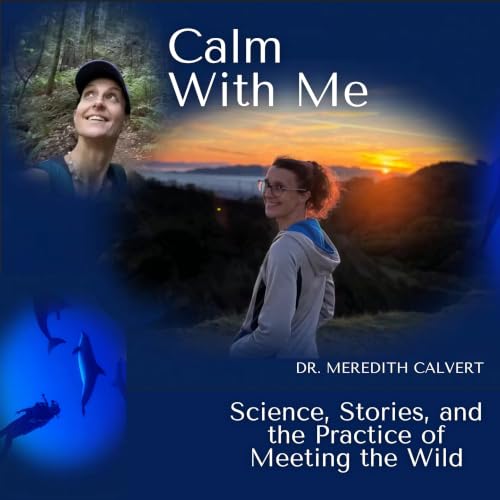
In this episode, neuroscientist, diver and yoga teacher Dr. Meredith Calvert breaks down the three F's of outdoor performance: fear, focus, and flow. She explains what's actually happening in your brain on a crux, why panicking makes you breathe in exactly the wrong way, and how natural environments both challenge us and restore the cognitive resources that modern life burns through.
The science is real. The tools are portable.
Calm With Me is hosted by Dr. Meredith Calvert — neuroscientist, yogi, Master Scuba Diver, and devoted student of the wild mind.
Mentioned in this episode:
- Come with me to find your own Wild Mind?
I built my WildCalm retreats around exactly this. Immersive experiences designed to help you slow down, breathe more deeply, and reconnect with yourself, through movement, breath, and nature.
Next adventure? SeaCalm Yoga & Scuba Diving in Roatán, Honduras, this Labor Day (2026). No yoga or scuba experience needed. Just curiosity, and a willingness to let the ocean do what it does best.
Find out more: https://meriyoga.org/seacalm2026
- WildCalm Retreats
- Follow me on Instagram: @meriyogasf
Time Stamps:
01:20 - Calm is a super power
01:40 - Three brain structures involved with fear
01:50 - The amygdala- your alarm center
02:15 - The prefrontal cortex - your logic center
02:50 - The hippocampus - your memory vault
03:20 - Inhibitory learning
03:40 - Introduction to box breathing
04:00 - Practice: Box breathing
04:30 - Panic and your breath
04:55 - The Bohr effect
05:20 - The CO2 spike or hypercapnia
06:00 - Auto-occlusion
07:15 - Introduction to reflexive breathing
07:30 - Practice: Reflexive breathing
08:00 - Focus and attention restoration theory
08:30 - Directed attention
08:55 - Involuntary attention
09:30 - Soft fascination
10:25 - Finding flow
10:55 - Flow and the vagus nerve
11:30 - Heart rate variability
11:50 - Anchor practice for flow: 5, 4, 3, 2, 1
13:00 - Fear is not a design flaw
Scientific references:
• Kaplan, S. The restorative benefits of nature: Toward an integrative framework, J. Env. Psych. 1995. 15(3):169-182
• Pham TP & Sanocki T. Human Attention Restoration, Flow, and Creativity: A Conceptual Integration. J Imaging. 2024 Mar 29;10(4):83
• McDonnell, A.S., Strayer, D.L. Immersion in nature enhances neural indices of executive attention. Sci Rep 14, 1845 (2024)
• Williams, KJH, Lee, KE, Hartig, T., et al. Conceptualising creativity benefits of nature experience: Attention restoration and mind wandering as complementary processes, J. Exp. Psych. 2018 (59), 36-45,
• Colzato, LS., Szapora A, Hommel, B. Meditate to Create: The Impact of Focused-Attention and Open-Monitoring Training on Convergent and Divergent Thinking. Front. Psych. 2012, 3.
• Lippelt DP, Hommel B, Colzato LS. Focused attention, open monitoring a n d loving kindness meditation: effects on attention, conflict monitoring, and creativity - A review. Front Psychol. 2014 S e p 23;5:1083.


 Oct 20 202623 min
 14 min
 10 min