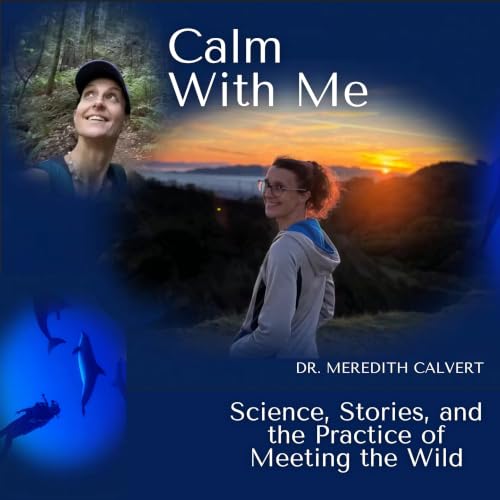
Couverture de Calm With Me

Calm With Me

Calm With Me

De : Dr. Meredith Calvert
Écouter gratuitement

Calm With Me blends neuroscience, yoga, adventure, and storytelling to explore how we build calm in real life, not in perfect conditions. Hosted by neuroscientist and yoga teacher Dr. Meredith Calvert, the podcast weaves together science-backed insight, nervous system tools, and stories from the trail, the ocean, and everyday life to help listeners navigate stress, uncertainty, burnout, and change with more steadiness and ease. Part science podcast, part reflective companion, Calm With Me is for anyone craving a slower nervous system, a fuller life, and a little more wonder along the way.Dr. Meredith Calvert Exercice et forme physique Fitness, alimentation et nutrition Hygiène et vie saine
Épisodes
  • Your Wild Mind: From Fear to Flow in the Great Outdoors
    Jun 27 2026

    You're mid-route. Your foot slips. Before your rational brain catches up, something ancient takes over and your heart is hammering, your breath has gone short and shallow and your hands are gripping harder than they should.

    Fear in the outdoors is fast, physical, and deeply intelligent. And if you know how to work with it, it's one of the most powerful entry points to presence you'll ever find.

    In this episode, neuroscientist, diver and yoga teacher Dr. Meredith Calvert breaks down the three F's of outdoor performance: fear, focus, and flow. She explains what's actually happening in your brain on a crux, why panicking makes you breathe in exactly the wrong way, and how natural environments both challenge us and restore the cognitive resources that modern life burns through.

    The science is real. The tools are portable.

    Calm With Me is hosted by Dr. Meredith Calvert — neuroscientist, yogi, Master Scuba Diver, and devoted student of the wild mind.

    Mentioned in this episode:

    • Come with me to find your own Wild Mind?

    I built my WildCalm retreats around exactly this. Immersive experiences designed to help you slow down, breathe more deeply, and reconnect with yourself, through movement, breath, and nature.

    Next adventure? SeaCalm Yoga & Scuba Diving in Roatán, Honduras, this Labor Day (2026). No yoga or scuba experience needed. Just curiosity, and a willingness to let the ocean do what it does best.

    Find out more: ⁠⁠⁠https://meriyoga.org/seacalm2026⁠⁠⁠

    • ⁠⁠⁠⁠WildCalm Retreats⁠⁠⁠⁠
    • Follow me on Instagram: ⁠⁠⁠⁠⁠⁠⁠@meriyogasf ⁠⁠⁠⁠⁠⁠

    Time Stamps:

    01:20 - Calm is a super power

    01:40 - Three brain structures involved with fear

    01:50 - The amygdala- your alarm center

    02:15 - The prefrontal cortex - your logic center

    02:50 - The hippocampus - your memory vault

    03:20 - Inhibitory learning

    03:40 - Introduction to box breathing

    04:00 - Practice: Box breathing

    04:30 - Panic and your breath

    04:55 - The Bohr effect

    05:20 - The CO2 spike or hypercapnia

    06:00 - Auto-occlusion

    07:15 - Introduction to reflexive breathing

    07:30 - Practice: Reflexive breathing

    08:00 - Focus and attention restoration theory

    08:30 - Directed attention

    08:55 - Involuntary attention

    09:30 - Soft fascination

    10:25 - Finding flow

    10:55 - Flow and the vagus nerve

    11:30 - Heart rate variability

    11:50 - Anchor practice for flow: 5, 4, 3, 2, 1

    13:00 - Fear is not a design flaw

    Scientific references:

    • Kaplan, S. The restorative benefits of nature: Toward an integrative framework, J. Env. Psych. 1995. 15(3):169-182

    • Pham TP & Sanocki T. Human Attention Restoration, Flow, and Creativity: A Conceptual Integration. J Imaging. 2024 Mar 29;10(4):83

    • McDonnell, A.S., Strayer, D.L. Immersion in nature enhances neural indices of executive attention. Sci Rep 14, 1845 (2024)

    • Williams, KJH, Lee, KE, Hartig, T., et al. Conceptualising creativity benefits of nature experience: Attention restoration and mind wandering as complementary processes, J. Exp. Psych. 2018 (59), 36-45,

    • Colzato, LS., Szapora A, Hommel, B. Meditate to Create: The Impact of Focused-Attention and Open-Monitoring Training on Convergent and Divergent Thinking. Front. Psych. 2012, 3.

    • Lippelt DP, Hommel B, Colzato LS. Focused attention, open monitoring a n d loving kindness meditation: effects on attention, conflict monitoring, and creativity - A review. Front Psychol. 2014 S e p 23;5:1083.


    Afficher plus Afficher moins
    14 min
  • Beneath the Surface: Neuroscience, Breath & the Wild Within
    May 30 2026

    Last episode, we explored Blue Mind — what water does to your brain from the outside. Today we go deeper. Literally.

    In this episode, Dr. Meredith Calvert unpacks the neuroscience of what happens when you actually go underwater: the ancient mammalian dive reflex that slows your heart without asking permission, the breath-buoyancy feedback loop that makes scuba diving one of the most intimate nervous system practices on the planet, and why the underwater environment produces a quality of presence that's hard to find anywhere else.

    We'll also do a short box breathing practice together — so you can feel the shift, not just understand it.

    If you've ever surfaced from a dive feeling clearer, calmer, and more yourself — this episode is the science behind that feeling.

    Mentioned in this episode:

    • Want to experience Blue Mind for yourself?

    I built the SeaCalm retreat around exactly this. My yoga & scuba diving retreat in is an immersive week-long experience designed to help you slow down, breathe more deeply, and reconnect with yourself, through movement, breath, and the ocean. Not just a yoga retreat, not just a dive trip. It’s a restorative prescription for Blue Mind: a full week of soft fascination, feel-good neurotransmitters, and turquoise water as far as the eye can see.

    No yoga or scuba experience needed. Just curiosity, and a willingness to let the ocean do what it does best.

    Find out more: ⁠⁠https://meriyoga.org/seacalm2026⁠⁠

    • Shrines of Science blog - ⁠Blue Mind: How the Ocean Heals⁠
    • ⁠⁠⁠WildCalm Retreats⁠⁠⁠
    • Follow me on Instagram: ⁠⁠⁠⁠⁠⁠@meriyogasf ⁠⁠⁠⁠⁠

    Time Stamps:

    01:30 - Blue mind recap

    01:55 - Mammalian dive reflex

    02:45 - Meditation, yoga and the switch from sympathetic to parasympathic nervous system dominance

    03:20 - Scuba diving is a breath practice

    03:27 - Scuba diving rule number one

    03:40 - Dirga pranayama - three-part breath

    04:10 - Breath and positional feedback in diving

    04:40 - Proprioreception

    05:00 - Underwater presence

    05:15 - Practice: Dirga Pranayama - three-part breath

    06:15 - Meredith's first dive

    06:40 - Eagle rays and the wild within us

    07:10 - Diving and directed attention restoration

    07:40 - Default mode network

    08:20 - Introduction to SeaCalm Yoga & Scuba retreat

    09:05 - Next episode: Awe and wonder as medicine

    Afficher plus Afficher moins
    10 min
  • Blue Mind: Your Brain on Water
    May 14 2026

    Season two of Calm With Me begins at the water’s edge. In this episode, neuroscientist, yoga teacher, and scuba diver Dr. Meredith Calvert explores the science behind “Blue Mind,” the deeply restorative state our brains enter around water. From childhood memories of England’s rugged coastline to the neuroscience of soft fascination, dopamine, serotonin, and nervous system regulation, this episode dives into why the ocean has such a profound ability to quiet the mind and bring us back to ourselves.

    You’ll learn how blue spaces influence stress, attention, and emotional well-being, and why calm may be less about forcing relaxation and more about giving your nervous system the right environment to settle naturally. A grounding, science-informed invitation to slow down, breathe deeply, and practice meeting the wild.

    Mentioned in this episode:

    • Want to experience Blue Mind for yourself?

    I built the SeaCalm retreat around exactly this. My yoga & scuba diving retreat in is an immersive week-long experience designed to help you slow down, breathe more deeply, and reconnect with yourself, through movement, breath, and the ocean. Not just a yoga retreat, not just a dive trip. It’s a restorative prescription for Blue Mind: a full week of soft fascination, feel-good neurotransmitters, and turquoise water as far as the eye can see.

    No yoga or scuba experience needed. Just curiosity, and a willingness to let the ocean do what it does best.

    Find out more: ⁠https://meriyoga.org/seacalm2026⁠

    • Shrines of Science blog - Blue Mind: How the Ocean Heals
    • ⁠⁠WildCalm Retreats⁠⁠
    • Follow me on Instagram: ⁠⁠⁠⁠⁠@meriyogasf ⁠⁠⁠⁠⁠

    Time Stamps:

    00:00 — The shift near the ocean

    01:20 — A seaside childhood

    01:50 — 'Just a little bit of fear'

    02:15 — Wallace J. Nichols and Blue Mind

    02:30 — The neurochemistry of Blue Mind

    03:10 — Soft fascination

    03:40 — The dose response of time spent near water

    04:10 — Moving water

    04:25 — Change your environment, change your nervous system

    04:50 — 'Immerse yourself in soft fascination'


    Scientific references:

    1. Britton, E., Kindermann, et al., (2018). Blue care: a systematic review of blue space interventions for health and wellbeing. Health Promotion International, 35, 50 - 69.

    2. McDougall, C., Hanley, et al. (2021). Neighbourhood blue space and mental health: A nationwide ecological study of antidepressant medication prescribed to older adults. Landscape and Urban Planning, 214, 104132.

    3. McDougall, C., Hanley, N., et al. (2022). Blue space exposure, health and well-being: Does freshwater type matter? Landscape and Urban Planning, 224,104446.

    4. Murrin, E., Taylor, N., et al., (2023). Does physical activity mediate the associations between blue space and mental health? A cross-sectional study in Australia. BMC Public Health, 23.

    5. Pasanen, T., White, M., et al., (2019). Neighbourhood blue space, health and wellbeing: The mediating role of different types of physical activity.. Environment international, 131, 105016.

    6. Pearson, A., Shortridge, A., et al. (2019). Effects of freshwater blue spaces may be beneficial for mental health: A first, ecological study in the North American Great Lakes region. PLoS ONE, 14.

    7. Tang, H., Lee, A., & Hung, S., (2024). Does built environment and natural leisure settings with bodies of water improve human psychological and physiological health?. Landscape and Ecological Engineering, 20, 547 - 558.

    8. Wright, K., Eden, S., et al., (2024). A qualitative exploration of the contribution of blue space to well‐being in the lives of people with severe mental illness. People and Nature, 6 (2), 849-864.

    9. Yin, J., Ramanpong, J., et al. (2023). Effects of blue space exposure in urban and natural environments on psychological and physiological responses: A within-subject experiment. Urban Forestry & Urban Greening. 87, 128066.


    Afficher plus Afficher moins
    6 min
adbl_web_anon_alc_button_suppression_t1
Aucun commentaire pour le moment