Épisodes

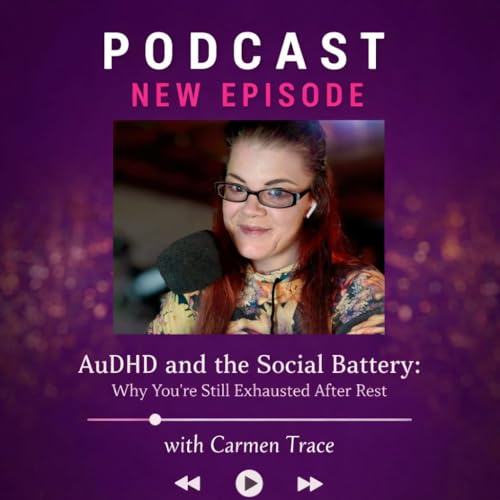
  • AuDHD and the Social Battery: Why You’re Still Exhausted After Rest
    Jan 6 2026
    Show Notes:Hello and welcome to Authentically ADHD – I’m Carmen, and I’m so glad you’re tuning in. Today we’re exploring a topic I know many of us grapple with: why you’re still exhausted even after resting, especially when you’re both autistic and ADHD (often called AuDHD). If you’ve ever wondered, “I took a break, so why do I still feel drained?” this episode is for you.We often hear about the idea of a “social battery.” The classic metaphor goes like this: social time drains you, alone time or rest recharges you, then you’re good to go again. It’s a handy way to explain why you might feel wiped out after a party or a day of meetings – you used up your social battery and need some quiet time to recharge. For neurotypical folks or even just introverts, that simple formula sometimes works: hang out with people (battery drains), spend a night in (battery refills), and you’re refreshed.But if you’re neurodivergent – and especially if you’re AuDHD (autistic + ADHD) – you’ve probably noticed it’s not that simple. You might spend a weekend resting at home only to wake up on Monday still bone-tired. Or you take a day off to recharge, and by evening you’re more exhausted than before. What gives? In today’s episode, we’re going to answer that. We’ll talk about why the one-dimensional social battery metaphor doesn’t fully capture what’s happening in our brains and bodies. We’ll dive into the neuroscience behind exhaustion in autism and ADHD: it’s not just being “peopled out” – it’s also things like masking, sensory overload, executive function fatigue, chronic stress mode, and even missed signals from our own bodies.By understanding these factors, we can start to make sense of why just “resting” isn’t always enough for us. Importantly, we’ll discuss what real rest means for an AuDHD brain. I’ll share some strategies and tips on how to recharge the right way (because if your rest isn’t targeting the actual type of tired you are, it’s not going to truly restore you). And be sure to stick around till the end – I have 7 reflection questions for you. These will help you apply what we talk about to your own life, so you can figure out what drains your energy and how to refill your tank more effectively.So, grab a comfy seat, maybe a notebook, and let’s unpack why you’re still exhausted after rest – and what we can do about it.The Classic “Social Battery” Metaphor – And Its LimitsLet’s start with that “social battery” idea. It’s a popular way to describe energy levels, especially for introverts. The idea is pretty straightforward: social interaction uses energy, and solitude or downtime charges you back up. For example, if you spend all day socializing with coworkers or attending events, you might feel drained – your social battery is empty. Then you recharge by being alone, watching Netflix, reading, sleeping, what have you. The next day, your battery is full again (or at least partially recharged) and you repeat the cycle.This metaphor resonates because it acknowledges that socializing can be tiring, even if it’s fun. It’s commonly mentioned for conditions like ADHD or just shy/introverted personalities: “I need to recharge my social battery.” For neurotypical people, often a good night’s sleep or a quiet Sunday morning might indeed restore that sense of energy.But here’s the catch: the social battery model assumes only one dimension of fatigue – social energy in versus out. It treats all “rest” as equal, like plugging your phone into any charger will top it off. For those of us with ADHD, autism, or both (AuDHD), our experience tells a more complex story. We don’t just have a single battery that drains and refills; we have an entire panel of batteries or fuel tanks, each for different kinds of energy. Sometimes you’re not even sure which battery is low – you just know you’re running on fumes. And crucially, if you try to recharge in the wrong way, it’s like putting the wrong fuel in a car: you don’t get very far, and you might even stall out.Have you ever tried to rest – say you cleared your weekend to do nothing – and you did all the “right” restful things like sleeping in or binging a show, but you still felt wiped out on Monday? I’ve been there. Before I understood the multiple dimensions of burnout, I would get frustrated at myself: “I rested, why am I still tired? What’s wrong with me?” The social battery idea would have me believe that rest = recharge, so if I rested and I’m still tired, I must be doing something wrong. But the truth was, my rest wasn’t actually addressing the kind of exhaustion I had.The classic metaphor doesn’t account for things like:Mental overload – maybe your mind was exhausted from racing thoughts or decision-making, but your “rest” didn’t quiet your mind.Sensory overload – maybe your senses were still on high alert from...
    Afficher plus Afficher moins
    47 min
  • Your Brain Isn’t Broken — It’s Patterned (Understanding the AuDHD Brain)
    Dec 27 2025
    If you’re AuDHD (autism + ADHD), life can feel like a constant contradiction: craving routine but rebelling against it, needing stimulation but getting overwhelmed, wanting connection but burning out socially. In this episode, Carmen breaks down what neurodivergence actually means (not a personality test), explains ADHD vs autism vs AuDHD, and gives practical, nervous-system-friendly strategies to build a life that fits your brain.Timestamped Chapters (approx)* 0:00 — Cold open: the AuDHD paradox in one breath* 1:30 — Neurodivergence: what it is (and what it isn’t) Autistic Self Advocacy Network+1* 6:00 — ADHD explained: executive function + attention regulation CDC+1* 9:30 — Brain networks + “default mode interference” (why focus leaks) PMC+1* 11:30 — Autism explained: social communication + restricted/repetitive patterns CDC+1* 13:30 — Sensory processing differences + prediction models PMC+2PMC+2* 15:00 — AuDHD: why it’s missed + DSM-5 history PMC+1* 18:00 — Co-occurrence and what it means (you’re not “rare” or “weird”) PMC+1* 23:00 — The AuDHD Paradox Show: real-life examples* 32:00 — Tools & strategies: rails not cages, rotation menus, sensory-first, scripts* 39:30 — Closing: your brain is patterned + gentle next stepsKey Takeaways* Neurodiversity = natural variation in brains; neurodivergent is a nonmedical identity term. Autistic Self Advocacy Network+1* ADHD centers on executive functioning and attention regulation, not intelligence or effort. CDC+1* Autism centers on social communication differences + restricted/repetitive patterns, often including sensory differences. CDC+1* AuDHD can look contradictory because traits can mask each other; dual diagnosis became formally allowable in DSM-5. PMC+1* Sustainable support = “rails not cages,” rotation menus, sensory regulation, and externalizing executive function.Resources Mentioned* CDC: ADHD diagnosis overview CDC* CDC: ASD clinical diagnostic criteria overview CDC* ASAN neurodiversity explanation Autistic Self Advocacy Network* AuDHD comorbidity review (open access) PMCPredictive processing + prediction differences in autism (review/empirical)PMC+1SCRIPT:Hey there! Welcome or welcome back to another episode of authentically ADHD. I am not going to lie, this year has been hard and im so glad if you have stuck along with me, because the rest of the school year is going to be even busier. So thank you for your patience, and grace as I work through this year and let out episodes when I can. I had some inspo for this one because of the new year coming up, and ive talked about this before but not so much in depth. As I go through this episode, i want to share that ive recently self diagnosed myself as AuDHD, a person who has both ADHD and Autism. What does that mean? Well, lets talk about it!Okay, quick check-in: have you ever felt like your brain is two different people sharing one body— one who’s like, “Please, for the love of God, routine. Predictability. Same mug. Same route. Same show on repeat.” and the other who’s like, “If I do the same thing twice I will evaporate into dust like a vampire in daylight.”If yes… hi. Welcome. You’re in the right place.Today’s episode is called: “Your Brain Isn’t Broken — It’s Patterned.” Because I need you to hear this like it’s a bass line in your chest:Your brain is not morally failing. Your brain is not lazy. Your brain is not “too much.”This Substack is reader-supported. To receive new posts and support my work, consider becoming a free or paid subscriber.Your brain is patterned. And if you’re AuDHD—autism + ADHD—your pattern can feel like a paradox factory that runs 24/7 with no off switch and a slightly rude customer service department.So… let’s talk about what neurodivergence actually is, how ADHD and autism overlap, where they differ, and why AuDHD can feel like living inside a contradiction—and then I’m gonna give you real strategies that don’t feel like being yelled at by a productivity guru who thinks “just try harder” is a nervous system plan.[tiny pause]Are you ready? Let’s get started.Substack adOkay, tiny intermission—because if this podcast is helping your brain feel a little more understood, I want you to know there’s a whole extra layer of support waiting for you on my Substack.That’s where I publish Authentically ADHD, and you can usually get the podcast there first—but it’s not just a podcast drop. I’ve started writing blogs there too, which means you get deeper dives, the “ohhh THAT’S what’s happening in my brain” explanations, plus practical tools you can actually use when your executive function is doing that thing where it simply… leaves the chat.And here’s why I’m obsessed with it: Substack is neurodivergent-friendly by design. You can read posts when you want to skim, you can listen when reading is too much, and I include graphics most of the time because we ...
    Afficher plus Afficher moins
    32 min
  • AuDHD and the Holidays: Navigating the Holiday Hustle and Overwhelm
    Nov 22 2025
    Hello and welcome to another episode of Authentically ADHD. I’m Carmen, and today we’re diving into how the holiday season feels through the eyes (and brain) of someone with AuDHD – that is, co-occurring autism and ADHD. For many of us, the holidays can feel less “holly jolly” and more like a perfect storm of stress. In this episode we’ll explore why the season can be extra hard, what it looks and feels like, and science-backed strategies to survive (and maybe even enjoy) the holidays. Whether you’re a newly diagnosed adult or a parent of a neurodivergent child, this one’s for you.What Is AuDHD? (Autism + ADHD)First, a quick science check. Autism and ADHD often go hand in hand. In fact, research suggests roughly 50–70% of autistic people also meet criteria for ADHD. Likewise, about two-thirds of people with ADHD have another condition like autism. In plain terms, having AuDHD means your brain experiences both sets of traits – the social-pragmatic and sensory sensitivities of autism and the attention-dopamine challenges of ADHD.This combination can feel like a constant tug-of-war in the mind. One part of you craves novelty and spontaneity (hello, ADHD!), while another part craves predictability and routine (hello, autism!). Imagine loving new experiences but also needing your favorite cookie recipe exactly the same every year. The result? It can be disorienting: you might feel like you “don’t fit” neatly into either camp. Some people with AuDHD describe it as an internal “tug-of-war” or seesaw: one side impulsive and messy, the other organized and anxious to plan.In practice, AuDHD often means compensating and crashing. For example, someone’s autism-driven focus might compensate for their ADHD-driven distractibility at work, or vice versa – ADHD-driven chaos can overwhelm autistic need-for-order, leaving them paralyzed by overwhelm. Dopamine is also at play: ADHD brains naturally crave dopamine and may impulsively seek novelty to get it. This can collide with autistic routines (which prefer sameness), causing even more internal conflict. All of this can be exhausting, but it also means AuDHD brains are vividly tuned in and often intensely creative. Think of it as life on high-intensity mode – colorful and chaotic, requiring constant balancing.Why the Holidays Are Extra ChallengingNow layer on the holidays, and the pressure cooker heats way up. Even neurotypical people report elevated stress: one survey found 62% of adults felt “very or somewhat” more stressed during the holidays than at other times of year. But for AuDHD brains, the holidays can amplify every stressor:Routines Disrupted: The holidays upend our anchors. School break means new daily rhythms, late nights, irregular meals – everything that might keep an autistic-AuDHD person grounded gets flipped. As one ND observer notes, “routines are often our anchor, and when they’re pulled away, it can leave us adrift”. Even small changes (late start on Monday, new host home, delayed bedtime) can throw our whole system off.Sensory Overload: Holiday sights, sounds, and smells come at you hard. Think bright lights, loud music, clanging dishes, lots of chatter, and maybe even firecrackers or poppers. These environments can push a neurodivergent nervous system into sensory overwhelm. In fact, decorations blaring carols while a dozen relatives talk at once – that’s the classic recipe for sensory overload. Neuroscience explains it as bombarding the five senses: your brain goes into fight-or-flight mode, and it can stay on high alert even after you’re home. One ADHD resource describes this: “the body’s nervous system shifts into ‘fight-or-flight’ mode… After the event, the body may remain on high alert, struggling to return to a relaxed baseline – leading to fatigue, overstimulation, and emotional shutdown.”. In short, holiday clamor can fry an AuDHD brain.Social and Family Dynamics: Holidays often mean forced proximity. You’re expected to play nice at a crowded party, join in traditions, maybe hug or kiss relatives, and make small talk. That’s a lot of unstructured social juggling. Neurodivergent people often need more downtime than society assumes, but the holidays cram intense social demands into the shortest days of winter. Feeling like you should be joyful and festive can clash with feeling drained, anxious, or withdrawn. This is the “disconnect between ‘should’ and ‘feel’” one psychologist talks about: everyone else is pretending joy, but you might feel agitated, melancholic, or exhausted instead. In fact, holiday stress can bring out “regressive” feelings: snapping at family, ruminating on past hurts, or longing for a perfect moment that never happens.Executive Overload: Then there’s all the planning and to-dos. Making a menu, shopping for gifts, wrapping, hosting – the holiday season can demand supercharged executive function. Neuroscience shows that high ...
    Afficher plus Afficher moins
    32 min
  • Masking, Unmasking, and the Exhaustion in Between
    Oct 25 2025
    IntroductionImagine trying to swim while holding a beach ball underwater – you might pull it off for a bit, but sooner or later that ball is bobbing to the surface. Masking ADHD can feel just like that. Many of us with ADHD learn early that our brains and behaviors can stand out, so we develop a “socially acceptable” persona to blend in. We smile, sit still, and force focus – all to hide our natural restlessness or distraction. This isn’t about being fake; it’s a survival strategy learned over years. But as the ADDA (Adult ADHD Organization) puts it, keeping that mask on “will take a lot of energy – and the same goes for hiding your ADHD symptoms” In this episode, we’ll explore what masking looks like, why we do it, how it varies across individuals, and most importantly, how to gradually unmask without burning out.What Is Masking and Why We Do It“Masking” (also called camouflaging or impression management) means hiding ADHD-related behaviors to appear neurotypical, usually to avoid stigma or negative judgments. Psychologists trace the idea back to Russell Barkley, who noted roughly one-third of people with ADHD develop masking habit. In practice, this can mean sitting unnaturally still to hide hyperactivity, speaking slowly to avoid interrupting, or painstakingly rehearsing what to say in social situations. We do it for safety. Maybe a teacher, boss, or parent once told us our energy was “too much,” or we saw peers get punished for fidgeting. Over time, we absorb: if we let our ADHD out, we risk judgment, rejection, or even losing out on opportunities. In fact, research shows it’s not paranoia: about 78% of adults with ADHD admit to concealing their symptoms at work for fear of discrimination In school, the disparity can be shocking – one study found students with overt ADHD behaviors are disciplined 3.5 times more often than their peers for the same actions. Add gender and cultural pressures, and masking can feel like the only path: for example, women with ADHD often face “double discrimination” (for having ADHD and for not fitting feminine organizational norms) and are 40% more likely than men to hide their diagnosis entirely. In short, from childhood on, many of us learn that showing our “whole” ADHD selves is risky or unwelcome. So we adapt. We smile when our mind is racing, offer practical reasons for missed details (“Sorry I’m late, traffic was a nightmare!”), and push down our impulsivity. This constant self-monitoring – judging every word, movement, or post you make – drains your brain like a marathon trainer. It literally spikes stress: one study found that simply drafting and editing an email to seem “normal” boosts cortisol by 45% – your body treats each message like a big performance reviewe. Over time, the nervous system can’t tell the difference between a social slip-up and physical dange, so we end up trapped in a cycle of hyper-alertness, exhaustion, and anxiety.What Masking Looks LikeBecause masking is so ingrained, it can look subtle – almost invisible – to others. Here are some common signs:Forcing calmness: You feel restless or impulsive inside, but you keep your voice and movements unusually slow. Your leg might be itching to bounce, but you tuck it under the chair. (Essentially, you’re acting tranquil on the outside to hide your inside.).Over-checking & perfectionism: You triple-check your work or double-back on a short text. It’s not just organization; it’s anxiety about making even a tiny mistake. You polish emails or assignments obsessively so no one will doubt you. This can buy you time socially, but it bleeds your time and energy.Mimicking behavior: You silently copy others. If classmates fidget with a pencil or crack jokes, you nod and do something similar, even if it feels unnatural. You rehearse social scripts or small talk lines so you don’t stand out.Hyper-focusing to overcompensate: You push intense focus on tasks that are being observed. In a meeting, you might go above and beyond on one project to cover for the times your attention drifts away.Suppressing stims: You swallow small yelps when you’re excited, hold in hand-flapping urges, or quietly tap your foot under the table so nobody notices your need to move.Masking emotions: Instead of expressing frustration or excitement, you “perform” a neutral or cheerfully appropriate response. You might bottle up anxiety during social events and then have a breakdown in private.Over time, these “adaptations” literally become a second job. You’re constantly monitoring yourself: “Am I moving too much? Did I blurt out something weird? Should I rephrase that?” It can feel like juggling while walking a tightrope. Nothing about the self feels authentic anymore – you’re playing roles, not being you. But it’s understandable: many ADHDers grew up being rewarded for “good behavior” and punished for impulsivity. The very need to mask is born ...
    Afficher plus Afficher moins
    30 min
  • Why Transitions Feel Like a Full-Body Earthquake
    Sep 8 2025

    In this episode of Authentically ADHD, we’re cracking open one of the most misunderstood struggles of AuDHD life: transitions. Whether it’s getting out of bed, switching tasks, or handling major life shifts like job changes or breakups—transitions can feel like full-body earthquakes that knock us off our axis.

    Join Carmen as she unpacks the neuroscience behind why transitions are so hard when you're wired with both ADHD and autism. From executive dysfunction to emotional dysregulation, sensory overload to task initiation paralysis—this episode breaks it all down with science, sarcasm, and soul.

    You’ll hear relatable anecdotes (including meltdowns over sock seams and hyperfocus hostage situations), insights from ADHD researchers and the ADHD Adults UK Podcast, and 10 practical tips to make transitions less chaotic and more compassionate.

    ✨ If you’ve ever wondered why a “simple” change feels like a system shutdown—you’re not alone. And you’re definitely not broken.

    📚 Topics Covered:

    * Executive functions involved in transitions

    * Why AuDHD brains resist shifting gears

    * Emotional and sensory overwhelm

    * Tools, rituals, and scripts to ease transitions

    * How to support yourself with structure—not shame

    🎧 Press play, breathe deep, and let’s navigate the messy magic of change—together.

    @authenticallyadhd_podcast

    Follow me:

    Linktree:

    https://linktr.ee/carmen_irace

    Join Focused: https://ihaveadhdllc.ontralink.com/t?orid=29951&opid=1


    Get full access to carmen_authenticallyadhd at carmenauthenticallyadhd.substack.com/subscribe
    Afficher plus Afficher moins
    31 min
  • Too Positive? Deep Dive on Toxic Positivity (part 1))
    Aug 31 2025

    🎙️ Episode Title: Too Positive? Deep Dive on Toxic Positivity – Part 1 💥 Podcast: Authentically ADHD with Carmen

    Episode Summary: In this powerful Part 1 episode, Carmen unpacks the surprisingly harmful impact of toxic positivity—that relentless “good vibes only” energy that floods our feeds and conversations but often leaves us feeling invalidated, misunderstood, or just plain unseen.

    We’re diving deep into what toxic positivity really is (spoiler: it’s not the same as genuine optimism), how it shows up in everyday life, and why it’s especially harmful for ADHD brains that already struggle with emotional regulation, rejection sensitivity, and internalized shame.

    Carmen explores the science behind emotional suppression vs. expression, using insights from trauma-informed therapy, positive psychology, and mindfulness-based neuroscience to help explain how this "be happy no matter what" mindset actually increases stress, shame, and even physical health risks. Plus, she digs into how society, culture, and even the self-help world contribute to the rise of this positivity pressure—and why folks with ADHD often bear the brunt of it.

    👀 Expect real talk, research-backed breakdowns, and compassionate call-outs like:

    * 🚫 “Your feelings make me uncomfortable.”

    * 🚫 “Let’s spiritually bypass our way out of this.”

    * 🚫 “If you’re not smiling, you’re failing.”

    Whether you’ve been on the receiving end of these vibes, or accidentally sent them yourself (we all have!), this episode gives you the language, validation, and science to understand why it feels so wrong—and what to do about it.

    ✨ Stick around for Part 2, where we’ll dive into actionable strategies to replace performative positivity with authentic, grounded emotional support—for yourself and others.

    @authenticallyadhd_podcast

    Follow me:

    Linktree:

    https://linktr.ee/carmen_irace

    Join Focused: https://ihaveadhdllc.ontralink.com/t?orid=29951&opid=1


    Get full access to carmen_authenticallyadhd at carmenauthenticallyadhd.substack.com/subscribe
    Afficher plus Afficher moins
    1 h et 1 min
  • ADHD & Energy Management The Spoon Theory Explained
    Aug 23 2025

    🎙️ Episode Title: ADHD & Energy Management: The Spoon Theory, Explained

    💥 Summary:In this episode of Authentically ADHD, we're digging deep into something that hits WAY too close to home for many of us: energy management. You know that frustrating gap between what you want to do and what your brain/body will actually let you do? Yeah, that.

    Enter: The Spoon Theory—a simple yet powerful metaphor that helps explain why ADHDers often feel completely wiped after doing things that seem “easy” to neurotypicals (like answering emails or… existing).

    We'll break down:

    * 🥄 What “spoons” actually are (and no, this isn’t about your silverware drawer)

    * ⚡ Why people with ADHD have an inconsistent energy battery and how that affects motivation, executive function, and emotional regulation

    * 🧠 The neuroscience behind burnout, decision fatigue, and overstimulation in ADHD brains

    * 🧃 How to create your own daily “spoon budget” to avoid crashing before noon

    * 🧰 Coping strategies to recharge your spoons, preserve your energy, and set boundaries without guilt

    Expect metaphors, real-life examples, sarcasm (obviously), and some truth bombs you didn’t know you needed. This is your permission slip to stop feeling lazy—and start honoring your unique brain-body energy loop.

    ✨ Because you don’t lack willpower—you’re just out of spoons, babe.


    Get full access to carmen_authenticallyadhd at carmenauthenticallyadhd.substack.com/subscribe
    Afficher plus Afficher moins
    36 min
  • ADHD’s Secret Focus Hack
    Aug 14 2025

    In this episode of Authentically ADHD, host Carmen dives into the powerful productivity hack of body doubling – a strategy that can help ADHDers stay focused, overcome procrastination, and actually get stuff done. Body doubling isn’t just about sitting next to a friend while you work (though that definitely helps!); it’s about harnessing the presence of another person, tool, or environment to provide external structure and motivation for your ADHD brain.

    Carmen explores the science behind why body doubling works, focusing on the role dopamine plays in task initiation and focus. From in-person body doubling to virtual co-working sessions, group productivity, passive presence, and even using apps and timers, this episode covers multiple ways to implement body doubling in your life.

    Through personal anecdotes, actionable tips, and a deep dive into the neuroscience behind it all, Carmen offers listeners practical, creative ideas for incorporating body doubling into their daily routines. Whether you're struggling with that looming to-do list or just need a productivity boost, this episode will give you the tools you need to find your focus and crush those tasks with a little help from your "focus buddies."

    If you’ve ever found it hard to start or stick with a task, this episode is for you. Tune in and discover how body doubling can become your secret weapon in the battle against procrastination!

    Don’t forget to subscribe, rate, and share with a friend who could use a productivity boost too!

    Linktree:

    https://linktr.ee/carmen_irace

    Join Focused: https://ihaveadhdllc.ontralink.com/t?orid=29951&opid=1

    Sources & Further Reading

    * Healthline – Body Doubling for ADHD: What Is It and How Does It Work?

    * PsychCentral – ADHD Body Doubling: What It Is and How It Works

    * Focusmate Blog – How a Body Double Can Help You Stay Productive and Accountable

    * Medical News Today – Body Doubling for ADHD

    Focusmate – Using Forest App for ADHD


    Get full access to carmen_authenticallyadhd at carmenauthenticallyadhd.substack.com/subscribe
    Afficher plus Afficher moins
    34 min