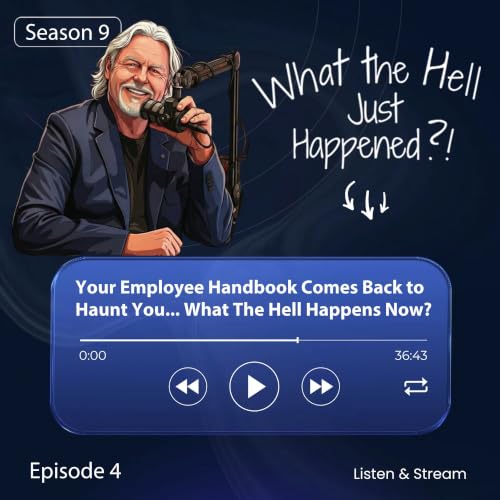
Couverture de What The Hell Just Happened?!

What The Hell Just Happened?!

What The Hell Just Happened?!

De : Paul Edwards
Écouter gratuitement

Offres de saison | 0,99 € par mois pendant les 3 premiers mois

5,99 €/mois par la suite. Des conditions s’appliquent. Annulation mensuelle possible.
You don’t know what you don’t know. And, when it comes to HR and employment laws, most employers are SHOCKED by what they learn from talking to CEDR CEO and Founder Paul Edwards for just ten minutes. But Paul’s a busy man. And, though he would love nothing more than to talk one-on-one with each and every business owner and manager interested in learning about HR compliance, team management strategies, and how to protect their businesses, there’s only so much Paul to go around. So, we’ve got the next best thing for you - Introducing ”What the Hell Just Happened?” In this new podcast, Paul sits down with a different HR expert from his Solution Center team each week to discuss the burning HR questions facing you now, and to offer expert insights on important HR considerations you didn’t know you didn’t know.© 2022 CEDR Economie Management Management et direction
Épisodes
  • Your Employee Handbook Comes Back to Haunt You... What The Hell Happens Now?
    Oct 21 2026

    What is one of the scariest things an HR professional can hear from a business owner? “I wrote my own employee handbook.”

    In this Halloween edition of What The Hell Just Happened!?, Paul Edwards and CeCe Delgado unpack the risks hiding inside DIY, borrowed, outdated, and AI-generated employee handbooks.

    A handbook can look official and still be missing the policies, state-specific requirements, reporting procedures, and practical safeguards your business actually needs. And adding a rule does not automatically make the rule legal, useful, or easy to enforce.

    Paul and CeCe dig into examples including rigid attendance rules, unauthorized-overtime language, no-gossip policies, copied handbook provisions, and the problems that can arise when an office manager is expected to maintain an HR document without specialized HR or employment-law expertise.

    They also talk about the hidden cost of doing it yourself: the owner's time spent researching, writing, revising, and trying to keep the handbook current as laws and workplace practices change.

    And then comes the truly scary part: if an employee dispute turns into a claim, the handbook does not disappear. It can become evidence.

    In this episode:

    • Why borrowing another business’s handbook can create problems you never intended.
    • Why a policy can sound reasonable and still create compliance risk.
    • What “unauthorized overtime” language can and cannot do.
    • How rigid attendance and discipline rules can box an employer into bad outcomes.
    • Why a generic or AI-generated handbook may miss the context your business needs.
    • Why putting an office manager in charge of maintaining a DIY handbook does not solve the expertise problem.
    • How quickly a handbook can become outdated.
    • Why the handbook may become evidence when an employee dispute reaches an attorney or agency.

    CEDR members: If you have a handbook or HR question, submit a request through backstageHR® so your team can help you work through the specific situation.

    Not a CEDR member? https://www.cedrsolutions.com/our-products/

    RELATED LINKS / RESOURCES
    • Learn About CEDR’s Custom Employee Handbooks

    https://www.cedrsolutions.com/get-started/

    • Explore CEDR HR Support for Your Practice

    https://www.cedrsolutions.com/our-products/

    • Learn How to Handle Unauthorized Overtime

    https://www.cedrsolutions.com/resources/guides/wage-complicance/

    • Why “No Gossip” Policies Can Be a Problem

    https://www.cedrsolutions.com/blog/nlrb-no-gossiping/

    • Learn More About Attendance Policies and Protected Absences

    https://www.cedrsolutions.com/blog/limiting-absences-basecamp/

    https://www.cedrsolutions.com/blog/safely-navigating-maternity-leave-absence/

    https://www.cedrsolutions.com/resources/forms/leave-of-absence-request/

    • Employee Handbook Guide / Handbook Best Practices

    https://www.cedrsolutions.com/our-products/employee-handbook/

    Afficher plus Afficher moins
    37 min
  • Secret Patients, Ghost Employees, and a DOL Investigation... What The Hell Happens Now?
    Oct 7 2026

    An employee secretly opens your dental practice on Saturdays, sees patients, keeps the cash, and leaves no patient records behind. A trusted long-term employee sells practice inventory on the side and adds family members who do not work there to payroll. Then a worker-classification problem turns into a Department of Labor investigation asking for years of financial records.

    This is the scary edition of What The Hell Just Happened!?

    In this episode, Paul Edwards and Jennie McLaughlin share real HR horror stories that show how quickly a problem can grow when trust, weak controls, or “we’ve always done it this way” collide with employee misconduct and compliance risk.

    They break down a hygienist secretly using a dental office as her own Saturday practice, an embezzlement scheme involving inventory and ghost employees, and a misclassification case that was exposed after a worker filed for unemployment. Along the way, Paul and Jennie talk about why “trust but verify” matters, how hidden payroll and inventory problems can continue for years, and why employee classification decisions deserve more attention than simply choosing “salary” or “contractor” in a payroll system.

    In this episode:

    An employee has keys to your practice and secretly starts seeing patients there when you are closed. What happens when a patient comes back and your office has no record they were ever seen?

    You trust a longtime employee so completely that you stop checking the systems they control. What can happen when that same person controls inventory, reporting, and payroll?

    A family member who never works for the practice is getting a paycheck. What is a “ghost employee,” and why can payroll fraud be so hard to notice?

    A worker you treated as a contractor files for unemployment. How can one classification decision turn into a much larger wage-and-hour investigation?

    Your payroll system accepted the way you classified someone. Does that actually mean the classification was correct?

    Related resources:

    To Catch an Office Thief: Stopping Theft and Employee Embezzlement

    https://www.cedrsolutions.com/blog/employee-embezzlement/

    Independent Contractor Checklist

    https://www.cedrsolutions.com/wage-compliance/

    Exempt vs. Non-Exempt Status: It’s More than Just Salary vs. Hourly!

    https://www.cedrsolutions.com/blog/exempt-vs-non-exempt-status/

    CEDR HR Education and Resources

    https://www.cedrsolutions.com/hr-education-and-resources/

    Take the next step:

    CEDR HR Solutions: https://www.cedrsolutions.com/

    Get started with CEDR: https://www.cedrsolutions.com/wage-compliance/?utm_campaign=Podcast&utm_source=wthjh-hrhorror

    Afficher plus Afficher moins
    25 min
  • Your Team Expects Raises You Can’t Sustain... What the Hell Happens Now?
    Sep 23 2026

    Your employee did a great job. Their performance didn't suddenly get worse, but that does not always mean the business can afford another large raise. After several years of bigger increases, employees may come to expect the same pace even when operating costs rise, the economy changes, or the business simply does not have as much room in the budget. So how do you reset those expectations without making a good employee feel punished?

    In this episode of What The Hell Just Happened!?, Paul Edwards and CeCe Delgado talk through one of the most uncomfortable compensation conversations for a practice owner: resetting raise expectations without making a strong employee feel punished or undervalued. They break down the difference between cost-of-living, merit, and “difference-maker” raises, and why a few years of larger increases can quickly become the new normal in an employee's mind.

    They also dig into why tying annual reviews too closely to raises can create expectations, how pay bands and measurable goals give compensation decisions more structure, and why the health of the business matters when deciding what raises are actually sustainable. Paul and CeCe discuss how constructive financial transparency can give employees more context about costs, business performance, and economic pressures so a smaller raise does not automatically feel like a judgment on their work. They also cover total compensation statements and other benefits that can help employees see the full value of working for your practice.

    In this episode:

    • Your team has come to expect 6% or 7% raises, but the business can't sustain that pace. How do you explain that strong individual performance and the financial performance of the business both affect what is available for raises?
    • Annual reviews have quietly become “raise day.” How can you separate performance conversations from automatic pay expectations?
    • You want compensation decisions to feel fair instead of arbitrary. How can pay bands, goals, and data give you a more consistent framework?
    • You can't put a large permanent increase into base pay this year. What else can you communicate or consider so employees still understand the value of their total compensation?

    Related resources:

    • Pay Transparency: How It Can Help You: https://www.cedrsolutions.com/podcast/pay-transparency-how-it-can-help-you/
    • How to Set the Pay Range for Any Position: https://www.cedrsolutions.com/blog/employee-pay-rate/
    • How Should I Handle an Off-Cycle Raise Request?: https://www.cedrsolutions.com/blog/how-to-respond-to-employee-raise-request/
    • 5 Ways to Help Your Team Manage Inflation Without Breaking the Bank: https://www.cedrsolutions.com/blog/help-your-team-manage-inflation/

    Take the next step:

    • CEDR HR Solutions: https://www.cedrsolutions.com/
    • Join CEDR’s HR Basecamp™: https://hubs.ly/Q04wxxSV0
    • Schedule a call to learn more about how CEDR can help your practice: https://hubs.ly/Q04wxyyZ0
    Afficher plus Afficher moins
    30 min
adbl_web_anon_alc_button_suppression_t1
Aucun commentaire pour le moment