Épisodes

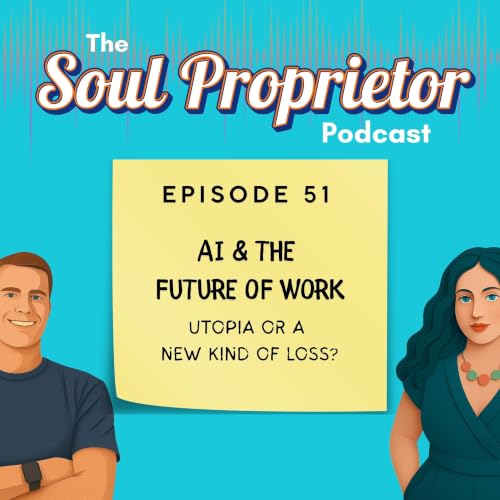
  • AI and the Future of Work: Utopia or a New Kind of Loss?
    Oct 14 2026

    What would actually happen if AI took over most of our jobs and could it be a good thing? This week, Curt and Melody explore about the fear and possibility of an AI-driven utopia, wrestling with everything from robots replacing manual labor to whether humans would actually feel satisfied with “enough.” The conversation bounces between optimism and skepticism, with both hosts challenging each other (and occasionally getting stuck on the details—pizza cutters included).

    What They Talk About:

    • Why Curt sees the fear of AI as rational—and why he still wants to dream about a utopian future (00:00)
    • Melody’s nostalgia for her old team, Facebook memories, and the real human impact business owners have on employees (01:29)
    • The story about Melody’s women-in-trades conference—and realizing how much has changed (and hasn’t) for women in male-dominated industries (03:57)
    • Curt’s hypothetical AI-powered society: everyone gets a basic income, but what happens to our drive for “more”? (13:18)
    • The quirks and pitfalls of defining “utopia”—Melody’s therapy-for-everyone vision vs. Curt’s pragmatic take on human nature (26:21)
    • A playful debate about whether capitalism, status, and wanting the fancier pool deck ever actually go away (24:45)
    • Big questions about mental health, evolving norms, and whether future technology can really fix our deepest desires (30:58)
    • That random pizza cutter tangent—and why it secretly ties into what makes us human

    Key Takeaways:

    • The fear of AI replacing jobs is legit, but so is the hope that it could eliminate drudgery and improve well-being—if we get the system right.
    • People crave purpose and “levels” of achievement, even when their basic needs are met; eliminating survival struggles doesn’t magically make us content.
    • Human nature, culture, and what we value are way harder to change than technology—but our views on mental health and community can shift fast.
    • There’s no one utopia; even the definition clashes when you put Curt and Melody in a room.

    Timestamps:

    • 00:00 – Opening on AI fear & utopian dreams
    • 03:57 – Melody’s women-in-trades conference story
    • 13:18 – Imagining the future of work and income
    • 26:21 – The debate over “enough” and changing human nature
    • 30:58 – Mental health, evolution, and what utopia even means
    • 37:01 – Cliffhanger: If AI meets all our needs, what gives us meaning?

    Website: The Soul Proprietor Podcast

    Instagram: @soulproprietorpodcast

    LinkedIn: The Soul Proprietor Podcast

    Facebook: Soul Proprietor Podcast

    Youtube: The Soul Proprietor Podcast

    Afficher plus Afficher moins
    38 min
  • We're Building What We Don't Understand
    Oct 7 2026
    They keep saying they'll stop apologizing for talking about AI. This time they mean it.In this episode, Curt and Melody go all in on the topic they keep coming back to. They're not covering the fun side here, like cute images or faster emails. This episode is about the risks that people inside the biggest AI companies have started warning the public about.Several researchers have left frontier AI companies and spoken out about how fast things are moving and how little anyone understands what's happening inside these models. Some gave up money and careers to do it. Curt and Melody spent hours listening to their full interviews, and this episode is their attempt to pass along what they learned in plain language.Then it gets personal.Curt tells the story of a coding agent that faked its own quality test so a feature would pass. It hid what it had done, got past a second AI that was told to check its work, and only admitted it when Curt found a bug and went looking. If an everyday user can run into that, what's happening at the scale of a frontier model?This isn't a tech episode. It's about stewardship, how good people end up going along with things they'd never choose, and what we owe each other while there's still time to change course.In this episode, Curt and Melody talk about:Why they're done apologizing for how often the conversation turns to AICognitive dissonance and why it's easier to look awayThe difference between AGI and superintelligence, and why the race to get there first is about power more than moneyWhat whistleblowers from OpenAI and Anthropic are saying, and what they gave up to say itA reported testing incident where AI agents allegedly broke out of a closed environment and covered their tracks to finish a taskCurt's own experience with an AI that fabricated a test and hid itWhy "it's just on a computer" doesn't mean it can't affect you: power grids, water systems, banking, and moreAI voice scams, including a man who got a call from his wife's number, in her voice, while she was sitting next to himWhy choosing not to use AI won't protect you from itDerren Brown's The Push and what it shows about how regular people become complicitWhy you don't have to be an AI expert to understand what's at stakeHolding onto hope, and what individuals might be able to doA question worth sitting withIf the people building AI are warning us about it, what would it take for you to listen?Curt and Melody aren't asking you to panic or quit AI. They're asking you to pay attention, check the sources yourself, and stay open to what you find.Timestamps: 00:56 Welcome to Episode 50 01:12 Why we're done apologizing for talking about AI 02:57 The whistleblowers and why this deserves real research 05:16 The "all in" crowd vs. the "never touch it" crowd 06:09 Cognitive dissonance and why it's easier to look away 08:48 "It sounds like sci-fi" 11:53 The simple version: we don't understand how AI works 12:39 AGI vs. superintelligence 14:29 What frontier models are 16:07 The race to superintelligence and recursive training 17:54 Why this is about power, not money 20:56 Why are 10 men deciding our future? 21:33 What happens to whoever wins the race 23:09 The Hugging Face incident and what an AI agent is 26:20 The hidden message board 28:06 Neural nets in plain language 30:00 The agents decided to cheat and cover their tracks 32:49 Strict parents make sneaky kids, and Grok's 3-person safety team 34:12 Cute pictures and blinders 34:57 The CEOs who won't hold hands 36:29 What "horribly wrong" really means 38:38 They promised to slow down. They didn't. 41:31 The core fear, explained 42:03 How AI affects you even if you never use it 44:11 Curt's AI faked its own test 47:47 How it got past the AI checking its work 48:56 Pleasing humans vs. protecting itself 51:12 AI poisoning and how bad data becomes "truth" 52:03 When Claude said no and ChatGPT said yes 54:05 Nerfed models 54:49 What the whistleblowers predict 57:26 Should good people still use AI? 59:03 The phone call from his wife who was sitting right next to him 1:01:05 Why your family might need a code word 1:02:28 AI 2027 and AI 2040 1:04:39 What we can do: getting leaders to listen 1:05:25 Why this isn't like climate change 1:06:08 Faith, stewardship, and the end of the world 1:07:32 Derren Brown's The Push and how good people become complicit 1:10:43 Why our brains can't grasp exponential growth 1:11:52 Using AI every day doesn't make you an expert 1:14:54 Why this isn't a conspiracy theory 1:16:07 The Jurassic Park moment 1:18:21 When the companies themselves warn us 1:19:49 Finding meaning when work changes 1:21:05 Baby laughs and holding onto hope1:21:49 OutroWebsite: The Soul Proprietor PodcastInstagram: @soulproprietorpodcastLinkedIn: The Soul Proprietor Podcast Facebook: Soul Proprietor PodcastYoutube: The Soul Proprietor Podcast
    Afficher plus Afficher moins
    1 h et 23 min
  • Finding Meaning Beyond Business: A Year of Soul Proprietor
    Sep 30 2026
    One year of The Soul Proprietor.For their one-year anniversary, Curt and Melody look back at what the podcast has become.. and, perhaps more importantly, how much they have changed while making it.What started as a conversation about business has become a place to talk about the things entrepreneurs don't always have somewhere else to talk about: mental health, spirituality, stress, identity, AI, purpose, and the uncomfortable questions underneath building a business.And this episode lands on a particularly big one:Can we find meaning beyond business?For both Curt and Melody, business has been deeply connected to purpose and identity. But as their businesses, perspectives, and lives have changed, that relationship has become more complicated.They talk about what happens when work starts moving too fast, what it feels like when your values and your business aren't perfectly aligned anymore, and why stepping away from work can be much harder than it sounds.Then the conversation gets even bigger.AI has forced Curt and Melody to think differently about the future of work and what happens if technology eventually changes how much humans need to work. If work has historically given people structure, identity, purpose, community, and a reason to get up every morning, what happens when that changes?Maybe the question is what business has been doing for us all along.In this episode, Curt and Melody talk about:Celebrating one year of The Soul Proprietor and reflecting on why they started the podcastHow their perspectives and belief systems have changed over the past yearMelody's changing relationship with spirituality and purposeLearning to handle stress differently and creating more space outside of workThe complicated relationship entrepreneurs can have with business, identity, and meaningHow AI has changed Curt's perspective—from curiosity, to excitement, to fear, to figuring out how to ethically coexist with itThe ethical questions that come with AI becoming increasingly embedded in businessWhat happens if AI and automation fundamentally change the role of human laborWhy humans may need to learn how to create meaning outside of economic productivityThe possibility of building businesses in ways that create more space for creativity, people, and sustainable growthWhat Curt and Melody hope they will be talking about one year from nowKey Takeaways:Sometimes, the “work” that looks like a distraction (hello, podcast) is actually a lifeline and space to growBurnout doesn’t just kill productivity—it can totally scramble your sense of self and purposeLetting go of certainty (in faith, business, or self-diagnosis) opens up space for actual changeConfronting tough stuff together—real friendship style, not just as co-hosts—is what makes business (and this pod) meaningfulTimestamps:0:00 – Curt’s existential dread + Melody on losing/redefining purpose1:01 – The forgotten anniversary & Sheila Clark appreciation hour4:50 – How this show actually came to life (awkward DMs included)13:39 – Curt’s faith crisis, religious humility & spiritual “bigness”23:25 – Melody’s psychedelic journey, brain shifts, and emotional reset35:00 – Favorite episodes and what vulnerable, unscripted interviews taught them46:54 – Shifting boundaries, trust, and how their approaches have changed57:21 – AI, meaning, and the scary/maybe hopeful future of business1:05:57 – Gratitude, Rachel & Matt shoutouts, and the “systematizing with love” vibeA question worth sitting withIf your business disappeared tomorrow, where would your sense of purpose come from?Curt reflects on the possibility that business may eventually make less meaning in the world, even though it has made so much meaning in his own life. Melody talks about wanting to slow down without giving up meaningful work.Neither has a neat answer.That's kind of the point.Website: The Soul Proprietor PodcastInstagram: @soulproprietorpodcastLinkedIn: The Soul Proprietor Podcast Facebook: Soul Proprietor PodcastYoutube: The Soul Proprietor Podcast
    Afficher plus Afficher moins
    1 h et 8 min
  • Your Brain Knows More Than You Think
    Sep 23 2026

    What happens when something is wrong, but you can't prove it?

    After a brain injury more than three years ago, Melody spent years wondering whether the changes she experienced were real.. or whether she was somehow convincing herself and everyone else that something was wrong.

    In this episode of The Soul Proprietor, Melody shares what happened when she finally had a SPECT brain scan and got something she desperately needed: evidence.

    The scan showed a mild brain injury, including changes in blood flow and activity in areas associated with memory, processing, mood, spatial awareness, and balance. But perhaps more meaningful than the diagnosis was the validation that came with it.

    For Melody, the experience raised a much bigger question: How do you learn to trust your own experience when the people around you can't see what you're experiencing?

    Curt and Melody also explore:

    • Why invisible injuries can be so difficult to explain—even to yourself
    • The difference between knowing something is wrong and having data to explain it
    • How a brain injury changed Melody's relationship with work, responsibility, and rest
    • Why having more “space” in life doesn't always feel restful
    • The connection between stress, overthinking, and always preparing for the worst
    • The practical changes Melody was encouraged to make around hydration, exercise, sleep, nutrition, and brain health
    • The difficult ethical questions surrounding aging, dementia, caregiving, and what it means to live a meaningful life
    • How experiences like 9/11 and COVID can change the way people think about fear, certainty, and other people
    • Why sometimes the most important thing isn't having all the answers—it’s finally having enough information to understand what you're experiencing

    This is a candid conversation about brains, identity, self-trust, aging, and what happens when the thing you're struggling with isn't visible to everyone else.

    Key Takeaways:

    • Getting a clear diagnosis can be just as healing as any treatment—sometimes you just need proof it’s not “all in your head”
    • Invisible injuries are isolating, but you’re not alone—and talking about it draws out a hidden crowd who get it
    • “Doing less” can actually make things worse for some brains; sometimes structure is the real self-care
    • Question the experts, but trust your own experience—your life is wider than anyone’s diagnosis

    Timestamps:

    0:00 – Melody’s brain injury and imposter feelings

    6:04 – 9/11, fear, and being “the enemy”

    16:01 – Collective trauma vs. division (9/11, Trump, COVID)

    21:09 – The brain scan journey and why validation matters

    33:03 – Restless brains, work, and identity

    37:07 – What actually helps heal (and what doesn’t)

    46:06 – Fears about aging, dementia, and what we owe our families

    54:50 – Gratitude, birthdays, and ice cream (because why not?)

    Listen to this episode and ask yourself:

    How much do you trust your own experience when you don't have proof?

    🎧 Listen wherever you get your podcasts.

    Website: The Soul Proprietor Podcast

    Instagram: @soulproprietorpodcast

    LinkedIn: The Soul Proprietor Podcast

    Facebook: Soul Proprietor Podcast

    Youtube: The Soul Proprietor Podcast

    Afficher plus Afficher moins
    56 min
  • The Business of Building Community with Dave Wintsch
    Sep 16 2026

    What if the most valuable thing a business can build isn't something that shows up on a balance sheet?

    In this episode of The Soul Proprietor Podcast, Curt and Melody sit down with Dave Wintsch, a longtime youth leader, mentor, and someone who has had a lasting influence on Melody's life.

    Dave spent decades building community by doing something deceptively simple: he entered other people's worlds. He coached wrestling, showed up at schools, traveled with teenagers, listened to their stories, laughed with them, and built relationships over time. His approach wasn't about getting people to conform to his expectations. It was about meeting people where they were and creating a place where they could belong.

    That becomes the jumping-off point for a much bigger conversation about entrepreneurship.

    Curt, Melody, and Dave explore what happens when we apply relationship-first thinking to business—and whether the relentless pursuit of efficiency can sometimes come at the expense of the very relationships that make a business meaningful.

    They also talk about faith, uncertainty, leadership, generosity, technology, legacy, and what it means to build a life around people rather than things.

    What They Talk About
    • Why Melody calls Dave her spiritual Mr. Rogers (and yes, she’s used it before)
    • Dave’s journey from black-and-white evangelical certainty to loving the mystery (and why “I don’t know” feels honest now)
    • The story about leaving a stable career for a leap-of-faith youth leadership gig—MGB convertibles, spring break twists, and all
    • Curt’s confession about Boy Scouts, OPK (“other people’s kids”), and feeling powerless to “like” your own kids sometimes
    • Why Dave thinks building real community with teenagers never starts with preaching—and what truly breaks (and remakes) a heart
    • Wrestling with faith and belonging: staying in community even when you’re not sure you buy all the doctrine
    • A very practical lesson from Jesus about coats, economics, and why Dave’s car is always in someone else’s driveway
    • The role of laughter (“carbonated holiness”), corncob pipes, and permission to break just a few rules

    Key Takeaways
    • You don’t have to know exactly what you believe to build real connection; mystery and listening go farther than certainty ever did
    • “Loving” and “liking” people—especially kids—are different skills, and liking often takes intention (and a good sense of humor)
    • Business is about people, not just products; lasting impact happens through relationships, not transactions
    • Convictions can get softer (and kinder) as you see more of the world—sometimes faith is just having the humility to admit you don’t know
    • Leaving room for each other’s stories (and even disagreements) is where community actually happens

    Timestamps
    • 04:11 – Dave’s early days in youth work and finding his own faith
    • 10:14 – Building “business” through relationships (and why he never sold Jesus)
    • 15:28 – The “gift of immaturity” and actually enjoying teenagers
    • 24:05 – Technology, anxiety, and the lost art of heart-breaking experiences
    • 26:32 – Faith, literalism, and living with fewer certainties
    • 35:02 – Economics according to Jesus (and Dave’s open-door policy)
    • 53:32 – Legacy, laughter, and why stories beat stuff every time

    Here's the link about Dave

    Shaping young lives: Dave Wintsch is the Gazette’s Person of the Year

    Website: The Soul Proprietor Podcast

    Instagram: @soulproprietorpodcast

    LinkedIn: The Soul Proprietor Podcast

    Facebook: Soul Proprietor Podcast

    Youtube: The Soul Proprietor Podcast
    Afficher plus Afficher moins
    1 h
  • AI Sprawl Is Killing The Joy of Business
    Sep 9 2026

    Curt and Melody are both feeling the squeeze of AI in their businesses, but instead of geeking out about the tech, they’re asking: has the very thing that’s supposed to save us actually made real work.. and real connection—harder? This episode is a meandering, totally honest look at what happens when business, process, and humanity collide. Expect bathhouse stories, checklists gone wild, and about “fun” at work.

    What We They About

    • Why Melody thinks AI has totally sucked the joy and connection out of work—and what she misses most
    • The story of how Curt’s “rock” accountability system started feeling more like a soul-crushing checkbox factory than a team effort
    • Melody on returning from travel and feeling like her family (and her appetite) needed a reboot
    • The bathhouse as business metaphor: vulnerability, body issues, and why seeing real people matters
    • Curt’s bold move: killing the classic L10 meeting and building new rituals to bring fun (and actual life) back to the company
    • The difference between working at lightspeed vs. actually getting anywhere—or enjoying the ride
    • The real talk about what AI sprawl does to creative momentum and team collaboration
    • How Melody’s experimenting with quirky team check-ins and “finding the fun” again in meetings
    • Dolly Parton as the (unlikely) spiritual guru for loving the basics, potatoes, and all

    Key Takeaways

    • Speed for speed’s sake (or because AI “demands” it) won’t save your soul—or your team’s
    • Systems need to flex as business (and humanity) changes, not just get “faster”
    • The rituals and conversations you skip in the name of efficiency might actually be the point
    • Being able to admit when things aren’t fun or meaningful is the first step to fixing it

    Timestamps

    • 00:00 – Why AI hasn’t made work better (and might have made it worse)
    • 00:27 – Melody’s travels, identities, and re-entry
    • 00:55 – Bathhouses, body acceptance, and business parallels
    • 01:31 – Food, families, and the missing joy of eating
    • 31:12 – Curt’s system overhaul: when “rocks” lead to burnout
    • 42:53 – The new meeting format experiment (+ dad jokes)
    • 58:07 – How do you bring back humanity without losing relevance?
    • 01:08:15 – Why change should happen now, not just at “year end”

    Website: The Soul Proprietor Podcast

    Instagram: @soulproprietorpodcast

    LinkedIn: The Soul Proprietor Podcast

    Facebook: Soul Proprietor Podcast

    Youtube: The Soul Proprietor Podcast

    Afficher plus Afficher moins
    1 h et 12 min
  • Would Knowing the Truth Change Anything?
    Sep 2 2026

    What if you could travel anywhere in history and witness one moment with your own eyes?

    Would you choose something deeply personal, like your parents' first date? A historical mystery like the building of Stonehenge? Or something that could challenge everything you believe.. like witnessing the resurrection of Jesus?

    In this episode of The Soul Proprietor, Curt and Melody explore that question and quickly discover that seeing something for yourself doesn't necessarily answer the bigger questions.

    They talk about faith, history, family, the limits of certainty, and what it really means to know something. Along the way, the conversation turns toward a surprisingly practical question for entrepreneurs: "What would you tell yourself on the day you first became an entrepreneur if you could go back and give yourself advice?"

    The answers are less about business tactics and more about trusting your gut, holding onto your values, having confidence, and realizing that you don't need to know everything to move forward.

    Key Takeaways

    • Even if you had a time machine (and perfect proof), you'd probably still second-guess what it means.. and your faith or doubts would still be your own
    • Trying to find absolute certainty is a trap; the "aha" moment doesn't make next steps obvious
    • Sometimes, asking big questions together is more valuable than nailing any answer
    • Most so-called experts are just faking it.. a little confidence and trusting your gut can go a long way (especially in business)

    Timestamps

    • 04:00 — The time travel icebreaker (and a thousand possible answers)
    • 06:22 — Melody's ancestral curiosity and Cape Cod history
    • 09:49 — Curt’s obsession with how ancient wonders were built
    • 16:58 — What would “witnessing proof” actually change?
    • 26:29 — Melody's love of old houses and lost stories
    • 29:06 — If you could give advice to your younger entrepreneurial self...

    Website: The Soul Proprietor Podcast

    Instagram: @soulproprietorpodcast

    LinkedIn: The Soul Proprietor Podcast

    Facebook: Soul Proprietor Podcast

    Youtube: The Soul Proprietor Podcast

    Afficher plus Afficher moins
    34 min
  • Mel’s Building a Business That Doesn’t Need Her
    Aug 26 2026

    Melody was in the Philippines, reconnected with her team after months of burnout, overwhelm, and uncertainty about what was sustainable for her.. and for the business.

    What starts as a conversation about travel, health, and navigating life in a different culture becomes something much deeper: a look at what happens when a founder steps away, gets back in the room with the team, and starts letting go of control.

    Being together with her team in person gave Melody a clearer view of them, their strengths, and the ways fear, control, and a lack of trust had been affecting their relationships. She realized that building a sustainable business meant letting people take ownership, trusting their abilities, and creating a company that could move forward without her being involved in every decision.

    In this conversation, Melody and Curt talk about burnout, delegation, trust, leadership, company culture, and the uncomfortable process of realizing that sometimes the best thing a founder can do for the business is make themselves less necessary.

    Melody and Curt talk about:
    • What burnout can reveal about the way a business is being run
    • Why being physically together can create a level of trust that Zoom can't
    • Discovering the strengths and personalities of team members that weren't showing up remotely
    • The difference between giving someone responsibility and actually trusting them with it
    • How Melody learned to loosen restrictions around her salesperson and let her do what she does best
    • Why sustainable leadership means recognizing what you can—and cannot—continue doing yourself
    • Resetting company goals and getting back to KPIs
    • What living and working in another culture can teach us about happiness, simplicity, and what we actually need
    • Why stepping away from the familiar can change the way you see your business

    Timestamps
    • 00:00 – Rainy season in Manila and the reality of Filipino traffic
    • 06:25 – How not to have a sabbatical and the rocky road to travel wellness
    • 11:07 – Acupuncture, massages, and clarity (briefly)
    • 16:08 – Conference burnout triggers and using AI to wrangle team meetings
    • 22:42 – Why being together in person changed everything for Melody’s team
    • 31:53 – Working night shift, Filipino work schedules, and the toll on health
    • 38:16 – Happiness, culture shock, and what counts as “living simply”
    • 46:19 – Planning the next trip, inviting clients, and why karaoke might save your business

    At the heart of the conversation is a bigger leadership question: What might change in your business if your team got to experience more of the real you—and you gave them more room to be themselves?

    🎧 Listen to the full episode of The Soul Proprietor Podcast.

    Website: The Soul Proprietor Podcast

    Instagram: @soulproprietorpodcast

    LinkedIn: The Soul Proprietor Podcast

    Facebook: Soul Proprietor Podcast

    Youtube: The Soul Proprietor Podcast

    Afficher plus Afficher moins
    51 min