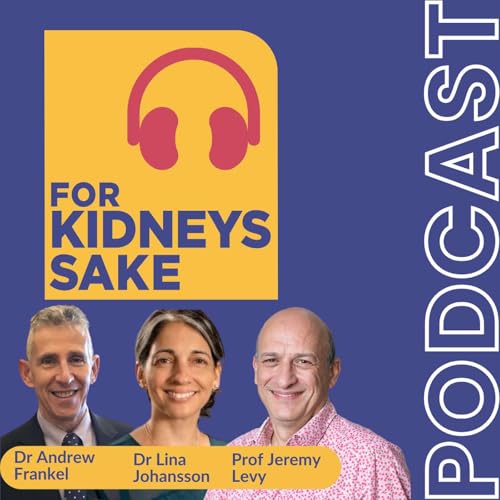
Couverture de For Kidneys Sake

For Kidneys Sake

For Kidneys Sake

De : North West London Kidney Care
Écouter gratuitement

À propos de ce contenu audio

For Kidneys' Sake podcast series is brought to you by Imperial College Healthcare NHS Trust and North West London Integrated Care Board (NWL NHS)

This podcast series aims to provide healthcare professionals, particularly primary care professionals, with accessible insights into kidney health.


Each episode offers bite-sized discussions on key topics such as chronic kidney disease management and heart failure and practical updates for improving patient care. With episodes just 15 minutes long, you can listen on your commute, during a break, or while out for a walk. Join us as we explore the latest advancements and strategies in integrated kidney care to empower clinicians and patients alike.

© 2026 For Kidneys Sake
Hygiène et vie saine Maladie et pathologies physiques Science
Épisodes
  • Bananas are STILL not the problem! Hyperkalaemia and CKD
    Apr 7 2026

    Do you have a question? Send it now...

    The For Kidneys Sake podcast series is brought to you by Imperial College Healthcare NHS Trust and North West London Integrated Care Board (NWL NHS)

    This episode is a refreshed re-release of our very first For Kidneys Sake podcast, updated to reflect current practice while reinforcing the core messages that remain just as relevant today.

    Despite increased awareness, we are still seeing patients with chronic kidney disease (CKD) being referred urgently for potassium levels that are only mildly elevated. This episode revisits how to interpret potassium results correctly, including recognising spurious hyperkalaemia, understanding when repeat testing is appropriate, and being clear that levels in the 5.5–6.0 mmol/L range are usually not an emergency. Urgent action is typically reserved for levels above 6.5 mmol/L or when there are clinical concerns.

    The refresh also highlights what has strengthened since the original release: even greater evidence supporting the continuation of RAAS inhibitors (ACE inhibitors, ARBs, and MRAs) in CKD and heart failure, alongside the growing role of newer potassium binders such as Lokelma and Veltassa to help patients stay on these vital therapies. We also revisit the persistent myth around dietary potassium—bananas are not the problem—and emphasise that restrictive diets are rarely the solution.

    This updated episode offers reassurance, clarity, and practical guidance, while staying true to the original aim: reducing unnecessary panic and supporting confident, evidence-based management of hyperkalaemia in primary care.

    This is a refreshed classic: A re-release of Episode 1, reinforcing key messages with updated evidence and current practice.

    Don’t panic with mild elevations: Potassium levels of 5.5–6.0 mmol/L are usually not an emergency, repeat and review before acting.

    Check for spurious results: Delayed sample processing is a common cause of falsely high potassium in primary care.

    Keep life-saving medications going: ACE inhibitors, ARBs and MRAs should not be stopped unnecessarily, use potassium binders if needed.

    Bananas aren’t the problem: Dietary restriction alone is rarely effective, focus on overall management rather than blaming specific foods.

    The purpose of this podcast is to inform and educate health care professionals working in the primary care and community setting. The content is evidence based and consistent with NICE guidelines and North West Guidelines available at the time of publication.

    The content of this podcast does not constitute medical advice and it is not intended to function as a substitute for a healthcare practitioner’s judgement.

    You can also join the community by signing up to our newsletter here

    Produced by award-winning media and marketing specialist Heather Pownall of Heather's Media Hub

    Afficher plus Afficher moins
    22 min
  • Your Kidneys Called… They Have Questions
    Mar 24 2026

    Send us Fan Mail

    The For Kidneys Sake podcast series is brought to you by Imperial College Healthcare NHS Trust and North West London Integrated Care Board (NWL NHS)

    What are patients really asking when they’re told they have chronic kidney disease?

    In this insightful and open episode, Sister Joana Teles steps out from behind the scenes to bring frontline wisdom from the “Know Your Kidneys” education programme. From the deceptively simple (“Is protein in my urine serious?”) to the quietly worrying (“Can my kidneys improve?”), Joana unpacks the real concerns patients carry and challenges clinicians to rethink how we communicate CKD with clarity, confidence, and compassion.

    Prof Jeremy Levy and Dr Andrew Frankel join the conversation to tackle myths, refine messaging, and emphasise the power of early intervention. Along the way, they cover everything from medication fears and heredity to diet, exercise, and when (not) to refer.

    The result? A practical, witty, and highly usable guide for primary care clinicians navigating early CKD conversations.

    Top 5 Takeaways

    1. Protein in urine = CKD (even with normal GFR) > Patients often hear “your kidneys are fine,” but proteinuria alone signals kidney damage and should be labelled and acted on.

    2. CKD can “improve” > While eGFR rarely rises, reducing albuminuria meaningfully lowers risks of kidney failure and cardiovascular disease. That’s a win worth explaining.

    3. Language matters > Avoiding the term “chronic kidney disease” can create confusion. Clear, honest terminology (with reassurance) empowers patients.

    4. Most CKD isn’t hereditary > Aside from conditions like polycystic kidney disease, CKD is usually linked to diabetes, hypertension, and cardiovascular risk.

    5. Primary care leads early CKD > Most patients don’t need a nephrologist. With the right tools, knowledge, and confidence, primary care teams are the experts.

    The purpose of this podcast is to inform and educate health care professionals working in the primary care and community setting. The content is evidence based and consistent with NICE guidelines and North West Guidelines available at the time of publication.

    The content of this podcast does not constitute medical advice and it is not intended to function as a substitute for a healthcare practitioner’s judgement.

    You can also join the community by signing up to our newsletter here

    Produced by award-winning media and marketing specialist Heather Pownall of Heather's Media Hub

    Afficher plus Afficher moins
    25 min
  • Kidney Diets: Less Fear, More Food
    Mar 10 2026

    Send us Fan Mail

    The For Kidneys Sake podcast series is brought to you by Imperial College Healthcare NHS Trust and North West London Integrated Care Board (NWL NHS)

    What should you actually eat if you’ve just been told you have chronic kidney disease?

    It’s one of the first questions patients ask and unfortunately, the internet often makes the answer far more confusing than it needs to be. In this episode of For Kidneys Sake, Dr Andrew Frankel and Prof Jeremy Levy are joined by renal dietitian Lina Johansson to cut through the noise and explain what people with early CKD (stages 2–3) really need to know about diet.

    Rather than restrictive lists of forbidden foods, Lina explains why the focus should be on a cardio-renal-metabolic friendly diet: more fruits, vegetables, and whole grains, fewer ultra-processed foods, and sensible salt reduction. The conversation tackles common myths from unnecessary potassium restrictions to the modern obsession with high-protein diets and offers practical advice clinicians can confidently share with patients.

    Top 5 Takeaways

    1. Most online “renal diet” advice is for advanced CKD — Much of the information patients find online is designed for people with late-stage kidney disease or dialysis, not those with early CKD.

    2. Early CKD diets should focus on heart-healthy eating — A cardio-renal-metabolic friendly diet emphasises fruits, vegetables, whole grains, and healthier protein choices.

    3. Potassium restriction is usually unnecessary — Patients with CKD stages 2–3 typically do not need to restrict potassium unless blood levels rise or certain medications require monitoring.

    4. Ultra-processed foods are the real dietary villain — Reducing foods with additives, preservatives, and high salt content can improve blood pressure, metabolic health, and kidney outcomes.

    5. Avoid high-protein trends — Extra protein shakes, bars, and supplements may accelerate kidney decline; moderation and more plant-based protein sources are preferable.

    Resources Mentioned in This Episode:

    KidneyWise
    https://kidneywise.co.uk

    Kidney Care UK – Kidney Kitchen
    https://www.kidneycareuk.org/kidney-kitchen/

    Kidney Research UK
    https://www.kidneyresearchuk.org

    NHS Website
    https://www.nhs.uk

    Resource Links:
    NICE GUIDELINES [NG203] chronic kidney disease: assessment and management Overview | Chronic kidney disease: assessment and management | Guidance | NICE

    Northwest London CKD guidelines for primary care Chronic kidney disease (nwlondonicb.nhs.uk)

    The purpose of this podcast is to inform and educate health care professionals working in the primary care and community setting. The content is evidence based and consistent with NICE guidelines and North West Guidelines available at the time of publication.

    The content of this podcast does not constitute medical advice and it is not intended to function as a substitute for a healthcare practitioner’s judgement.

    You can also join the community by signing up to our newsletter here

    Produced by award-winning media and marketing specialist Heather Pownall of Heather's Media Hub

    Afficher plus Afficher moins
    21 min
Aucun commentaire pour le moment