Épisodes

  • Rewriting Your Story: Quantum Human Design and the Hero’s Journey with Dr. Karen Parker
    Jan 22 2026

    Send us a text

    In this episode of Nourish Nervous System, I’m joined by Dr. Karen Parker, founder of Quantum Human Design, for a powerful conversation about the stories we carry—and how they shape our nervous system, health, and sense of purpose, especially during times of burnout and uncertainty.

    Dr. Karen shares her unique approach to Human Design, blending science and spirituality, including quantum physics, epigenetics, narrative coaching, and embodied awareness.

    Together, we explore how reclaiming your personal story can support emotional resilience, nervous system regulation, and lasting wellness.

    In this episode, we explore:

    • What Human Design is and how it supports embodied, aligned decision-making
    • How Quantum Human Design expands traditional Human Design into an evolutionary healing system
    • Why burnout is often rooted in disconnection from the body and personal narrative
    • How the Hero’s Journey applies to healing, trauma, and nervous system regulation
    • The connection between storytelling, chronic stress, and physical symptoms
    • Why reclaiming your story is a radical and empowering act of self-sovereignty

    This episode is especially supportive if you’re navigating burnout, chronic stress, overwhelm, or major life transitions, or if you’re seeking a deeper, more holistic understanding of wellness that honors the mind, body, and spirit.

    Join us for a rich conversation on rewriting your story, restoring vitality, and reconnecting with your inner compass.

    Connect with Dr. Karen Parker:

    Get your free human design chart

    The StoryLab Experience

    Instagram

    YouTube

    Facebook


    Resources:

    Ayurvedic Dosha Quick Reference Guide

    Abhyanga Self Massage Guide

    Weekend Nervous System Reset

    Nourished For Resilience Workbook


    Find me at www.nourishednervoussystem.com

    and @nourishednervoussytem on Instagram


    Afficher plus Afficher moins
    39 min
  • From Reactivity to Regulation: Somatic Healing, Parts Work, True Resilience & Authentic Leadership with Karen Canham
    Jan 15 2026

    Send us a text

    In this episode of The Nourish Nervous System, I am joined by Karen Canham, board-certified wellness practitioner and founder of Karen Ann Wellness, for a deep and grounded conversation on nervous system regulation, somatic healing, and what it truly means to heal beyond willpower.

    Karen shares her personal journey — from recovering from anorexia, to climbing the corporate ladder, to ultimately finding her way into nervous system work, somatic experiencing, and parts work therapy.

    Together, we explore how embodiment can become a powerful doorway into healing, resilience, and authentic leadership.

    This conversation weaves together polyvagal theory, somatic parts work, and the lived experience of learning to move from chronic stress and reactivity into regulation, clarity, and connection.

    In this episode, we explore:

    • Karen’s path from eating disorder recovery to nervous system–based healing work
    • Why the nervous system is the foundation of true resilience (not just stress relief)
    • The role of the vagus nerve and how regulation supports healing and capacity
    • Healing through awareness instead of willpower
    • What somatic parts work is and how it helps integrate emotions with compassion
    • How to work with emotions rather than control or suppress them
    • The nervous system “ladder” and understanding states of shutdown, regulation, and activation
    • How nervous system regulation supports leadership, relationships, and co-regulation
    • Why resilience isn’t about staying calm all the time — but moving fluidly between states
    • A simple, accessible embodiment practice you can begin today

    Karen also reframes leadership as an essential life skill — one rooted in clarity, compassion, and presence — and shares how nervous system regulation can create powerful ripple effects in families, workplaces, and communities.

    Guest Information:

    Karen Canham is a board-certified wellness practitioner and founder of Karen Ann Wellness, where she helps individuals and organizations move from stress and reactivity into regulation — clear, confident, and connected.

    Website: https://karenannwellness.com

    Resources:

    Ayurvedic Dosha Quick Reference Guide

    Abhyanga Self Massage Guide

    Weekend Nervous System Reset

    Nourished For Resilience Workbook


    Find me at www.nourishednervoussystem.com

    and @nourishednervoussytem on Instagram


    Afficher plus Afficher moins
    36 min
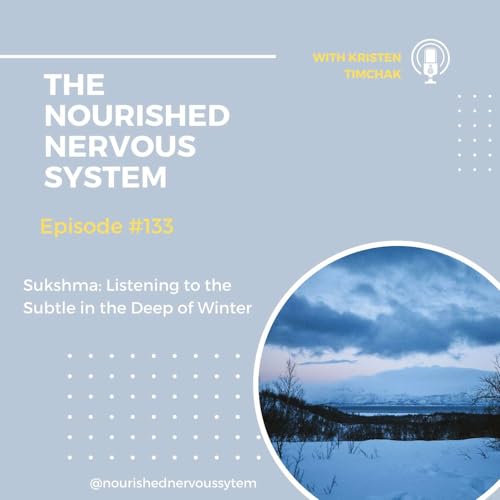
  • Sukshma: Listening to the Subtle in the Deep of Winter
    Jan 8 2026

    Send us a text

    In this New Year episode of Nourish the Nervous System, we explore winter not as a time for pushing forward or reinventing ourselves, but as a season of subtlety, listening, and inward refinement.

    Rather than loud resolutions or high-energy goals, winter invites a quieter kind of awareness — one that whispers instead of shouts. Through the Ayurvedic lens of Vata dosha and the Sanskrit quality sukshma (the subtle), we explore how this season affects the nervous system, our emotions, and our inner rhythms.

    This episode is an invitation to slow down, tune in, and honor sensitivity as a form of strength — not fragility.

    In this episode, we explore:

    • Why New Year’s energy can feel misaligned in the deep of winter
    • The contrast between summer’s outward buzz and winter’s inward stillness
    • Vata dosha in winter, with a focus on sukshma (the subtle quality)
    • How winter heightens nervous system sensitivity and perception
    • Subtle signs many people notice this time of year, including:
      • quiet or lingering fatigue
      • low-grade anxiety
      • emotional waves without a clear story
      • increased sensitivity to sound, light, and conversation
    • Translating Ayurveda into modern language:
      • sensory processing
      • nervous system load
    • Why “subtle” does not mean weak — it means attuned
    • How winter can surface emotional material without anything being “wrong”
    • The cultural pressure to feel “up” and productive — even in winter
    • Honoring rest without slipping into stagnation or disconnection

    Practical ways to support sukshma energy in winter:

    • Softening the edges of your day and reducing transitions
    • Creating sensory nourishment with dim lighting, quiet, and warmth
    • Using warm oil (especially on the feet) to ground the nervous system
    • Staying connected to intuition through journaling, somatic awareness, or creative expression
    • Balancing subtlety with sthula (the gross, tangible quality) through grounding movement:
      • strength-based exercise
      • walking outdoors
      • using larger muscle groups
      • getting fresh air and natural light

    Reflection questions for the week:

    • What feels louder now that life is quieter?
    • What is asking for attention?
    • What no longer fits?

    You’re invited to sit with these questions gently — through journaling, meditation, or simply noticing what arises.

    Mentioned in this episode:

    • Gentle Ayurvedic Guide to Perimenopause
    • Rhythm & Ritual — a small-group seasonal cohort for perimenopause, Ayurveda, and somatic support
      • Spring and Fall cohorts
      • Focused on rhythm, nervous system regulation, and seasonal wisdom
      • Join the waitlist to learn more

    Winter doesn’t ask us to fix ourselves. It

    Resources:

    Ayurvedic Dosha Quick Reference Guide

    Abhyanga Self Massage Guide

    Weekend Nervous System Reset

    Nourished For Resilience Workbook


    Find me at www.nourishednervoussystem.com

    and @nourishednervoussytem on Instagram


    Afficher plus Afficher moins
    26 min
  • People Pleasing, Trauma Bonds & Elegant Boundaries: A Somatic Conversation with Dr. Nima Rahmany
    Jan 1 2026

    Send us a text

    In this episode of The Nourished Nervous System, I’m joined by Dr. Nima Rahmany, chiropractor, educator, and creator of the Becoming Trigger-Proof methodology, for a deep and illuminating conversation about people pleasing, trauma responses, attachment patterns, and how nervous system healing transforms our relationships — with others and with ourselves.

    Dr. Nima shares his personal journey from chiropractic care into somatic psychology and attachment work, shaped by his own experiences with ruptured relationships, trauma bonding, and nervous system dysregulation.

    Together, we explore how stress, chronic illness, burnout, and relational conflict often stem from self-abandonment learned early in life — and how healing begins by turning inward.

    This conversation weaves somatic awareness, polyvagal theory, shadow work, and attachment theory into a compassionate framework for understanding why so many of us struggle with boundaries, resentment, and emotional exhaustion.

    In this episode, we explore:

    • The fawn response and how people pleasing develops as a survival strategy
    • Why self-abandonment often leads to burnout, autoimmunity, and chronic stress
    • How childhood attachment wounds show up in adult relationships and parenting
    • The difference between being boundaryless, walled-off, and elegantly boundaried
    • Why resentment builds when we ignore our body’s “no”
    • How shadow work helps us reclaim disowned parts of ourselves
    • A somatic approach to working with triggers in real time
    • What it actually means to be “regulated” — and why regulation doesn’t mean being calm all the time
    • How to build resilience by increasing your capacity to feel, rather than suppress, emotion

    Dr. Nima also walks us through a powerful, embodied example of how triggers with our children or partners can become doorways to healing unmet needs within ourselves — offering a practical, compassionate roadmap for rupture and repair.

    This episode is especially supportive if you:

    • Identify as a people pleaser or “the strong one”
    • Struggle with guilt around saying no
    • Feel chronically depleted despite doing “all the right things”
    • Are navigating parenting, partnership, or work stress
    • Sense that your nervous system is asking for a different way of relating

    Resources mentioned:

    • Website
    • Dr. Nima Rahmany’s Attachment Style Quiz
    • The Trigger-Proof Experience
    • Facebook


    Resources:

    Ayurvedic Dosha Quick Reference Guide

    Abhyanga Self Massage Guide

    Weekend Nervous System Reset

    Nourished For Resilience Workbook


    Find me at www.nourishednervoussystem.com

    and @nourishednervoussytem on Instagram


    Afficher plus Afficher moins
    51 min
  • Ojas and the Perimenopause Portal: Tending Vitality, Resilience, and the Sacred Nectar (part 3 of a 3 part series)
    Dec 25 2025

    Send us a text

    In this episode, I’m concluding our three-part series on Ayurveda and perimenopause with a deep dive into ojas — the subtle essence that governs vitality, immunity, resilience, and emotional steadiness.

    We’re recording in the dark days of winter here in the Northern Hemisphere, and I begin by reflecting on how seasonal rhythms mirror the inner transitions many of us experience during perimenopause.

    Just as nature turns inward in winter, this phase of life invites us to slow down, listen more closely, and tend ourselves with greater care.

    In Ayurveda, perimenopause is not seen as a problem or a decline, but as a time of refinement — a transition into a wiser, more conserving phase of life.

    Ojas becomes especially precious during this time, as rising vata (air and space) can draw on our reserves of vitality if we’re not supported.

    In this episode, we explore:

    • What ojas is from an Ayurvedic perspective — physically, energetically, and emotionally
    • Why perimenopause is considered an ojas-sensitive window
    • How hormonal shifts, stress, sleep disruption, and midlife responsibilities can affect ojas
    • The relationship between rasa dhatu, agni, and ojas
    • Signs of ojas depletion — emotionally and physically
    • The difference between para ojas (essential, life-sustaining) and apara ojas (day-to-day, replenishable vitality)
    • How ojas depletion can show up differently through vata, pitta, and kapha qualities
    • Gentle, realistic ways to rebuild and protect ojas during perimenopause
    • Why this phase is not a depletion story, but a recalibration of energy and vitality

    This episode is an invitation to soften the narrative around perimenopause and to see it as a meaningful turning point: a time to protect the sacred nectar of vitality so we can move into the next phase of life feeling steadier, resourced, and radiant.

    Resources mentioned:

    • Free download: A Gentle Ayurvedic Guide to Perimenopause: Five Ways to Support Your Nervous System and Digestion
    • Self-abhyanga (oil massage) practices
    • Previous episodes in this series on Rasa and Agni

    If this episode resonates with you, I’m also quietly preparing a spring offering that weaves together one-on-one Ayurvedic consultations, group support, yoga, somatic practices, and seasonal rhythm — you can join my mailing list to learn more when it’s ready.

    • Join the WAITLIST for Rhythm & RItual: an Ayurvedic Journey for Perimenopause

    Thank you so much for listening and for walking this transition with curiosity and care.

    Resources:

    Ayurvedic Dosha Quick Reference Guide

    Abhyanga Self Massage Guide

    Weekend Nervous System Reset

    Nourished For Resilience Workbook


    Find me at www.nourishednervoussystem.com

    and @nourishednervoussytem on Instagram


    Afficher plus Afficher moins
    34 min
  • Perimenopause, Cycles & Sovereignty: Reclaiming the Feminine Rhythm with Alyx Coble-Frakes
    Dec 18 2025

    Send us a text

    In today’s episode of The Nourished Nervous System, I’m joined by Alyx Coble-Frakes, founder of The Agenda, for a powerful and wide-ranging conversation about menstrual cycles, perimenopause, and what happens when women stop overriding their bodies.

    This episode lands perfectly in the middle of my three-part series on Ayurveda and perimenopause, expanding the conversation beyond hormones as something to “fix” and into hormones as sources of insight, rhythm, and power.

    Together, we explore how understanding the menstrual cycle can radically change how we work, relate, parent, create, and lead — and why ignoring cyclical biology has contributed to burnout, relationship strain, and increasingly difficult perimenopause experiences in modern culture.

    One of the central themes we explore is the concept of “meno divorce” — a term used to describe the increased likelihood of separation or divorce during perimenopause and menopause, often initiated by women. Rather than framing this as hormones “ruining relationships,” we talk about perimenopause as a truth-revealing portal, where long-standing imbalances, unmet needs, and emotional inequities become impossible to ignore.

    This conversation is honest, validating, fiery, and deeply compassionate — touching on patriarchy, unpaid labor, nervous system overload, erotic aliveness, and the reclamation of feminine wisdom.

    In This Episode, We Discuss:

    • The menstrual cycle as an internal seasonal rhythm
    • The four phases of the cycle and how they affect energy, mood, libido, and cognition
    • Why women aren’t meant to function on linear, masculine productivity models
    • Perimenopause as a portal into clarity, sovereignty, and self-truth
    • What “meno divorce” really reflects — and why it’s not about women being “crazy”
    • Hormonal shifts and reduced tolerance for emotional and relational inequity
    • The mental load, unpaid labor, and libido loss many women carry in midlife
    • How understanding cycles can transform partnerships and communication
    • Why tracking your cycle is a foundational self-care and self-advocacy tool
    • The overlap between Ayurvedic wisdom and cycle awareness
    • Reclaiming erotic aliveness, intuition, and feminine leadership in midlife


    About Today’s Guest:

    Alex Kabul Franks is the founder of The Agenda, a platform dedicated to helping menstruating people sync their lives with their hormonal rhythms so they can feel more in flow physically, emotionally, and mentally.

    Through cycle-syncing tools, education, and advocacy, Alex’s work helps women shift from battling their hormones to recognizing them as a powerful internal guidance system.

    You can learn more about Alex and her work through The Agenda app and planner (links below).

    Instagram

    Check out The Agenda App:

    App Store

    Resources:

    Ayurvedic Dosha Quick Reference Guide

    Abhyanga Self Massage Guide

    Weekend Nervous System Reset

    Nourished For Resilience Workbook


    Find me at www.nourishednervoussystem.com

    and @nourishednervoussytem on Instagram


    Afficher plus Afficher moins
    40 min
  • Agni and the Perimenopause Portal: Tending Your Inner Fire (part 2 of a 3 part series)
    Dec 11 2025

    Send us a text

    In this second episode of my perimenopause series, we explore Agni — your digestive and metabolic fire — and why it plays such a central role in the perimenopause transition.

    Ayurveda teaches that perimenopause isn’t just a hormonal shift. It’s a metabolic one.

    A deep recalibration in how the body digests food, processes experience, regulates energy, and maintains balance.

    Today, I walk through how Agni changes during this time, the three ways Agni can become imbalanced (Vata, Pitta, and Kapha styles), and how these patterns show up physically, mentally, and emotionally.

    We talk about the connection between digestion, estrogen metabolism, the nervous system, and why supporting your inner fire can bring more steadiness and clarity into this phase of life.

    This episode is both validating and deeply practical — a gentle guide to understanding your body through the lens of rhythm, nourishment, and internal wisdom.

    In this episode, I cover:
    • Why Ayurveda views perimenopause as a metabolic transition
    • How fluctuating estrogen affects Agni, digestion, heat regulation, and mood
    • The three main Agni patterns that show up during perimenopause
    Vata/ Vishama Agni: irregular, sensitive, unpredictable
    Pitta/ Tikshna Agni: hot, sharp, overactive
    Kapha/ Manda Agni: slow, heavy, dull
    • Physical + emotional signs for each pattern
    • The role of fat tissue, the adrenals, and peripheral estrogen production
    • How Agni influences Rasa (hydration, lubrication, nourishment)
    • Why this time is a sacred window for tending your nervous system
    • Lifestyle, food, and pacing practices to support each type of Agni
    • The deeper spiritual meaning of tending your “sacred fire” during this transition
    • How metabolic steadiness supports hormones, sleep, immunity, and overall vitality
    • Why this transition is refinement — not decline

    Resources:

    Ayurvedic Dosha Quick Reference Guide

    Abhyanga Self Massage Guide

    Weekend Nervous System Reset

    Nourished For Resilience Workbook


    Find me at www.nourishednervoussystem.com

    and @nourishednervoussytem on Instagram


    Afficher plus Afficher moins
    26 min
  • You Are Enough: Embracing Self-Compassion Through Internal Family Systems and Polyvagal Theory with Soulla Demetriou
    Dec 4 2025

    Send us a text

    In this episode, I sit down with self-compassion teacher, somatic coach, IFS practitioner, and soon-to-be author Soulla Demetriou.

    We explore what it really means to come home to yourself, befriend your inner world, and move through life with more ease, compassion, and truth.

    In this conversation, we talk about:

    • Soulla’s story
    How her early experiences with anxiety and panic opened the door to yoga, mindfulness, somatics, and eventually Internal Family Systems (IFS).

    • What self-compassion truly is
    Not clichés or forced positivity — but a daily practice of inner friendship, boundaries, honesty, and care.

    • The nervous system’s role in healing
    Why so many of our patterns come from old protective responses, and how safety changes everything.

    • A simple, grounded explanation of IFS
    How our “parts” develop, what they’re trying to protect, and how self-energy (the clear sky beneath the weather) helps bring them into balance.

    • The wound of “not enoughness”
    Why so many of us carry it, and how we begin healing it gently.

    • Returning to who we really are
    The beautiful overlap between IFS self-energy and the Ayurvedic idea of living from sattva, clarity, and inner steadiness.

    About Soulla Demetriou

    Soulla is a somatic and transformational coach, IFS practitioner, mindfulness teacher, and author of the upcoming book You Have Always Been Enough. She supports people around the world in reconnecting with their inner truth and emotional sovereignty.

    Connect with Soulla

    Website

    Instagram

    → Begin a free 7-Day Self-Compassion Journey — a beautiful, practical introduction to building a kinder relationship with yourself

    → Pre-order Soulla’s book: You Have Always Been Enough: A Healing Guide to Self-Love and Inner Freedom

    → Explore Soulshine Retreats in Spain

    → Curious about working 1:1 with Soulla — simply email her to have a chat and find out more: soulla@soulshinewithsoulla.com

    Resources:

    Ayurvedic Dosha Quick Reference Guide

    Abhyanga Self Massage Guide

    Weekend Nervous System Reset

    Nourished For Resilience Workbook


    Find me at www.nourishednervoussystem.com

    and @nourishednervoussytem on Instagram


    Afficher plus Afficher moins
    49 min