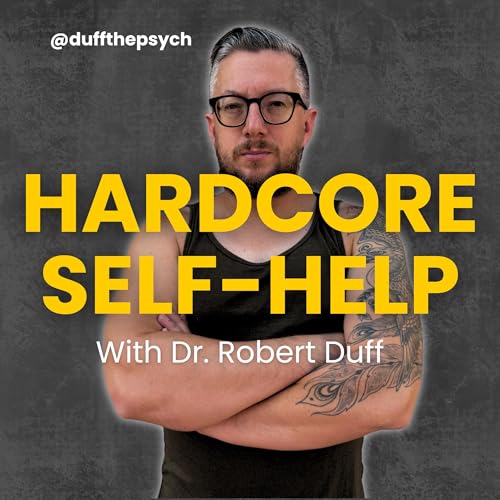
Couverture de The Hardcore Self-Help Podcast with Duff the Psych

The Hardcore Self-Help Podcast with Duff the Psych

The Hardcore Self-Help Podcast with Duff the Psych

De : Robert Duff Ph.D.
Écouter gratuitement

À propos de ce contenu audio

Hey, friends! My name is Robert. I am a neuropsychologist and self-help author. In this podcast, I interview fascinating individuals and provide information about psychology, mental health, neuroscience, relationships, and more. I have been told that I ask amazing questions and that I am talented at breaking down complex science into digestible information. Come have a listen and let me know if you agree! Hygiène et vie saine Psychologie Psychologie et psychiatrie
Les membres Amazon Prime bénéficient automatiquement de 2 livres audio offerts chez Audible.

Vous êtes membre Amazon Prime ?

Bénéficiez automatiquement de 2 livres audio offerts.
Bonne écoute !
    Épisodes
    • The Secrets of Good Daughtering with Dr. Allison Alford
      Feb 17 2026

      We talk a lot about parenting.

      But we don't talk nearly enough about being a daughter.

      In this episode, I sit down with Dr. Allison Alford — communication scholar, professor at Baylor University, and author of Good Daughtering — to unpack the hidden emotional labor adult daughters carry inside their families.

      We explore the invisible work, the guilt, the pressure to be "enough," and how daughters can set boundaries without walking away from the people they love. This isn't about cutting family off. It's about understanding your role, recalibrating it, and finding pride instead of burnout.

      If you've ever felt like you're doing a lot… but it's never quite enough — this one will hit.

      What We Cover
      • What "daughtering" actually means (and why it's invisible)

      • The "specter of expectation" and where guilt really comes from

      • The difference between healthy families and the "messy middle"

      • Why boundaries aren't magic — they're strategy

      • How to shift your role even if no one else in your family changes

      • Why being a daughter can be a noble pursuit — not just a burden

      • What changes when daughters finally see the system clearly

      Chapters

      00:00 – Intro + Texas roots & communication background
      01:00 – "Not by magic": boundaries during the holidays
      02:00 – Why she wrote Good Daughtering (research → real-world tools)
      06:45 – Growing up with a therapist mom + learning to "talk about talking"
      12:00 – Emotions A–Z vs A–F (communication differences in relationships)
      16:00 – Generational healing, enmeshment & the "messy middle" family
      20:00 – What "daughtering" actually means (visible + invisible labor)
      23:30 – The guilt, pressure & the "specter of expectation"
      26:00 – Where to begin: notice → calibrate → communicate
      29:00 – When family won't change: boundaries + internal work
      36:00 – Realizing the invisible labor in her own life
      42:00 – Daughters as an untapped community
      46:00 – Is daughtering a noble pursuit?
      49:00 – What's inside the book (tools, scripts, boundary setting)
      53:00 – What changes if daughters "see the Matrix"? + Release date

      About Dr. Allison Alford

      Dr. Allison Alford is a communication scholar and Clinical Associate Professor at Baylor University. Her research focuses on family communication, identity, and the overlooked emotional labor of adult daughters.

      🌐 Website:
      https://www.daughtering101.com

      📸 Instagram:
      https://www.instagram.com/daughtering101

      📘 Good Daughtering (Releases February 17, 2026):
      https://www.harpercollins.com/products/good-daughtering-allison-m-alford

      (You can also find it on Amazon, Barnes & Noble, Bookshop, and other major retailers.)

      Afficher plus Afficher moins
      58 min
    • Intimacy, Breakups, and Dating in the Real World: A Conversation with Dr. Justin Garcia
      Jan 27 2026
      Dating and relationships have never been simple — but in today's world of apps, algorithms, and endless options, it's easy to feel overwhelmed and disconnected. In this episode, I speak with Dr. Justin Garcia, Executive Director of the Kinsey Institute, evolutionary biologist, sex researcher, and author of the upcoming book The Intimate Animal. We talk about what our biology can (and can't) tell us about love and desire, how technology is reshaping intimacy, and why breakups can hit so hard. We also get personal — sharing stories about grief, recovery, non-monogamy, and navigating love in the real world. Dr. Garcia brings a refreshingly nuanced perspective, blending science, lived experience, and a deep respect for the complexities of modern relationships. Topics Covered The biological basis of pair bonding and why love is a survival strategy How dating apps are changing the way we connect — and the pitfalls of infinite choice Non-monogamy, open relationships, and what science really says about them Breakups, heartbreak, and why they feel like addiction withdrawal Infidelity: what motivates it, and why it's often about secrecy more than sex Practical dating advice backed by years of research The neuroscience of attraction, and how foreplay, communication, and intention keep passion alive How personal experience shaped Dr. Garcia's latest work — including his own recent marriage and fatherhood Guest Bio Dr. Justin Garcia is an evolutionary biologist, sex researcher, and Executive Director of the Kinsey Institute at Indiana University. He's also the Chief Scientific Advisor for Match Group, guiding large-scale studies on modern relationships like the annual Singles in America survey. His research has been featured in outlets like The New York Times, TIME, and CNN, and his new book The Intimate Animal: The Science of Sex, Fidelity, and Why We Live and Die for Love will be released on January 27, 2026. Learn more: Kinsey Institute Bio – https://kinseyinstitute.org/about/staff/executive-director-justin-garcia.html Pre-order The Intimate Animal – https://www.hachettebookgroup.com/titles/justin-r-garcia-phd/the-intimate-animal/9780316594035/ Resources Mentioned Singles in America study – https://www.singlesinamerica.com/ Kinsey Institute – https://www.kinseyinstitute.org/ Dr. Garcia's social media: Search "Dr. Justin Garcia" on major platforms or follow updates via the Kinsey Institute Key Takeaways Love and sex are biologically distinct but deeply intertwined. We're wired for long-term bonding, but novelty and desire often create tension within those bonds. Breakups are more than emotional — they're neurochemical. Love activates the brain's reward systems, and heartbreak can mimic drug withdrawal. Modern dating can feel overwhelming because our brains haven't evolved to handle endless digital choice. Intention and curiosity matter more than perfection. Non-monogamous relationships aren't inherently less loving or stable. They often demand high levels of communication and negotiation. Infidelity is less about desire and more about secrecy. Even in non-monogamous relationships, broken trust hurts. There's no perfect formula for love. Each connection is unique, and understanding yourself can help you show up better in relationships. Connect with Me Have a question, topic suggestion, or want to be a guest? Email: duffthepsych@gmail.com Website: https://duffthepsych.com Contact form: https://duffthepsych.com/contact Please rate and subscribe on your favorite podcast platform — it helps more people find the show!
      Afficher plus Afficher moins
      1 h et 2 min
    • Compassionate and Effective Schizophrenia Care with Dr. Tracy Hicks
      Jan 20 2026

      In this episode, I'm honored to welcome Dr. Tracy Hicks, a dual-certified family and mental health nurse practitioner with over two decades of clinical experience—and a deeply personal connection to serious mental illness. Dr. Hicks is both the daughter of a parent and the mother of a child with schizophrenia spectrum disorders. Her perspective blends professional expertise with lived experience in a way that is both deeply compassionate and refreshingly practical.

      We talk about what schizophrenia really is (and isn't), the impact of stigma on individuals and families, and the importance of person-centered, empathetic care. Dr. Hicks shares her personal journey—raising a daughter with serious mental illness while navigating barriers in the healthcare system—and offers guidance for both providers and caregivers who want to better support those living with schizophrenia.

      This is a powerful and deeply human conversation for anyone touched by serious mental illness.

      Topics We Cover
      • What schizophrenia is and how it's commonly misunderstood

      • Growing up with a parent who has schizophrenia

      • Early warning signs and delays in diagnosis for her daughter

      • How stigma and systemic bias impact treatment access and quality

      • Long-acting injectable medications: what they are and why they matter

      • Creating space for curiosity and shared decision-making in care

      • How to support loved ones without losing yourself

      • Advice for providers on building trust and improving outcomes

      • The power of grace, boundaries, and self-care for caregivers

      Timestamps

      00:00 – Introduction to Dr. Tracy Hicks and her personal/professional background
      03:00 – From nursing to psychiatry: building a whole-person care model
      07:00 – Childhood memories of a parent with schizophrenia
      11:00 – Explaining what schizophrenia is and is not
      14:00 – Challenging stereotypes: what schizophrenia actually looks like
      18:00 – Early signs in Dr. Hicks' daughter and missed opportunities for intervention
      22:00 – Racism, bias, and provider assumptions
      24:00 – Treatment begins with the story, not the symptoms
      26:00 – Why empathy and curiosity matter more than credentials
      28:00 – The question that opens everything: "What's your goal for today?"
      32:00 – Including family and support systems in the care plan
      36:00 – Communication shifts that changed lives
      41:00 – What long-acting injectables are and how to present them as an option
      47:00 – Combating clinical inertia and provider bias
      51:00 – What Dr. Hicks would do differently as a parent
      54:00 – Creating your own space when the system doesn't serve you
      58:00 – Boundaries, burnout, and filling your own cup as a caregiver
      1:02:00 – Final thoughts on stigma, advocacy, and asking for what you need
      1:03:30 – Where to follow Dr. Hicks and access her work

      Guest Links
      • Website: https://www.cfcmentalhealthoutreach.org

      • Instagram: https://instagram.com/drhicksnp

      Stay Connected
      • Email: duffthepsych@gmail.com

      • Send a message or question: https://www.duffthepsych.com/contact

      • YouTube: https://www.youtube.com/@duffthepsych

      • Instagram: https://instagram.com/duffthepsych

      If this episode resonated with you, please consider subscribing, leaving a review, or sharing it with someone who could benefit. Conversations like this one can make a world of difference for people who feel alone in their experience.

      Until next time, take care of yourself.

      Afficher plus Afficher moins
      1 h et 4 min
    Aucun commentaire pour le moment
