Couverture de The Edgewater Podcast

The Edgewater Podcast

The Edgewater Podcast

De : Gerald Farinas
Écouter gratuitement

3 mois pour 0,99 €/mois

Après 3 mois, 9.95 €/mois. Offre soumise à conditions.

À propos de ce contenu audio

Welcome to The Edgewater Podcast. I am Gerald Farinas and I talk about social justice, empire and colonialism, and current events from the perspective of a Hawaii-born Ilocano Presbyterian Church (USA) elder commissioner here in the Edgewater neighborhood of Chicago, Illinois. Find me IRL at GeraldFarinas.com.

gerfarinas.substack.comGerald Farinas
Politique et gouvernement Sciences sociales
Les membres Amazon Prime bénéficient automatiquement de 2 livres audio offerts chez Audible.

Vous êtes membre Amazon Prime ?

Bénéficiez automatiquement de 2 livres audio offerts.
Bonne écoute !
    Épisodes
    • Podcast: Anti-trans attacks come from Catholic bishops and new bill in Congress
      Dec 17 2025
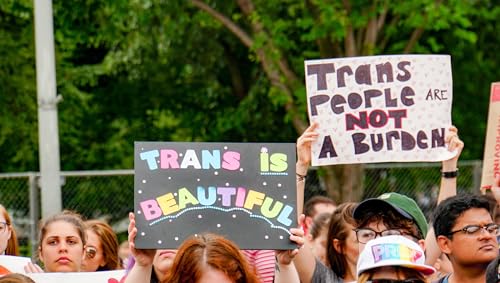
      Photo: Ted Eytan via Wikimedia Commons.I decided to focus my message today on trans issues because it’s what made me the most angry this week. And it’s only Tuesday night.A major fight is happening right now over gender-affirming care. Or actually, it has been attacked over and over this past decade. It’s just getting worse as the rhetoric gets worse.This healthcare is essential and even life-saving for many people, but it is getting mowed down politically and institutionally, largely because most people don’t fully understand what it is. The current public discussion is loud and often scary, but it’s built on a major misunderstanding.These attacks are coming from several directions, hitting both private institutions and potential federal law. The U.S. Conference of Catholic Bishops (USCCB) recently put an official ban on gender-affirming care in all Catholic hospitals. Since Catholic healthcare is a huge part of the U.S. system, this decision makes it much harder for transgender and gender-diverse people to get care. “Just don’t go to a Catholic hospital or medical clinic then!” they say. Well, the problem is in some places, the only hospital or clinic is the Catholic-affiliated one. Doctors at these facilities are now forbidden from offering hormonal or surgical treatments that help someone match their body to their gender identity.In Congress, the U.S. House is expected to vote on H.R. 3492, the “Protect Children’s Innocence Act.” This bill tries to make it a crime to offer gender-affirming care to minors, falsely calling it “mutilation” or “chemical castration.” If this law passes, doctors who provide this proven, necessary care could face up to ten years in federal prison. It’s important to note the contradiction here. While the bill seeks to stop this specific, consensual care for trans youth, it oddly leaves room to allow non-consensual surgeries on intersex infants and children, a practice human rights groups strongly oppose, arguing that those decisions should wait until the person is old enough to agree.The most common public idea is that gender-affirming care just means a big “sex-change” surgery. This is wrong. This incorrect idea is what is driving the push to ban the care.Gender-affirming care is a complete, personal plan that involves a range of support. For the vast majority of people, especially younger people, it does not involve surgery at all.The care usually starts with social affirmation. This is non-medical and completely reversible. It simply means using the person’s chosen name and pronouns and allowing them to present themselves (through clothes or hairstyle) in a way that aligns with their gender identity.Next is mental health support, which is crucial at every age. This involves counseling and therapy to help the person understand their gender identity and deal with gender dysphoria. This is the deep unhappiness that comes from their body not matching who they are inside. Therapy is also vital for addressing common mental health issues like depression and anxiety that affect gender-diverse young people.Medical steps are only taken after careful discussion with doctors and parents, following clear medical guidelines for different ages. These steps are mostly non-surgical. Puberty blockers temporarily pause puberty. This gives a young person time to explore their gender identity before their body changes in ways that are hard to undo; these blockers are fully reversible. Hormone therapy involves giving estrogen or testosterone to help a person develop physical features that match their gender. This is partially reversible.[By the way, there was another report this past week that more and more men are asking for testosterone treatments because they feel less virile, manly, or even have less sculpted bodies because of lack of testosterone. These are straight men wanting this. Guess what?! That’s gender-affirming care!]Surgical interventions are rarely done for minors. They are mostly reserved for adults, or sometimes older teenagers with extensive medical review and parental consent. Surgery, such as chest reconstruction or genital reconstruction, is the final option in the process and is not required to be considered to be receiving gender-affirming care.Gender-affirming care is standard, evidence-based medicine. It is supported by every major medical and mental health organization in the United States, all of which stress that decisions about care must stay between the patient, their family, and their doctors. Not politicians.The American Medical Association (AMA) calls attempts to ban gender-affirming care a “dangerous intrusion into the practice of medicine.” It states that medical and surgical treatments for gender dysphoria are medically necessary and opposes any laws that criminalize or prevent the provision of this evidence-based care. The AMA also supports protections for physicians, patients, and families who seek or provide ...
      Afficher plus Afficher moins
      9 min
    • Podcast: If we don't uphold due process, precedent could take away due process for all
      Dec 13 2025
      The digital public square, whether it’s Facebook or X, often becomes a stage for what can only be described as armchair constitutional experts. They are quick to spew definitive statements, often about sensitive legal matters like immigration, and lately, the loudest nonsense has been about how undocumented immigrants, or “aliens,” as the law calls them, don’t deserve due process.Based on that single assertion, you can tell these folks have zero understanding of what due process actually is.This is more than just a legal quibble; it’s a dangerous oversimplification of American constitutional law. This common online belief is utterly wrong. Due process is a right that applies to all persons within U.S. borders, and most importantly, setting a legal precedent to allow deportations without due process can critically undermine and essentially “screw up” the rights of everyone else, including U.S. citizens.Since people don’t seem to understand, let’s use even simpler language here.The phrase “due process” is often thrown around on social media, especially when discussing immigration, usually by people who fundamentally misunderstand what it means. You see posts claiming that undocumented immigrants don’t deserve due process, and therefore should be summarily deported. This position is not only legally incorrect, but it also reveals a dangerous ignorance about one of the most bedrock principles of American law.Due process is essentially a simple guarantee. The government cannot take away a person’s life, liberty, or property without a fair procedure. It is enshrined in both the Fifth and Fourteenth Amendments of the U.S. Constitution.Notice that the text of the Fifth Amendment says that “no person” shall be “deprived of life, liberty, or property, without due process of law.” It does not say “no citizen.”This is a critical distinction. The Supreme Court has repeatedly affirmed that the constitutional protection of due process applies to all persons physically within the United States, regardless of their citizenship or immigration status.A person (whether a citizen, a legal resident, or an undocumented immigrant) has a right to a fair hearing before the government can subject them to a penalty like deportation, detention, or the loss of property.For an undocumented immigrant, due process typically means they have the right to be informed of the charges against them, to present evidence, to cross-examine government witnesses, and to appeal a deportation order, all before an immigration judge. It is the system that ensures the government acts according to law, not arbitrary decree.At issue today is that a vast majority of those detained by ICE and CBP raids have not had due process. And thankfully, courts are agreeing with this assertion.Now, let’s talk about the chilling consequence of setting a precedent that allows the government to strip anyone of their fundamental rights without due process.When people argue that due process is an unnecessary hurdle for deporting undocumented immigrants, they are essentially arguing that the government should be able to act with speed and efficiency over fairness and law. This is where the rights of everyone (including U.S. citizens) are put at risk.The law operates on precedent.If the government is allowed to create a system where one group of people (undocumented immigrants) can be detained or expelled without the basic safeguards of a fair hearing, that power does not magically stop there. Once the legal and political door is opened to shortcut due process for one politically unpopular group, it sets a terrible legal precedent that can be used against others in the future.Imagine a scenario where a U.S. citizen is mistakenly identified as a foreign national subject to deportation. If due process has been eroded, and the government can act quickly and secretly, that citizen has no meaningful way to prove their identity and assert their rights before they are potentially placed on a plane. The mechanism designed to protect the rights of non-citizens is the exact same mechanism that ensures a citizen cannot be unjustly imprisoned or have their property seized.The procedures may be different in immigration court versus criminal court, but the underlying principle is the same.The government must have a solid, legally verifiable reason and must follow fair procedures before it can act against a person.Due process is the great leveler; it is the constitutional chain that binds the power of the state.It is not a reward for good behavior or a privilege reserved for citizens.It is a fundamental right of simply being a person on U.S. soil, and it protects everyone equally, including the very citizens who wish to deny it to others.Undermining it for anyone is like dismantling a load-bearing wall in your own house. The collapse will eventually reach everyone inside. Get full access to Not Quite Communist by Gerald Farinas at ...
      Afficher plus Afficher moins
      6 min
    • Podcast: 'Why can't we have nice' immigrants, President asks
      Dec 13 2025

      The statement, “Why can’t we have nice people from Norway?” might sound harmless at first. However, when President Donald Trump made this statement recently, while discussing his rabid immigration policy, it becomes a deeply damaging message.

      The comment is inappropriate, not just because it’s so vile to say, but because the President is using his immense power, in his capacity as President of the United States, to say that certain races are better or more valuable than others.

      The harm is immediate.

      It belittles non-white immigrants. By setting up “nice people from Norway” against people from other, non-white countries that the President has criticized before, the message is clear. Some immigrants are automatically seen as good, and others are not.

      This is what we call in political science nativism, which means preferring native-born inhabitants over immigrants. Nativism is a type of government-supported racism.

      It tells immigrants of color, no matter how much they contribute (and we’re not just talking about undocumented immigrants here) that they are seen as second-class citizens or a potential problem, simply because of their background or looks.

      The President’s statement also gives comfort and strong words to people who already hold racist views, translating their private bias into a public, presidential-level preference.

      This comment echoes a racist past. This desire to pick immigrants based on race or culture is not new; it mirrors the ethno-nationalism that has caused trouble throughout history.

      The goal of racist nativists is to create a “purer” national identity by choosing who gets to come in. The U.S. has done this before, through laws like the Chinese Exclusion Act of 1882 and the Immigration Act of 1924.

      The 1924 Act specifically set limits to strongly favor people from northern and western Europe (like Norway) while shutting out people from Southern and Eastern Europe, Asia, and Africa. The goal then was to keep America a mostly white, Anglo-Saxon country.

      This recent comment brings back that old, racist way of thinking. It treats American identity not as shared ideas and values (something we were taught since elementary school), but as something based on a person’s race and ancestry.

      This language directly supports the beliefs of white Christian nationalism.

      This movement argues that America was meant to be a Christian nation for white people of European descent, and that all laws and culture should reflect this. In their view, immigrants from non-white and non-Christian countries are not just foreign; they are a major threat that must be stopped to “save” the nation.

      When a national leader suggests favoring immigrants from a country like Norway while speaking badly about those from non-white or non-Christian regions, like when the President disparaged Somalians in America as “garbage people,” they are essentially taking the idea of a racially and culturally “pure” America and making it a preference of the government.

      By using the phrase “nice people,” the President sends a subtle but clear signal that supports a policy based on race and religion. This confirms to his supporters that the country’s highest office agrees with their vision of a racial ranking.

      The preference for “nice people from Norway” is not an accident. It is a powerful, intentional move that smells of historical prejudice, promotes a harmful and unequal view of the world, and encourages those who want to turn the United States into a nation based on ethnicity alone.

      It is deeply wrong because it breaks the basic American promise of equality, replacing it with a presidential preference for one race and nation over others.

      This is not Christian. This is not American.


      Get full access to Not Quite Communist by Gerald Farinas at gerfarinas.substack.com/subscribe
      Afficher plus Afficher moins
      4 min
    Aucun commentaire pour le moment