Couverture de Tech Threads: Weaving the Intelligent Future

Tech Threads: Weaving the Intelligent Future

Tech Threads: Weaving the Intelligent Future

De : Baya Systems
Écouter gratuitement

Offres de saison | 0,99 € par mois pendant les 3 premiers mois

5,99 €/mois par la suite. Des conditions s’appliquent. Annulation mensuelle possible.
À propos de ce contenu audio
This podcast hosted by Baya Systems explores the cutting edge of technology, from AI acceleration to data movement and chiplet innovation. Each episode dives into groundbreaking advancements shaping the future of computing, featuring insights from industry experts on the trends and challenges defining the tech landscape. Tune in to stay ahead in the rapidly evolving world of technology.©2025 Baya Systems Politique et gouvernement
Épisodes
  • Memory Meets Compute: How Hybrid Bonding and 3D Memory Could Transform AI Inference
    Oct 29 2026
    n this episode of Tech Threads: Weaving the Intelligent Future, Baya Systems’ Nandan Nayampally sits down with Charlie Cheng, founder and CEO of TeRAM, to discuss the AI memory wall and the industry’s shift toward alternative memory architectures. With Nvidia licensing Groq’s technology and Cerebras drawing attention to wafer-scale computing, the race to bring memory closer to compute is reshaping how AI systems are built.

    Charlie draws on a career spanning microprocessors, EDA, IP licensing, and ASICs, including his time as CEO of Kilopass, the memory IP licensor acquired by Synopsys. He explains why AI inference changes the memory problem: during decode, every token requires a pass through the entire model, so memory bandwidth now stands alongside capacity as a limiting factor in generating each profitable token. What was once an engineering concern has become a direct cost on the CFO’s P&L.

    The conversation covers why on-die SRAM is no longer scaling, why HBM supply is constrained, and why 3D integration through hybrid bonding is the natural next step for the data center, on-prem AI, and edge devices such as AR/VR glasses. Charlie also shares TeRAM’s goal of delivering 64GB of memory capacity and about 200TB/s of bandwidth close to compute. That could shrink AI models from multiple racks to less than one and cut total power by roughly 7x.

    As memory moves closer to compute, the pressure shifts to how data moves across the chip. Nandan and Charlie discuss how hybrid bonding and chiplets are changing network-on-chip topologies, partitioning, and routing, and why efficient data movement is the other half of breaking the memory wall.

    Tune in for an expert look at how new memory architectures, chiplets, and efficient data movement could help unlock faster, more power-efficient, and more scalable AI inference.

    Recorded and produced by ROC Vox Recording & Production, LLC Rochester, NY
    rocvox.com
    Afficher plus Afficher moins
    32 min
  • Scaling Custom Silicon in China: Technology Is Only the Beginning
    Sep 24 2026
    In this episode of Tech Threads: Weaving the Intelligent Future, Baya Systems Founder and CEO Sailesh Kumar joins AdoreSys Founder and CEO KengSu Teoh to discuss the companies’ new partnership and what it means for semiconductor customers across China and the broader Asia-Pacific region.
    Hosted by Nandan Nayampally, the conversation explores the rapid growth of custom silicon, the increasing importance of data movement and interconnect technology, and how Baya and AdoreSys are combining complementary strengths to support complex SoC and chiplet designs.

    From Technology Adoption to Implementation
    Sailesh and KengSu discuss how Baya and AdoreSys can combine their complementary strengths to support customers across the design journey, from evaluating advanced interconnect technology to silicon implementation.

    Inside the Conversation
    • Why data movement and connectivity are becoming defining challenges in modern computing systems
    • How the shift toward custom silicon is changing customer requirements and development models
    • Why chiplet architectures create new opportunities and new connectivity challenges
    • What semiconductor design teams in China value when evaluating and adopting technology
    • How local engineering relationships can accelerate technical engagement and customer support
    • What Baya Systems and AdoreSys hope to accomplish through their partnership

    Recorded and produced by ROC Vox Recording & Production, LLC Rochester, NY
    rocvox.com
    Afficher plus Afficher moins
    44 min
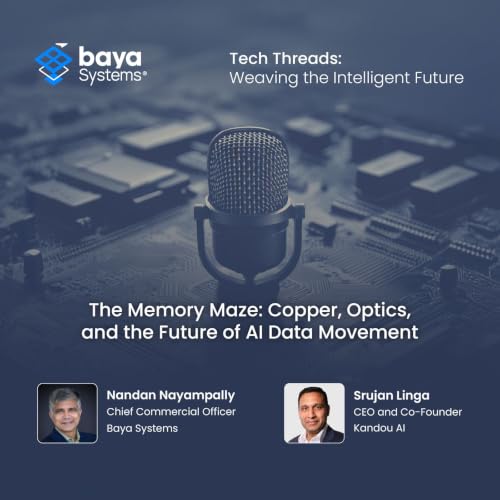
  • The Memory Maze: Copper, Optics, and the Future of AI Data Movement
    Aug 18 2026
    As AI models grow larger and more autonomous, every query requires extraordinary volumes of data to move quickly between memory and compute, making data movement one of the defining challenges for next-generation AI infrastructure.
    In this episode of Tech Threads, Nandan Nayampally speaks with Srujan Linga, CEO and co-founder of Kandou AI, about why the industry’s so-called “memory wall” is actually a multidimensional “memory maze,” shaped by different requirements for bandwidth, latency and capacity.
    They explore the limitations of relying exclusively on high-bandwidth memory, the untapped potential of copper interconnects, and how technologies such as Chord Signaling and Copper MIMO can increase bandwidth while reducing power and extending reach. The conversation also examines where copper and optics can complement one another, how advanced interconnects could turn an entire PCB into a larger multi-chip system, and why the economics and scalability of AI infrastructure must be considered alongside raw performance.
    The result is a system-level perspective on what it will take to build more efficient, scalable and accessible AI infrastructure.
    Afficher plus Afficher moins
    44 min
adbl_web_anon_alc_button_suppression_t1
Aucun commentaire pour le moment