Épisodes

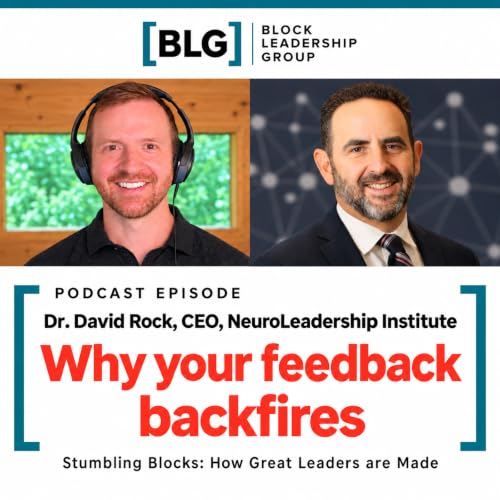
  • Dr. David Rock, CEO, NeuroLeadership Institute: Why Your Feedback Backfires
    Nov 9 2026

    Dr. David Rock has spent two decades studying what happens in the brain when we deal with other people. One finding should stop every manager cold: the more right your feedback is, the harder people fight it.

    David coined the term "neuroleadership" and co-founded the NeuroLeadership Institute, which has advised about two-thirds of the Fortune 100. His new book, Good With Humans: The Neuroscience of What Makes Us Tick and What Ticks Us Off, comes out November 17.

    We start with the research that shaped his career: Getting left out of a simple game of catch lights up the same part of the brain as physical pain. From there, David walks through his SCARF model, the five things your brain is scanning for every time you’re around other people: Status, Certainty, Autonomy, Relatedness, and Fairness.

    Then Dr. Rock gets practical. Why forcing everyone back to the office five days a week backfires, and what you can give people instead. Why the AI tools most of us use at work are quietly making conflict worse. The “SCARF death spiral” behind so many broken relationships at work and at home. And three ways to share feedback that people can actually hear.

    Pre-order Good With Humans: https://link.amazon/B083Elqm2
    NeuroLeadership Institute: https://neuroleadership.com

    Related: My conversation with Tim Creasey of Prosci on why change efforts fail: https://podcasts.apple.com/us/podcast/tim-creasey-chief-innovation-officer-prosci-how-to/id1849573843?i=1000792693011

    Chapters
    0:00:00 The more right you are, the harder they fight
    0:00:24 Introduction
    0:01:30 Why rejection hurts like physical pain
    0:06:52 The SCARF model
    0:13:32 Leading change without triggering threat
    0:16:35 Good With Humans
    0:21:12 Why AI is making workplace conflict worse
    0:23:14 The SCARF death spiral
    0:25:55 Feedback usually backfires, so do this instead
    0:32:35 How to motivate an 18-year-old, and everyone else
    0:36:43 Power, CEOs, and empathy
    0:41:32 One thing every listener should know

    #Leadership #ChangeManagement #Neuroscience #TheBrain #DrDavidRock #Leading

    Afficher plus Afficher moins
    43 min
  • Sandra Sobieraj Westfall: The Price Of Saying 'No'
    Oct 13 2026

    In 2016, a former PEOPLE reporter named Natasha Stoynoff said Donald Trump attacked her during an interview at Mar-a-Lago. Sandra Sobieraj Westfall, the Washington Bureau Chief for PEOPLE Magazine, made a business and editorial decision: She would stand by her friend and colleague. The magazine would cover the President's policies, but it would not cover his family the way it had covered every other First Family.

    This is the story of that decision and what happened next.

    Sandra Sobieraj Westfall spent six years as a White House correspondent for the Associated Press and 20 years at PEOPLE. She went to 24 White House Correspondents' Dinners, flew on Air Force One, and interviewed First Families from both parties.

    In the first of several conversations, we talk about the night a gunman tried to get into the Washington Hilton, and what Elizabeth Edwards taught her about grief.

    Content note: This episode quotes President Trump's Access Hollywood remarks about women and discusses sexual assault and may not be suitable for children. President Trump has denied Natasha Stoynoff's account.

    In this episode:

    • Where Sandra drew the line.
    • Ivanka Trump and "no hard feelings"
    • The morning the "bottom dropped out"
    • Starting over after 20 years: helping people in crisis tell their own stories

    This episode is for leaders facing a values decision with risks associated, and for anyone who has been laid off and wondered what comes next.

    Top 5 things I learned:

    1. Being right doesn't protect your job.
    2. You can lose a job without losing your dignity.
    3. You get to decide what happens next.

    Resources mentioned:

    • PEOPLE, "Physically Attacked by Donald Trump: A PEOPLE Writer's Own Harrowing Story" (Oct. 12, 2016)
    • Hillary Rodham Clinton, Something Lost, Something Gained: https://amzn.to/3TP0Ogd
    • Sandra's company, Storied Communication
    • Chapters: 0:00:00 Cold open: "We're Team Natasha"
    • 0:00:31 Introduction
    • 0:03:27 24 White House Correspondents' Dinners
    • 0:06:11 Frank, the Secret Service and the freezer
    • 0:08:02 The PEOPLE table and Rosario Dawson
    • 0:10:04 The worst flacks
    • 0:12:36 Her stumble: leaving the AP
    • 0:16:32 The decision about Trump
    • 0:17:04 Natasha Stoynoff's story
    • 0:18:58 Donald Trump's own words
    • 0:20:41 Would she do it differently?
    • 0:22:51 PEOPLE stops covering politics
    • 0:24:23 "No hard feelings"
    • 0:26:41 Laid off
    • 0:29:59 Starting over
    • 0:30:44 Helping people in crisis tell their stories
    • 0:33:30 What matters now

      #Leadership #Decisions #Tradeoffs
    Afficher plus Afficher moins
    43 min
  • Tim Creasey, Chief Innovation Officer, Prosci: How To Lead Change
    Oct 2 2026

    Tim Creasey: Chief Innovation Officer, Prosci: How to Lead Change

    Why do smart, well-run companies keep leading big changes that fail? Tim Creasey has spent 25 years at Prosci studying change management and shares the answer on this podcast.

    Tim is Chief Innovation Officer at Prosci, the research firm behind the ADKAR Model, one of the most widely used change management frameworks in the world. We talk about why change is so hard for humans, why employees resist even the changes they asked for, and what leaders have to do differently to get people to adopt AI.

    Tim also walks through the ABCs of sponsorship. Since Prosci's very first study, active and visible sponsorship has been the top contributor to change success, and Tim says it often separates the projects that succeed from the ones that fail by a three-to-one or four-to-one margin. He explains why executives can't delegate AI adoption, why AI is a new operating system rather than another tool, and why you should repeat your core message five to seven times without apologizing for it.

    In this episode:

    • The ADKAR Model in plain English: Awareness, Desire, Knowledge, Ability, Reinforcement
    • Why AI adoption is different: it showed up in our pockets before it showed up at work
    • "That's the way we've always done it" and how to lead an exhausted workforce
    • Humans in the loop, humans leading the loop, and humans drawing the loops

    For CEOs, CHROs, transformation leaders, HR leaders, and change practitioners leading digital transformation or an AI rollout.

    Top things I learned:

    1. Awareness means sharing why, not what. Telling people a change is coming is not the same as helping them understand why it matters.
    2. Executives have to use AI themselves in order for their people to follow suit. You can't lead what you haven't touched.
    3. Employees want two messengers. They want the business reasons for change from the top and the "what does this mean for me" from their direct supervisor.

    Resources mentioned:

    • Prosci ADKAR Model
    • Prosci, AI Adoption Across the Enterprise (2026)
    • Tim's ABCs of Leaving Change to Chance
    • Related episode: Shalene Gupta of Fast Company and "The Middle Manager's AI Survival Guide"

    Chapters:
    0:00:00 Cold open: the new capability era
    00:54 Introduction
    0:02:08 What the ADKAR Model is
    0:04:34 Knowledge vs. ability: the golf test
    0:05:49 Why change is so hard for humans
    0:08:03 The cubicle story
    0:09:43 Awareness: the number one source of resistance
    0:12:07 Why executives must use AI themselves
    0:14:00 AI as a digital collaborator
    0:17:01 Building a conference app in 90 minutes 0:19:26 AI started at home, not at work
    0:21:51 Prosci's benchmarking research
    0:23:16 The ABCs of sponsorship
    0:24:43 Why leaders should repeat themselves
    0:28:03 Trust and change 0:30:39 Advice for a new change leader
    0:33:11 Reallocating talent at the speed of AI
    0:34:01 Leading exhausted leaders through change

    Follow Stumbling Blocks and leave a review so other leaders can find the show. #ChangeManagement #Leadership #Transformation #Change #

    Afficher plus Afficher moins
    38 min
  • Jim Olson, Chief Communications Officer: How to Turn your Setback Story into your Comeback Legacy
    Jul 30 2026

    Most crisis experts have never actually sat in the room when everything fell apart. Jim Olson has. He was head of communications at US Airways when Flight 1549 landed on the Hudson. He was at Starbucks when its flagship store in Jakarta was bombed. And he was at United Airlines the night Dr. David Dao was dragged off a plane and it became one of the first viral crises in business history.

    Then the crisis came for him. In 2024 Jim was diagnosed with stage 4 melanoma that had spread to his lung and his brain. During treatment he lost his eyesight. He is now legally blind. And he wrote a book about all of it called Tailwind.

    We talk about the 2am back pain that had no medical explanation and ended up saving his life. The "do hard things" tattoo he got a month before he went blind. And why he now prays in gratitude for the healing that's already happening instead of begging for the healing he wants.

    If you're carrying something heavy right now, this one is for you.

    In this episode:

    00:00 The monster storm none of us escapes
    00:25 Welcome to the Treehouse
    02:00 The Dr. David Dao crisis, from the comms chief's chair
    06:00 The fog of war, and why the first information is almost always wrong
    10:54 Inside the Good Morning America apology
    13:00 When your policies get in the way of your values
    14:30 Miracle on the Hudson and the three flight attendants nobody named
    18:36 The unsung heroes in Jim's own life
    20:53 The 2am back pain that saved his life
    25:00 Stage 4, and then the brain tumor
    29:00 Losing his sight
    33:30 "Cancer made me stronger. Blindness made my world brighter."
    35:00 Writing Tailwind blind, on short-term disability
    38:49 Ambition without purpose is a sailboat without a compass
    41:00 Why me? Oscar Munoz and the two kinds of patients
    44:49 Faith, gratitude, and a letter to God
    47:37 Praying for what's already being made

    Get Jim's book, Tailwind: https://www.amazon.com/Tailwind-Compass-Turning-Setback-Comeback/dp/B0GXCCZ1QY

    Hear the Oscar Munoz episode referenced throughout: https://podcasts.apple.com/us/podcast/oscar-munoz-ceo-united-airlines-why-its-never-too-late/id1849573843?i=1000744337146


    Stumbling Blocks explores the stumbles, crises, and formative moments that forge great leaders.

    Hosted by Jonathan Block and recorded at the Treehouse Studio.

    Questions? Comments? Email me: Jonathan@Blockleadershipgroup.com

    Afficher plus Afficher moins
    49 min
  • Scott Stanzel, Chief Communications Officer, Truist: 9/11 at the White House
    Sep 11 2026

    On 9/11/2001, Scott Stanzel was 28 years old, working his dream job at the White House when Secret Service agents came running down the halls, throwing open doors and shouting at everyone to get out. They had two minutes.

    For twenty-five years, Scott has said almost nothing publicly about September 11th. "Over the years I've struggled with how to talk about my experiences or even acknowledge that day," he wrote once.

    This is the first time he has sat for an interview to tell the whole story:


    Time Chapter

    02:36 9:37 a.m. and the phone call about the Pentagon

    04:30 Smoke rising over the Old Executive Office Building

    08:59 "There's another plane. You have two minutes."

    09:53 "Take off your shoes and run"

    11:08 The West Exec gates thrown open

    11:58 How a 28-year-old landed a White House job

    13:18 The crystal clear blue morning

    15:30 Calling mom, who was out running errands

    17:33 The cell network fails, and Washington switches to BlackBerrys

    18:53 Anita and Tim McBride clear a floor for the White House

    19:43 10:03 a.m., Shanksville, and the plane that was coming for them

    22:11 What the passengers on United 93 pieced together

    26:46 What the day was supposed to be: No Child Left Behind

    29:20 8:46 a.m., the first plane, and "did the pilot have a heart attack?"

    32:16 From national tragedy to act of war

    33:27 The car bomb that never happened

    37:03 President Bush at Barksdale Air Force Base

    38:22 Staff sent home before dark

    40:01 The pager, and why Scott went back

    42:43 "It honestly felt like we had entered into some dystopian world"

    44:56 The president returns, and Ari Fleischer pre-briefs the pool

    52:06 Twenty-five years later, what is America's role?

    1:00:55 Alone on the phones until five in the morning

    1:05:41 "I wanted to make sure that I was worthy of that moment"

    1:07:25 Shanksville, September 11, 2002

    1:13:31 What he tells his daughters

    1:17:55 What he wants all of us to know

    1:19:46 One tangible thing you can do to honor the day

    1:21:57 To kids who feel dispirited by politics

    #Leadership #Courage #Heroism #9/11 #NeverForget

    Afficher plus Afficher moins
    1 h et 24 min
  • Kelli Arena, CEO, Nat'l Cryptologic Foundation: How I Went From CNN to CEO
    Jun 29 2026

    Kelli Arena spent her career at CNN telling the public what powerful people would rather keep quiet. She covered the Justice Department, won an Emmy, and reported the Moussaoui trial, the only 9/11 case tried in an American civilian courtroom.

    After Kelli left journalism, she went into another form of public service, serving as Chief of Communications for the National Security Agency, spending eight years helping the Agency find its voice.


    Kelli has remade herself across four worlds: journalism, academia, government, and now the nonprofit sector, where she just became President and CEO of the National Cryptologic Foundation.

    A few things she gets into, worth your time even if you never press play:

    She took six months of maternity leave, three separate times, as an on-air correspondent. Everyone said it would end her career. It didn't. Younger women in the newsroom started thanking her, because she'd quietly given them permission.

    She earned back America's trust at the NSA the boring way: Through Consistency. Relationships. A rule that every reporter got a callback within 30 minutes, even when the answer was "no comment."

    And her advice for anyone starting over: "Listen more than you speak. Every single time I have listened to others before making a decision, it has been a better decision."

    0:00:00 The Stumble that nearly ended my career

    0:01:33 Meet Kelli Arena

    0:02:52 A new chapter: President and CEO of the National Cryptologic Foundation

    0:03:25 What cryptology is, and 500,000 open cyber jobs

    0:05:30 AI's impact “can't be overstated”

    0:07:30 Who gets displaced, and how we reskill them

    0:08:40 Getting cyber smart as citizens

    0:10:05 Becoming CNN's justice correspondent, then 9/11

    0:12:05 Six months of leave, and the warnings that proved false

    0:15:00 A day in the life: news as the ultimate team sport

    0:18:10 Inside the Moussaoui trial

    0:21:45 “I am Al Qaeda”: chaos in the courtroom

    0:23:35 Why the jury chose life over death

    0:25:16 Laid off: the 2009 budget cuts

    0:27:25 Reinvention: teaching journalists to hold power accountable

    0:30:15 The women who risked everything just to drive

    0:32:50 Advice to young reporters in a hostile climate

    0:35:20 A story Jonathan had never told on air

    0:38:05 Inside the NSA: secrecy meets a journalist

    0:42:00 Taking “no such agency” public

    0:43:45 Re-earning America's trust after Snowden

    0:48:00 Knowing when it's time to leave

    0:49:30 What she's most proud of

    0:51:30 Myron Kandel and the bag of work clothes

    0:55:10 The reinvention lesson: listen more than you speak

    New here? Follow Stumbling Blocks so you don't miss what's next. A quick review is the best way to help other leaders find the show.

    Afficher plus Afficher moins
    57 min
  • Shalene Gupta, Editor, Fast Company: The Manager's AI Survival Guide
    May 29 2026

    Shalene Gupta, staff editor for Fast Company's Work Life and Leadership section, interviewed 35 middle managers at some of the biggest companies in the world for her piece "The Middle Manager's AI Survival Guide." What she found is that the contradictory headlines about AI at work aren't actually contradictory. There are two different worlds, and which one you're working in makes a world of difference.

    One idea sits under all of it, and it matches what I find in my own work. People will walk through almost any change, AI included, when they trust that their leader has their back.

    In this episode:

    0:00:00 The question every manager is asking

    0:01:20 The one-line takeaway from the AI Survival Guide

    0:02:30 Two universes: the AI race vs. where most of us work

    0:04:53 Ethan at Meta: "If you think they'll replace you, they probably will"

    0:06:07 The math: a person vs. $200 to $500 a month in tokens

    0:07:36 ClickUp's "100x more productive" memo

    0:08:40 Are we weighing the human cost? (Dimon at Davos)

    0:09:49 What it feels like to be a middle manager today

    0:11:48 What the excited managers had in common (and a Georgia-Pacific surprise)

    0:14:10 Advice for leaders taking teams through AI

    0:16:26 Advice for the rest of us

    0:17:07 My takeaway, and a look at next week

    Links:


    "The Middle Manager's AI Survival Guide" (Fast Company): https://www.fastcompany.com/91531056/the-middle-managers-ai-survival-guide

    The Power of Trust, by Sandra Sucher and Shalene Gupta: https://amzn.to/4xdcxUK

    The Cycle, by Shalene Gupta: https://www.amazon.com/Cycle-Confronting-Pain-Periods-PMDD/dp/1250882893

    Shalene Gupta: https://shalenegupta.com


    Shalene Gupta is the staff editor for Fast Company's Work Life and Leadership section, co-author of The Power of Trust with Harvard's Sandra Sucher, and author of The Cycle.


    Stumbling Blocks: How Great Leaders Are Made is hosted by
    Jonathan Block, founder of Block Leadership Group, recorded in the Treehouse Studio in Georgia.


    If this was worth your time, follow the show and leave a review. It's the best way to help other leaders find it.


    Next week: Retired Vice Admiral Mark Harnitchek, who led the Defense Logistics Agency, on loss, grief, and leadership as a mirror. I'll see you then on The Stumble.

    Afficher plus Afficher moins
    18 min
  • Dana Perino, White House Press Sec. & Bestselling Author: "Purple State" & Crossing Party Lines
    May 6 2026

    Dana Perino's new book is called Purple State. It's a political romance novel set in a gerrymandered Wisconsin district, about three young women who discover that love and friendship don't stop at party lines.

    Coming from the 26th White House Press Secretary and co-host of The Five on Fox News (the most-watched show on cable news!), it's a book worth paying attention to. Especially as we find ourselves more divided than any time in recent history.

    Dana talks about the personal story behind the book: The time a dear friend said, "Do not pass up the chance to be loved." She almost didn't listen.

    Dana tells the story of sitting in the Oval Office with President Bush just before walking out to face a press corps hungry over a tell-all memoir from her predecessor. She was furious on his behalf. He told her something about forgiveness that changed her.

    Purple State is out now. Pick it up today here:* https://amzn.to/4tRzGcZ

    CHAPTER MARKERS

    0:00:00 Welcome to the Treehouse Studio

    0:01:13 The 2007 Phone Call

    0:02:35 Life After the White House

    0:04:58 Purple State: The Book

    0:06:59 Why I Wrote a Novel

    0:10:42 Wearing Your Politics Lightly

    0:12:57 The Oval Office and the Forgiveness Lesson

    0:15:52 68% of Young People Won't Date Across Party Lines

    0:17:29 Do Not Pass Up the Chance to Be Loved

    0:19:00 Peter, the Proposal, and the Open-Ended Ticket

    0:20:05 Dinner With the Queen's Staff

    0:21:46 There Is Freedom in Being Disciplined

    0:23:41 Closing Thoughts on Purple State

    0:24:49 Outro

    KEYWORDS / TAGS

    Dana Perino, Purple State, leadership, Fox News, The Five, White House Press Secretary, forgiveness, discipline, political fiction, women in leadership, Minute Mentoring, President Bush, Jonathan Block, Stumbling Blocks, career resilience, love, faith

    *Amazon affiliates receive a small commission from Amazon for purchases made through this link. Commissions do not impact editorial decisions.

    Afficher plus Afficher moins
    26 min