Couverture de Stumbling Blocks: How Great Leaders Are Made

Stumbling Blocks: How Great Leaders Are Made

Stumbling Blocks: How Great Leaders Are Made

De : Jonathan Block
Écouter gratuitement

Offres de saison | 0,99 € par mois pendant les 3 premiers mois

5,99 €/mois par la suite. Des conditions s’appliquent. Annulation mensuelle possible.
À propos de ce contenu audio

Here, leaders share the moments along the way that have shaped them most deeply. Their stumbling blocks.

You'll hear leaders as they really are: challenged, battered, and deeply flawed. And you'll see them picking back up, dusting themselves off, and leading again. Because if we let them, stumbling blocks make us better.

Welcome to Stumbling Blocks: How Great Leaders are Made.

I’m your host, Jonathan Block. I've spent the last 20 years studying leadership, and I ask leaders to take us back to the moments that aren't on highlight reel:

• The day they got laid off.

• The crisis that almost broke them.

• The loss that re-shaped how they see the world.

Join me to uncover the stumbles that make leaders great.

Welcome to The Stumble.

Subscribe today.

Questions? Comments?
Linkedin: www.linkedin.com/in/jonathanfblock
Insta: @JonathanFBlock
Twitter: @JonathanFBlock
Email: Jonathan@BlockLeadershipGroup.com

2026 Jonathan Block
Economie Management Management et direction
Épisodes
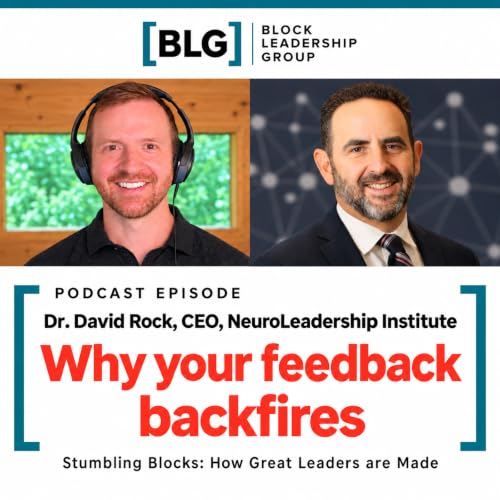
  • Dr. David Rock, CEO, NeuroLeadership Institute: Why Your Feedback Backfires
    Nov 9 2026

    Dr. David Rock has spent two decades studying what happens in the brain when we deal with other people. One finding should stop every manager cold: the more right your feedback is, the harder people fight it.

    David coined the term "neuroleadership" and co-founded the NeuroLeadership Institute, which has advised about two-thirds of the Fortune 100. His new book, Good With Humans: The Neuroscience of What Makes Us Tick and What Ticks Us Off, comes out November 17.

    We start with the research that shaped his career: Getting left out of a simple game of catch lights up the same part of the brain as physical pain. From there, David walks through his SCARF model, the five things your brain is scanning for every time you’re around other people: Status, Certainty, Autonomy, Relatedness, and Fairness.

    Then Dr. Rock gets practical. Why forcing everyone back to the office five days a week backfires, and what you can give people instead. Why the AI tools most of us use at work are quietly making conflict worse. The “SCARF death spiral” behind so many broken relationships at work and at home. And three ways to share feedback that people can actually hear.

    Pre-order Good With Humans: https://link.amazon/B083Elqm2
    NeuroLeadership Institute: https://neuroleadership.com

    Related: My conversation with Tim Creasey of Prosci on why change efforts fail: https://podcasts.apple.com/us/podcast/tim-creasey-chief-innovation-officer-prosci-how-to/id1849573843?i=1000792693011

    Chapters
    0:00:00 The more right you are, the harder they fight
    0:00:24 Introduction
    0:01:30 Why rejection hurts like physical pain
    0:06:52 The SCARF model
    0:13:32 Leading change without triggering threat
    0:16:35 Good With Humans
    0:21:12 Why AI is making workplace conflict worse
    0:23:14 The SCARF death spiral
    0:25:55 Feedback usually backfires, so do this instead
    0:32:35 How to motivate an 18-year-old, and everyone else
    0:36:43 Power, CEOs, and empathy
    0:41:32 One thing every listener should know

    #Leadership #ChangeManagement #Neuroscience #TheBrain #DrDavidRock #Leading

    Afficher plus Afficher moins
    43 min
  • Sandra Sobieraj Westfall: The Price Of Saying 'No'
    Oct 13 2026

    In 2016, a former PEOPLE reporter named Natasha Stoynoff said Donald Trump attacked her during an interview at Mar-a-Lago. Sandra Sobieraj Westfall, the Washington Bureau Chief for PEOPLE Magazine, made a business and editorial decision: She would stand by her friend and colleague. The magazine would cover the President's policies, but it would not cover his family the way it had covered every other First Family.

    This is the story of that decision and what happened next.

    Sandra Sobieraj Westfall spent six years as a White House correspondent for the Associated Press and 20 years at PEOPLE. She went to 24 White House Correspondents' Dinners, flew on Air Force One, and interviewed First Families from both parties.

    In the first of several conversations, we talk about the night a gunman tried to get into the Washington Hilton, and what Elizabeth Edwards taught her about grief.

    Content note: This episode quotes President Trump's Access Hollywood remarks about women and discusses sexual assault and may not be suitable for children. President Trump has denied Natasha Stoynoff's account.

    In this episode:

    • Where Sandra drew the line.
    • Ivanka Trump and "no hard feelings"
    • The morning the "bottom dropped out"
    • Starting over after 20 years: helping people in crisis tell their own stories

    This episode is for leaders facing a values decision with risks associated, and for anyone who has been laid off and wondered what comes next.

    Top 5 things I learned:

    1. Being right doesn't protect your job.
    2. You can lose a job without losing your dignity.
    3. You get to decide what happens next.

    Resources mentioned:

    • PEOPLE, "Physically Attacked by Donald Trump: A PEOPLE Writer's Own Harrowing Story" (Oct. 12, 2016)
    • Hillary Rodham Clinton, Something Lost, Something Gained: https://amzn.to/3TP0Ogd
    • Sandra's company, Storied Communication
    • Chapters: 0:00:00 Cold open: "We're Team Natasha"
    • 0:00:31 Introduction
    • 0:03:27 24 White House Correspondents' Dinners
    • 0:06:11 Frank, the Secret Service and the freezer
    • 0:08:02 The PEOPLE table and Rosario Dawson
    • 0:10:04 The worst flacks
    • 0:12:36 Her stumble: leaving the AP
    • 0:16:32 The decision about Trump
    • 0:17:04 Natasha Stoynoff's story
    • 0:18:58 Donald Trump's own words
    • 0:20:41 Would she do it differently?
    • 0:22:51 PEOPLE stops covering politics
    • 0:24:23 "No hard feelings"
    • 0:26:41 Laid off
    • 0:29:59 Starting over
    • 0:30:44 Helping people in crisis tell their stories
    • 0:33:30 What matters now

      #Leadership #Decisions #Tradeoffs
    Afficher plus Afficher moins
    43 min
  • Tim Creasey, Chief Innovation Officer, Prosci: How To Lead Change
    Oct 2 2026

    Tim Creasey: Chief Innovation Officer, Prosci: How to Lead Change

    Why do smart, well-run companies keep leading big changes that fail? Tim Creasey has spent 25 years at Prosci studying change management and shares the answer on this podcast.

    Tim is Chief Innovation Officer at Prosci, the research firm behind the ADKAR Model, one of the most widely used change management frameworks in the world. We talk about why change is so hard for humans, why employees resist even the changes they asked for, and what leaders have to do differently to get people to adopt AI.

    Tim also walks through the ABCs of sponsorship. Since Prosci's very first study, active and visible sponsorship has been the top contributor to change success, and Tim says it often separates the projects that succeed from the ones that fail by a three-to-one or four-to-one margin. He explains why executives can't delegate AI adoption, why AI is a new operating system rather than another tool, and why you should repeat your core message five to seven times without apologizing for it.

    In this episode:

    • The ADKAR Model in plain English: Awareness, Desire, Knowledge, Ability, Reinforcement
    • Why AI adoption is different: it showed up in our pockets before it showed up at work
    • "That's the way we've always done it" and how to lead an exhausted workforce
    • Humans in the loop, humans leading the loop, and humans drawing the loops

    For CEOs, CHROs, transformation leaders, HR leaders, and change practitioners leading digital transformation or an AI rollout.

    Top things I learned:

    1. Awareness means sharing why, not what. Telling people a change is coming is not the same as helping them understand why it matters.
    2. Executives have to use AI themselves in order for their people to follow suit. You can't lead what you haven't touched.
    3. Employees want two messengers. They want the business reasons for change from the top and the "what does this mean for me" from their direct supervisor.

    Resources mentioned:

    • Prosci ADKAR Model
    • Prosci, AI Adoption Across the Enterprise (2026)
    • Tim's ABCs of Leaving Change to Chance
    • Related episode: Shalene Gupta of Fast Company and "The Middle Manager's AI Survival Guide"

    Chapters:
    0:00:00 Cold open: the new capability era
    00:54 Introduction
    0:02:08 What the ADKAR Model is
    0:04:34 Knowledge vs. ability: the golf test
    0:05:49 Why change is so hard for humans
    0:08:03 The cubicle story
    0:09:43 Awareness: the number one source of resistance
    0:12:07 Why executives must use AI themselves
    0:14:00 AI as a digital collaborator
    0:17:01 Building a conference app in 90 minutes 0:19:26 AI started at home, not at work
    0:21:51 Prosci's benchmarking research
    0:23:16 The ABCs of sponsorship
    0:24:43 Why leaders should repeat themselves
    0:28:03 Trust and change 0:30:39 Advice for a new change leader
    0:33:11 Reallocating talent at the speed of AI
    0:34:01 Leading exhausted leaders through change

    Follow Stumbling Blocks and leave a review so other leaders can find the show. #ChangeManagement #Leadership #Transformation #Change #

    Afficher plus Afficher moins
    38 min
adbl_web_anon_alc_button_suppression_t1
Aucun commentaire pour le moment