Épisodes

  • Why Modern Movies Feel Flat | The Lost Art of Dramatic Writing
    Nov 11 2026

    Why do so many modern movies and television shows look better than ever, yet feel so flat?Have screenwriters forgotten the difference between writing a story to be read and writing a story to be performed?In this video, I explore the lost art of dramatic writing and how the growing influence of script readers may be changing the way screenplays are written.There's a fundamental difference between literary writing and dramatic writing. A novel is intended to be experienced through reading. A screenplay is intended to inspire a performance, leaving room for actors, directors, and other artists to elevate the material.But when writers become more concerned with pleasing script readers than creating compelling performances, something important can get lost between the page and the screen.Has the fierce competition for screenwriters struggling to get script readers' attention caused an increasing sacrifice of great dramatic storytelling for screenplays that are simply fun to read like a novel?What do you think? Can you name a recent movie or television show where the dramatic writing truly shines through in the performances? Share your examples in the comments.

    StoryRay.com

    Afficher plus Afficher moins
    3 min
  • Your Writing Sounds Great, But Nothing Happens
    Sep 22 2026

    Some writers are exceptionally talented at creating beautiful images with words. They can describe the perfect room, the perfect atmosphere, or the perfect sunset. But after they finish setting the scene, something still has to happen.

    I call these writers “table setters.” They arrange everything beautifully, but sometimes forget to serve the meal.

    In this video, I discuss the difference between setting a scene and actually moving a story forward, why screenwriting requires even more narrative movement than novel writing, and one simple question you can ask after every scene:

    What has changed?

    If nothing has changed narratively, you may have set the table without serving the story.

    Find me at: StoryRay.com

    Afficher plus Afficher moins
    13 min
  • The Storytelling Skill AI Can't Replace
    Sep 15 2026

    Your character isn’t just moving through a plot. They’re moving through an inner journey too.

    In this video, I explore a simple three-phase framework for thinking about a character’s spiritual development:

    Spiritual youth: realizing that life is but a dream.
    Spiritual adolescence: realizing that it isn’t just your dream, but an interconnected dream where what we do affects others.
    Spiritual maturity: realizing that eventually, all dreams must end.

    The point isn’t that every character has to pass through all three phases. Knowing where your character is can help reveal the themes already buried inside your story and help you build external conflicts that actually challenge what’s happening inside them.

    And to see how it works, I apply the framework to one of the simplest stories almost everybody knows: Goldilocks and the Three Bears. Then I take Goldilocks a little further than the original fairy tale ever did.

    Because sometimes the question isn’t just what happens to your character?

    It’s what are they spiritually ready to understand when it happens?

    Find me at: StoryRay.com

    Afficher plus Afficher moins
    19 min
  • Hollywood’s Unchecked Ego Problem
    Sep 4 2026

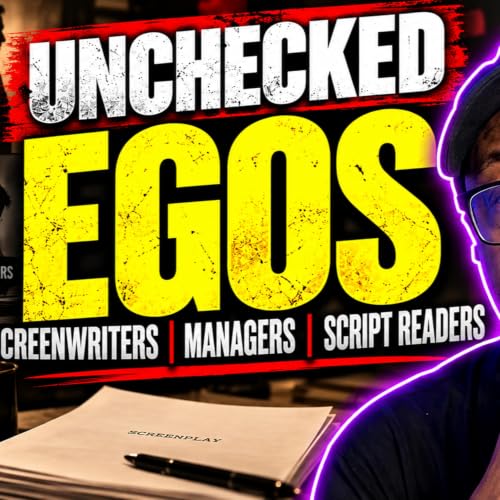
    Everybody has an ego, screenwriters included.But I believe there’s an important difference between an ego that is anchored to the work, the money, or some tangible consequence, and an ego that is anchored primarily to opinion.In this video, I continue my conversation about script-reader's outsized egos and look at another powerful gatekeeper in modern screenwriting: the manager.I talk about how representation changed around the late 1990s and early 2000s, how managers became an unofficial necessary step between writers and the industry, and how the old process of paid development increasingly gave way to writers doing rounds of speculative rewrites before anyone actually buys the script.Writers have egos. Producers have egos. Everyone involved in filmmaking has an ego.My argument is simple: if you’re going to have influence over the creative process, your ego should be anchored to something besides your opinion.

    You can find me at: StoryRay.com

    Afficher plus Afficher moins
    12 min
  • Cousy-ism: The Hollywood Trick That Makes Average Talent Look Elite
    Sep 8 2026

    Hollywood loves to celebrate the people who make it. But what happens when the system controls who gets the opportunity to compete in the first place?Let's call it Cousy-ism: when someone appears excellent compared with the competition available to them, while people with equal or greater talent are systematically excluded from competing at all.Using Bob Cousy, Jackie Robinson and the integration of professional sports as a jumping-off point, I look at the question: Does talent alone determine who gets through the door, or does the system also select for people willing and able to make themselves fit inside the smallish spaces provided for them?This isn't about tearing down the people who succeeded. It's about remembering the talented people who never got the opportunity.Nobody should have to make themselves small in order to do big things.Follow my free Substack at: Jamal Green Substack https://storyray.substack.com/Omega Conquest® - coming soon.

    Afficher plus Afficher moins
    10 min
  • Hollywood Is Selling Your Childhood Back to You
    Aug 22 2026

    When does nostalgia stop serving the story and start replacing the story?We love the movies, characters, music and worlds we grew up with. Studios know that. And increasingly, those memories have become some of the most valuable intellectual property in Hollywood.In this video, I look at nostalgia bait, endless reboots, legacy characters, the Easter Egg Economy, and why recognizing something we already love can sometimes substitute for discovering something genuinely new.The problem isn't nostalgia. Nostalgia can be powerful, emotional and fun.The problem is when it becomes the entire business model.Because every movie we’re nostalgic for today was once something audiences had never seen before.At some point, somebody still has to create the next myth.

    Find me at: StoryRay.com

    Afficher plus Afficher moins
    4 min
  • Movies That Blew My GenX Mind
    Aug 20 2026

    Some movies don’t just entertain you — they get into your creative DNA. These are a few of the movies that blew my Gen X mind and still influence the stories I tell today.From Sergio Leone’s *Once Upon a Time in the West* and *The Good, the Bad and the Ugly* to *Midnight Run*, *It’s a Mad, Mad, Mad, Mad World*, *Cannonball Run*, *Flash Gordon*, *The Last Dragon* and the original 1986 *Transformers: The Movie*, I look back at the films that stuck with me — and why.Along the way, I started noticing a recurring idea that keeps showing up in both the movies I love and my own writing: shifting alliances. Enemies become allies. Partners become adversaries. And sometimes the person who drives you absolutely crazy is also the person whose strengths perfectly complement your own.I also get into the power of music and sound, memorable movie openings, coherent action, and how some films become permanently connected to the people we first experienced them with.Basically, these are movies that blew my mind before I realized they were teaching me how I wanted to tell stories. - Part 1...Find me at: storyray.comDARIUS LOVES, a short story.

    Afficher plus Afficher moins
    15 min
  • Why Race-Swapped Characters Bother Some People
    Aug 9 2026

    Why do some people have such a difficult time accepting race-swapped or gender-swapped versions of characters they grew up loving?


    I started thinking about something deeper: people who grew up identifying with heroes who rarely looked like them may have developed a different relationship with fictional characters than people who almost always saw themselves reflected on screen.


    Maybe the negative reaction isn’t simply about racism and hate. Maybe it’s also about a limited world view created when society was inherently different. Maybe it’s nostalgia rooted in racial hierarchy? In this video I explore a possible alternative to racism and bigotry.

    This is my perspective. Let me know yours in the comments.

    Find me at: storyray.com

    Afficher plus Afficher moins
    10 min