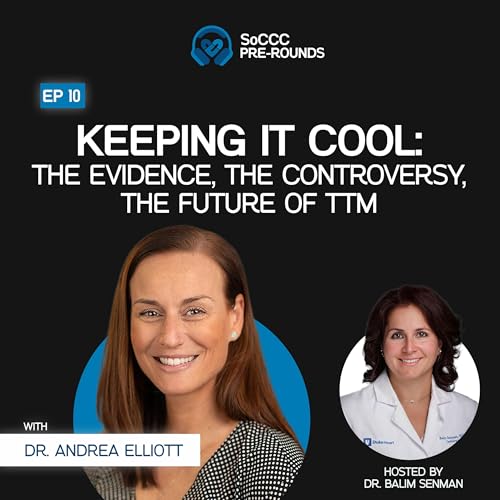
• Keeping It Cool: The Evidence, the Controversy, the Future of TTM with Dr. Andrea Elliott
    May 1 2026
    In this episode of SoCCC Pre-Rounds, Dr. Balim Senman and Dr. Andrea Elliott, a cardiologist and critical care physician at the University of Minnesota, dive into the evolving landscape of targeted temperature management (TTM) after cardiac arrest. They explore how temperature control strategies have shifted from early hypothermia trials to modern fever-avoidance methods, with ongoing debates around TTM in critical care. Dr. Elliott discusses landmark studies like Bernard, HACA, TTM, Hyperion, and TTM2, highlighting their impact and limitations.The conversation delves into the real-world application of temperature targets, considering patient severity, neurologic injury, and the unique challenges posed by ECPR patients. Dr. Elliott also covers the physiological costs of hypothermia, common complications, and practical aspects of managing shivering, devices, and protocols. Whether you're a trainee or an experienced clinician, this episode offers evidence-based insights and practical guidance for optimizing post-arrest care.TTM is for comatose survivors: Only patients who remain unresponsive after ROSC benefit; awake patients do not.Fever prevention matters most: Trial data on hypothermia vs normothermia are mixed, but fever (>37.7°C) is consistently harmful and must be aggressively avoided.One size does not fit all: Patients with longer downtimes or more severe neurologic injury may benefit more from active cooling. Allowing spontaneous hypothermia is reasonable.ECPR patients are different: Prolonged CPR and ECMO-based temperature control make them physiologically distinct from patients in major TTM trials.[00:00] Introduction[02:16] Historical background of TTM[03:13] Early human studies and mechanisms[04:17] Landmark trials Bernard and HACA[06:06] TM1 Hyperion and TM2 trials[10:25] Patient selection for TTM[11:39] Personalized temperature targeting[13:21] Management of hypothermic and normothermic patients[15:47] TTM in ECPR and ECMO patients[18:09] Drawbacks and risks of hypothermia[19:19] Protocols and cooling devices[21:59] ECPR-specific cooling techniques[16:04] "ECPR patients by definition have had refractory arrest, not attaining ROSC. So that 20- 25 minute time is blown out of the water. Our ECPR population has an average of 60 minutes of CPR time, so more than double. So the time for that neurologic injury is extensive." — Dr. Andrea Elliott[18:43] "You can actually get into trouble if with some under-resuscitation and some patients, if you get them too cold too quickly, and so you'll have to give extra volume back."— Dr. Andrea Elliott[22:37] "The most important thing is to make sure that you avoid fevers in our ECPR patients. We also use cooling towers, so we basically cool the fluid or the blood that is in the tubing outside of the patient so that it goes through a cooling bath."— Dr. Andrea ElliottBecome a member of the Community: https://www.soccc.org/subscribeDr. Andrea Elliotthttps://med.umn.edu/bio/andrea-elliotthttps://www.linkedin.com/in/andrea-elliott-5575b4267/Dr. Balim Senmanhttps://www.linkedin.com/in/balim-senman-7561436b/https://x.com/BalimSenmanMDhttps://www.soccc.org/Supported By:This episode is made possible by unrestricted support from Zoll LifeVest — thanks for keeping high-impact education free for our community.DisclaimerThis podcast is not medical advice, just candid, practical discussions about what your hosts do every day in the CICU. Always consult your supervising team and current guidelines before applying any interventions.
    Afficher plus Afficher moins
    24 min
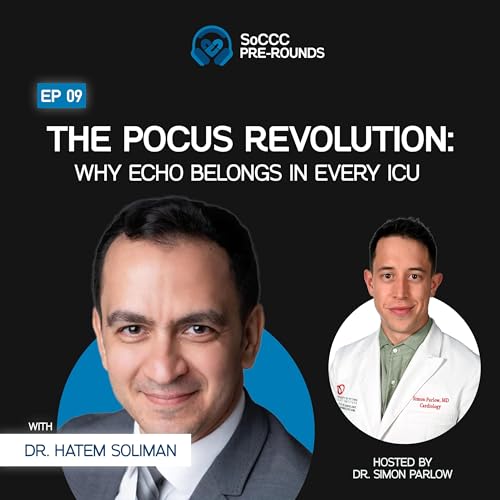
  • The POCUS Revolution: Why Echo Belongs in Every ICU with Dr. Hatem Soliman
    Apr 3 2026
    In this episode of SoCCC Pre-Rounds, Dr. Simon Parlow is joined by Dr. Hatem Soliman, a leading expert in critical care echocardiography, for a deep dive into the game-changing role of point-of-care ultrasound or POCUS in resuscitation and cardiac intensive care.Together, they unpack how resuscitative echocardiography can help identify reversible causes of cardiac arrest, like pericardial tamponade or tension pneumothorax, and even guide real-time chest compression placement to improve CPR effectiveness.Dr. Soliman highlights two must-have views: the apical five-chamber for stroke volume and the short-axis great vessels view to assess RV function and pulmonary pressures.If you're looking to sharpen your bedside skills and bring more precision to your resuscitation toolkit, this episode is packed with insights you won’t want to miss.Key TakeawaysMove beyond the IVC: Hepatic, portal, and renal vein Doppler give a clearer picture of systemic venous congestion than IVC alone.Cardiac output needs context: Doppler VTI can mislead unless combined with views like apical five-chamber and timing indices like isovolumetric contraction time.Every echo parameter has a pitfall: Never interpret one measure in isolation; always integrate findings with clinical judgment.His go-to views in shock? Apical 5 chamber (LVOT VTI) and parasternal short axis of great vessels (PA flow) to assess perfusion and RV afterload.In This Episode[00:00] Introduction to the podcast[02:24] Role of echo in cardiac arrest[03:43] Training and cautions with echo in CPR[06:19] Key skills for new trainees in critical care echo[07:33] Physiological assessment in critical care echo[09:21] Multi-organ ultrasound and venous congestion[11:45] Systemic venous congestion in post-ICU patients[12:18] Comprehensive cardiac output assessment[15:50] Pitfalls and dangers of critical care POCUS[17:18] Favorite echo views in cardiac ICUNotable Quotes[06:33] "Critical care echo is actually complex... you need to further proceed from this basic level to intermediate and then advanced levels in which you will be able to assess physiological changes in the heart." — Dr. Hatem Soliman[09:22] "The practice of multi-organ ultrasound and looking beyond the chest cavity for congestion is a very important advancement in point-of-care ultrasound." —Dr. Hatem Soliman[17:24] "If I have two views to look at in a very short time... the apical five chamber view to get the LVO TVTI because that immediately gives you a clue about stroke volume and cardiac output." — Dr. Hatem SolimanDr. Hatem SolimanDr. Hatem Soliman is a cardiac intensivist at Harefield Hospital and senior lecturer at King’s College London. He serves on the executive board of the European Association of Cardiovascular Imaging and the editorial board of JACC: Cardiovascular Imaging. A global educator and author of key POCUS textbooks, Dr. Suleiman is renowned for advancing the use of bedside echocardiography in critical care to improve hemodynamic assessment and patient outcomes.Resources and LinksBecome a member of the Community: https://www.soccc.org/subscribeDr. Hatem Solimanhttps://www.escardio.org/https://www.linkedin.com/in/hatemsoliman/Dr. Simon Parlowhttps://www.ottawaheart.ca/profile/parlow-simonMentioned Doyen A. et al. Portal Doppler Ultrasound in Congestion Assessment (André Denault’s work)JACC Imaging, Journal of Cardiovascular UltrasoundEuropean & American Resuscitation GuidelinesSupported By:This episode is made possible by unrestricted support from Zoll LifeVest — thanks for keeping high-impact education free for our community.DisclaimerThis podcast is not medical advice, just candid, practical discussions about what your hosts do every day in the CICU. Always consult your supervising team and current guidelines before applying any interventions.
    Afficher plus Afficher moins
    19 min
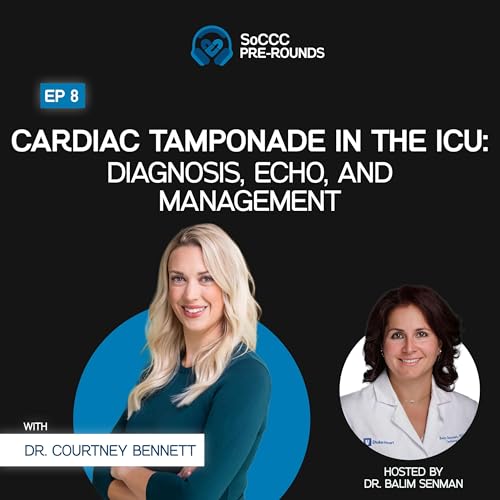
  • Cardiac Tamponade in the ICU: Diagnosis, Echo, and Management with Dr. Courtney Bennett
    Mar 6 2026
    In this episode of SoCCC Pre-Rounds, Dr. Balim Senman sits down with Dr. Courtney Bennett, a critical care cardiologist and echocardiographer at Mayo Clinic Rochester, to unpack the bedside recognition and management of cardiac tamponade. The conversation emphasizes tamponade as a clinical diagnosis, highlighting key physical exam clues such as tachycardia, hypotension, elevated JVP, pulsus paradoxus, and electrical alternans. Dr. Bennett explains the physiology of ventricular interdependence and why the rate of pericardial fluid accumulation matters more than volume alone.The episode also explores how point-of-care echocardiography supports but does not replace clinical judgment, distinguishing early findings like inflow variation from late signs such as chamber collapse. Management strategies are discussed in real-world terms, including when to urgently drain an effusion, how to stabilize patients with fluids and vasopressors while awaiting intervention, and common pitfalls like inappropriate diuresis. This episode delivers practical, high-yield guidance for clinicians managing undifferentiated shock in the cardiac ICU.Key TakeawaysTamponade is a clinical diagnosis: Pericardial effusion alone does not equal tamponade without hemodynamic compromiseTachycardia often comes first: Hypotension and shock may follow as compensation failsSmall, rapidly accumulating effusions can be fatal, while large chronic effusions may be well toleratedEcho supports, not replaces clinical judgment: Chamber collapse suggests late disease; inflow variation may signal early tamponadeDrain emergently when unstable: Approach and urgency depend on patient trajectory, not imaging aloneIn This Episode[00:00] Introduction[01:11] Definition of cardiac tamponade[01:50] Physical exam findings in tamponade[03:25] Pulsus paradoxus: definition and mechanism[04:57] Etiologies of pericardial effusion[05:43] Volume vs. hemodynamic instability[06:40] Clinical vs. echo diagnosis of tamponade[08:09] Echocardiographic findings in tamponade[10:02] Management: tamponade vs. stable effusion[12:10] Stabilizing the pre-tamponade patient[13:23] Fluid vs. diuretics in tamponadeNotable Quotes[01:28] "This is a diagnosis when a patient has pericardial effusion. So excess fluid around the heart that's causing them to have hypotension, low blood pressure, and part of that actually could be what we would describe as Beck's triad." — Dr. Courtney Bennett[12:38] "So first and foremost, I would start with IV fluid resuscitation bolus. I don't think there's a well-defined amount that we should use. 500 a liter of fluid. You have to use your clinical assessment because many of our patients may also be peripherally volume overloaded as well. But typically in this scenario, fluid is really the upfront management."— Dr. Courtney Bennett[13:48] "Sometimes I work with learners who think that because there's an excess of fluid around the heart, we should be giving diuretics. That's not the case because diuretics will decrease the preload and actually worsen the hypotension."— Dr. Courtney BennettResources and LinksBecome a member of the Community: https://www.soccc.org/subscribeDr. Courtney Bennetthttps://alumniassociation.mayo.edu/colleague-notes/courtney-bennett-d-o/Dr. Balim Senmanhttps://www.linkedin.com/in/balim-senman-7561436b/https://x.com/BalimSenmanMDhttps://www.soccc.org/Supported By:This episode is made possible by unrestricted support from Zoll LifeVest — thanks for keeping high-impact education free for our community.DisclaimerThis podcast is not medical advice, just candid, practical discussions about what your hosts do every day in the CICU. Always consult your supervising team and current guidelines before applying any interventions.
    Afficher plus Afficher moins
    15 min
  • The Basics of the Pulmonary Artery Catheter with Dr. Aniket Rali
    Feb 6 2026
    Did you know that pulmonary artery catheters are crucial for patients with unclear shock etiology? In this episode of SoCCC Pre-Rounds, Dr. Elliot Miller sits down with Dr. Aniket Rali, a dual-trained critical care and heart failure cardiologist at Vanderbilt, for a deep dive into the art and science of pulmonary artery catheterization, also known as the Swan-Ganz catheter.Dr. Rali demystifies the PAC by walking us through the fundamentals of when to use it, who should not get one, and how to interpret and troubleshoot the data it provides. Whether you're a resident inserting your first swan or a fellow refining your hemodynamic assessments, this episode will elevate your bedside practice.From contraindications and waveform recognition to zeroing, troubleshooting, and avoiding wedge-related complications, Dr. Rali shares high-impact pearls grounded in real-world CICU experience.Key TakeawaysUse PACs when shock etiology is unclear; they're diagnostic, not therapeuticAvoid PACs in patients with endocarditis, thrombus, or proximal PEKnow your waveforms; it's your only guide during bedside placementAlways level and zero the transducer for accurate pressuresJustify PAC use daily and remove once it’s no longer neededTroubleshoot waveform loss by checking positioning, clots, or tubingAvoid repeated wedging; use diastolic-to-wedge trends when possibleUse chest X-ray to confirm safe placement and prevent complicationsIn This Episode[00:00] Introduction[01:16] Pulmonary artery catheter basics[02:04] Indications for PA catheter use[06:57] Special considerations: left bundle and pacemaker leads[08:12] Bedside placement preparation and checklist[11:33] Presenting PA catheter data on rounds[12:03] Ensuring data accuracy and daily safety checks[15:17] Sequence for presenting hemodynamic data[16:23] Cardiac output measurement methods[18:31] Choosing between Fick and thermodilution[20:04] Limitations in shunt physiology[20:58] Troubleshooting PA catheter issuesNotable Quotes[02:17] "At the end of the day, a diagnostic tool is not going to treat your patient. But if it provides you with additional information that helps you reach the right diagnosis, then it becomes a valuable tool." — Dr. Aniket Rali[09:07] "I firmly believe that the more you sweat in peace, less you bleed in war. And that holds true of any procedure." — Dr. Aniket Rali[10:07] "You really should not be putting in a bedside swan unless you have mastered the waveforms, because the waveforms are your only guidance as to which cardiac chamber you are in." —Dr. Aniket Rali[12:31] "I encourage trainees, next time they have a patient with a SWAN Ganz catheter in, to just have them move their arm or move the catheter up by a foot and down by a foot and see how the pressure readings change." — Dr. Aniket Rali[27:28] "Long live the swan." — Dr. Aniket RaliDr. Aniket RaliDr. Aniket Rali is a heart failure and critical care cardiologist at Vanderbilt University. She’s known for her expertise in hemodynamics, real-world application of advanced monitoring, and thoughtful mentorship of trainees learning the art of bedside right heart catheterization.Resources and LinksBecome a member of the Community: https://www.soccc.org/subscribeDr. Aniket Ralihttps://medicine.vumc.org/department-directory/Aniket-Ralihttps://www.linkedin.com/in/aniket-rali-md-facc-fccp-69ab15228Dr. Elliot Millerhttps://x.com/ElliottMillerMDhttps://www.soccc.org/Supported By:This episode is made possible by unrestricted support from Zoll LifeVest — thanks for keeping high-impact education free for our community.DisclaimerThis podcast is not medical advice, just candid, practical discussions about what your hosts do every day in the CICU. Always consult your supervising team and current guidelines before applying any interventions.
    Afficher plus Afficher moins
    28 min
  • Navigating the Initial Hours of Cardiogenic Shock with Dr. Rebecca Mathew
    Jan 2 2026
    How do you diagnose cardiogenic shock quickly and accurately at the bedside? What should your first therapeutic move be? And how do you know if your resuscitation is working?In this episode of SoCCC Pre-Rounds, Dr. Simon Parlow sits down with Dr. Rebecca Mathew, Director of the Cardiac ICU at the University of Ottawa Heart Institute and co-principal investigator of the CAPITAL Research Group. Together, they break down a clear, real-world approach to diagnosing, stabilizing, and treating cardiogenic shock from the moment the patient arrives.Drawing from frontline CICU experience and landmark trials such as CAPITAL DOREMI, Dr. Mathew discusses why history and physical exam still drive the diagnosis, how to approach congestion and perfusion, when inotropes actually help, and how to integrate invasive hemodynamics when available. The episode offers practical, bedside-ready guidance for clinicians managing shock in any setting.Key TakeawaysCardiogenic shock is best diagnosed through history, exam, and perfusion assessment, not lactate or invasive data alone.SCAI is the most practical framework, but Stage D should be assigned only after a failed therapeutic trial.Use inotropes only if hypoperfusion persists after decongestion; dobutamine quickly shows responsiveness.Swan-Ganz catheters help when available, but most shock worldwide is managed without invasive hemodynamics.Avoid early prognostication in the first 24–48 hours to prevent harmful self-fulfilling assumptions.In This Episode[00:00] Introduction [01:06] Importance of initial medical management in cardiogenic shock[02:53] Defining cardiogenic shock and SCAI classification[05:27] Phenotypes and subtypes of cardiogenic shock[07:23] Caveats in SCAI classification[07:49] Bedside diagnosis and risk stratification[09:53] Physical exam: hyperperfusion and congestion[11:54] Initial management approach: decongestion and inotropes[14:17] Therapeutic targets and monitoring response[15:24] Inotrope selection and individualized therapy[16:55] Ongoing research and future directions[17:55] Therapeutic targets: clinical and biochemical markers[19:47] Mean arterial pressure (MAP) targets[21:01] Prognostic factors and risk scoresNotable Quotes[03:21] “I think in its most basic sense, I think of cardiogenic shock as a clinical syndrome of clinical and biochemical hyper perfusion that’s due to a primary cardiac disorder.” — Dr. Rebecca [15:48] “People often ask me what inotrope I reach for, and despite having done the DoReMi trial and proving there’s no difference, I am anecdotally a big believer in dobutamine.” - Dr. Rebecca [22:10] “Once you’re in the throes of shock, I think we just need to focus on the tsunami in front of us and manage that.”[23:26] “The most exciting thing about cardiac critical care and managing cardiogenic shock is you are basically seeing physiology in real time." — Dr. RebeccaDr. Rebecca MathewDr. Rebecca Mathew is a critical care cardiologist and Director of the Cardiac ICU at the University of Ottawa Heart Institute. She leads major cardiogenic shock research programs, including the CAPITAL DOREMI trial published in the New England Journal of Medicine and the ongoing CAPI2 trial focused on early inotrope strategies. Her work spans clinical care, trial leadership, and translational shock physiology.Resources and LinksBecome a member of the Community: https://www.soccc.org/subscribeDr. Rebecca Mathewhttps://www.ottawaheart.ca/profile/mathew-rebeccaDr. Simon Parlowhttps://www.ottawaheart.ca/profile/parlow-simonhttps://www.soccc.org/Supported By:This episode is made possible by unrestricted support from Zoll LifeVest — thanks for keeping high-impact education free for our community.DisclaimerThis podcast is not medical advice, just candid, practical discussions about what your hosts do every day in the CICU. Always consult your supervising team and current guidelines before applying any interventions.
    Afficher plus Afficher moins
    26 min
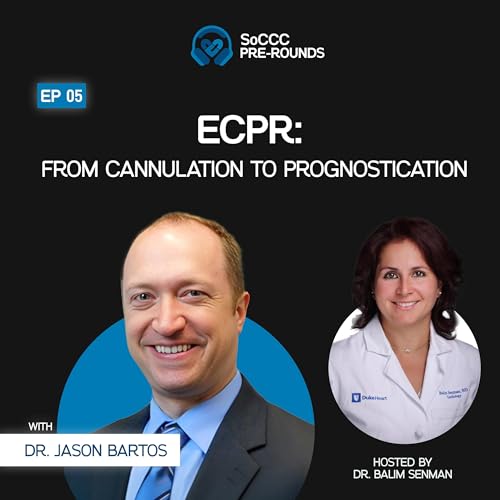
  • ECPR: From Cannulation to Prognostication with Dr. Jason Bartos
    Dec 5 2025
    Should we be using ECMO during cardiac arrest? In this episode of SoCCC Pre-Rounds, Dr. Balim Senman sits down with Dr. Jason Bartos, interventional and critical care cardiologist at the University of Minnesota and one of the nation’s leading voices on extracorporeal cardiopulmonary resuscitation (ECPR). Together, they break down when and why to consider ECMO in cardiac arrest, the patient selection puzzle, and what truly impacts outcomes in the field.Dr. Bartos shares pearls from the ARREST trial and offers hard-won insights into what it takes to build an ECPR program that saves lives from timing and volume to sedation, TTM, and neuroprognostication. Whether you’re a trainee encountering ECPR for the first time or a team leader building a resuscitation program, this episode delivers essential guidance grounded in real-world experience.Key TakeawaysECPR = ECMO during or shortly after cardiac arrest; best for patients with witnessed arrest and refractory shockable rhythmsAvoid ECPR in patients with poor baseline function, irreversible comorbidities, or prohibitive vascular anatomyOutcomes depend on systems: high-volume centers, early activation, and streamlined protocols improve survivalDon’t oversedate; sedation is not required for ECMO; prioritize comfort and cannula safetyUse 37°C TTM with aggressive fever prevention; ECMO allows precise temperature controlNeuroprognostication takes time; wait beyond 72 hours, and don’t withdraw care too early some patients recover even after 30 daysIn This Episode[00:00] Introduction[00:45] Episode introduction & guest welcome[01:25] What is ECPR?[02:14] Rationale and data behind ECPR[03:13] Key ECPR trials and outcomes[08:56] ECPR patient selection & center volume[10:15] Selection criteria details[13:06] Absolute and relative contraindications[15:11] In-hospital ECPR activation & information gathering[16:21] Standardizing in-hospital ECPR response[18:22] Timing and team mobilization for ECR[19:56] Post-ECMO management: sedation & temperature[21:40] Sedation practices on ECMO[23:28] Temperature management evolution[25:29] Neuroprognostication after ECPR[29:13] Early predictors of poor neurological outcomeNotable Quotes[01:34] "ECPR is extracorporeal cardiopulmonary resuscitation. It's the use of ECMO for patients with cardiac arrest." — Dr. Jason Bartos[25:40] "The danger to the patients in the ICU post-arrest is us. We really have the task of trying to determine and predict and inform family members of how their loved one is going to do in this worst circumstance of their life." — Dr. Jason Bartos[25:29] "Neuroprognostication is near and dear to my heart, partly because I think it's honestly the most important thing we do in the ICU for any post-arrest patient, but particularly for this population." — Dr. Jason BartosDr. Jason BartosDr. Jason Bartos is an interventional and critical care cardiologist at the University of Minnesota. He leads one of the nation’s highest-volume ECPR programs and is a founding member of the Center for Resuscitation Medicine. He is nationally recognized for his leadership in post-arrest care, real-world ECMO implementation, and advancing cardiac arrest science.Resources and LinksBecome a member of the Community: https://www.soccc.org/subscribeDr. Jason Bartoshttps://med.umn.edu/bio/jason-bartoshttps://www.linkedin.com/in/jason-bartos-b6898441Dr. Balim Senmanhttps://www.linkedin.com/in/balim-senman-7561436b/https://x.com/BalimSenmanMDhttps://www.soccc.org/Supported By:This episode is made possible by unrestricted support from Zoll LifeVest — thanks for keeping high-impact education free for our community.DisclaimerThis podcast is not medical advice, just candid, practical discussions about what your hosts do every day in the CICU. Always consult your supervising team and current guidelines before applying any interventions.
    Afficher plus Afficher moins
    32 min
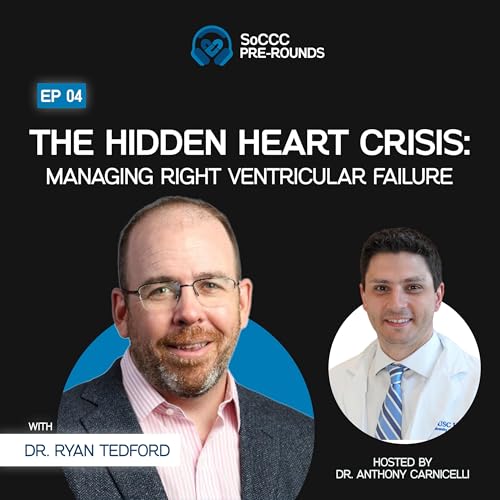
  • The Hidden Heart Crisis: Managing Right Ventricular Failure with Dr. Ryan Tedford
    Nov 7 2025
    In this episode, Dr. Anthony Carnicelli sits down with Dr. Ryan Tedford, a top expert on right ventricular (RV) failure, to break down everything you need to know about this tricky condition. RV failure happens when the right side of the heart struggles to pump properly, messing with blood flow through the lungs and raising pressure in the veins. It shows up in a bunch of serious illnesses like pulmonary hypertension, left heart failure, and sepsis.Dr. Tedford walks us through how to spot RV failure using key measurements from right heart catheterization, like right atrial pressure and the pulmonary artery pulsatility index (PAPi).He also shares a simple, practical approach to managing RV failure: avoid overloading the heart with fluids, lower the pressure, the right heart has to pump against with pulmonary vasodilators, and boost its strength with inotropes like dobutamine. And when things get really serious, mechanical support might be needed. The good news? The right ventricle is pretty resilient, and with the right care, patients can bounce back.Key TakeawaysRV failure is a clinical syndrome due to dysfunction in any part of the right heart circulatory system, not just the RV itself.Don't skip hemodynamics: Right heart cath data is essential to distinguish RV from LV failure and guide therapy.Afterload reduction strategies include managing left-sided filling pressures and careful ventilator settings (avoid high PEEP and hyperinflation).The RV is more resilient than we think with the right therapy, recovery is often possible, even in severe cases.In This Episode[00:00] Introduction[01:39] Defining right ventricular failure[02:14] Importance of the right heart in critical care[03:57] Role of hemodynamic evaluation[04:12] Key hemodynamic metrics for RV failure[05:19] Echo vs. hemodynamics in RV failure[08:01] Treatment strategies: preload, afterload, and contractility[10:04] Avoiding hypotension and ischemia[11:16] Stepwise vs. immediate mechanical support[12:07] Prognosis and recovery of RV failure[13:50] Closing remarks and takeawaysNotable Quotes[02:02] "Although the RV is one of the biggest and perhaps most important components of the right heart circulatory system, actually any part of the right heart circulatory system can contribute to overall right heart failure." — Dr. Ryan Tedford[02:43] "If you go back, you know, 30 years or 80 years, in fact, the right heart has been largely ignored." — Dr. Ryan Tedford[04:04] "A comprehensive hemodynamic evaluation is really key. And I would say you really can't get it right without the right heart catheterization." — Dr. Ryan TedfordDr. Ryan TedfordDr. Tedford is a Professor of Medicine/Cardiology and holds the Dr. Peter C. Gazes Endowed Chair in Heart Failure at the Medical University of South Carolina (MUSC). He directs the Advanced Heart Failure and Transplant Fellowship and serves as the section head of heart failure and medical director of cardiac transplantation. An internationally recognized researcher with over 200 publications, his work focuses on right ventricular function, pulmonary hypertension, and hemodynamics.Resources and LinksBecome a member of the Community: https://www.soccc.org/subscribeDr. Ryan Tedfordhttps://www.linkedin.com/in/ryan-tedford-7163aa6/Dr. Anthony Carnicellihttps://www.soccc.org/https://www.linkedin.com/in/anthony-carnicelli-926a0b88/Mentioned Pragmatic approach to temporary mechanical circulatory support in acute right ventricular failure by Dr. Anthony CarnicelliSupported By:This episode is made possible by unrestricted support from Zoll LifeVest — thanks for keeping high-impact education free for our community.DisclaimerThis podcast is not medical advice, just candid, practical discussions about what your hosts do every day in the CICU. Always consult your supervising team and current guidelines before applying any interventions.
    Afficher plus Afficher moins
    15 min
  • Post-Cath Instability: Rapid Evaluation and Management in the ICU
    Oct 3 2025
    What do you do when a patient returns from the cath lab hypotensive and unstable? In this episode of SoCCC Pre-Rounds, critical care cardiologists Dr. Ann Gage and Dr. Zach Il'Giovine join host Dr. Elliott Miller to break down the management of post-catheterization hypotensive emergencies. This conversation delves into rapid assessment, differential diagnosis, and life-saving interventions in the acute care setting.The experts emphasize the importance of taking a moment to gather context before rushing to the bedside. Was it a PCI, EP study, or structural intervention? This pause allows for a more focused differential diagnosis, covering complications such as vascular issues (groin hematoma, retroperitoneal bleed), cardiac tamponade, and acute stent thrombosis. A standout takeaway: manual pressure is your first-line tool for managing bleeding, and don’t hesitate to call the proceduralist early. They also highlight when to order a CT scan (pro-tip: non-contrast first) and the principles behind massive transfusion protocols.This episode offers actionable insights for handling hypotensive emergencies with confidence and precision. Key TakeawaysBuild a differential based on the cath details: arterial, venous, pericardial?Retroperitoneal bleed is high on the list for sudden post-cath hypertension.First move: Is the patient in extremis? If yes, act. If not, think.Groin pain or back pain? Start with pressure and basic labs.For massive bleeds: use balanced transfusions and proper IV access.Most important treatment for groin bleeds? Manual pressure.In This Episode[00:00] Introduction[00:56] Meet the guests: Dr. Ann Gage and Zach Il'Giovine[02:09] Gathering info before seeing post-cath patient[03:46] Building the differential diagnosis[08:13] Physical exam and bedside assessment[09:57] Hemodynamic assessment and initial workup[16:00] Massive hemorrhage and transfusion protocols[17:05] Procedural complications and communication[19:55] Manual pressure crucial for groin bleeds[21:11] Conclusion and take-home messagesNotable Quotes[04:06] "I was told once by a medicine resident that if you were a good resident, you would have two or three things on your differential, but if you were great, you would appear at the bedside with at least 10 things on your differential." — Dr. Ann[00:13:55] "Nothing really makes me madder than coming in the morning and seeing that the residents gave contrast to ten people, when if you've got a hemodynamically significant bleed, you do not need contrast." — Dr. Elliott[00:20:53] "On more than one occasion, manual pressure has saved lives." — Dr. Zach Dr. Ann GageDr. Ann Gage is a critical care and interventional cardiologist at Centennial Heart in Nashville. She bridges the cath lab and CICU with expertise in both patient care and procedural nuance.Dr. Zach Il'GiovineDr. Zach Il'Giovine is a heart failure and critical care cardiologist at Centennial Heart. He focuses on managing complex ICU patients, procedural complications, and bridging multidisciplinary care.Resources and LinksBecome a member of the Community: https://www.soccc.org/subscribeDr. Ann Gage https://centennialheart.com/https://www.linkedin.com/in/ann-gage-b7036831https://x.com/anngagemd?lang=enDr. Zach IlGiovinehttps://centennialheart.com/https://www.linkedin.com/in/zachary-il-giovinehttps://x.com/zilgiovinemd?lang=enDr. Elliott Millerhttps://x.com/ElliottMillerMDhttps://www.soccc.org/Supported By:This episode is made possible by unrestricted support from Zoll LifeVest — thanks for keeping high-impact education free for our community.DisclaimerThis podcast is not medical advice, just candid, practical discussions about what your hosts do every day in the CICU. Always consult your supervising team and current guidelines before applying any interventions.
    Afficher plus Afficher moins
    22 min