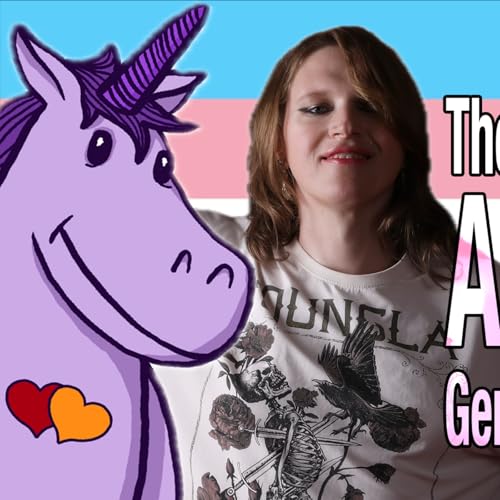
Couverture de Ruby RaeD

Ruby RaeD

Ruby RaeD

De : Ruby Rae Durand
Écouter gratuitement

Offres de saison | 0,99 € par mois pendant les 3 premiers mois

5,99 €/mois par la suite. Des conditions s’appliquent. Annulation mensuelle possible.

Welcome to Ruby RaeD, a podcast about identity, transformation, and the realities we don’t always say out loud.

Hosted by Ruby Rae, this channel explores personal storytelling, transgender experiences, relationships, and the deeper psychological and social layers that shape who we are.

Some episodes are raw and reflective. Others break down complex topics around identity, perception, and cultural narratives.

This is a space for honesty, curiosity, and perspective.

If you have ever questioned who you are, who you are allowed to be, or what it means to live authentically, you are in the right place.

This is Ruby RaeD.

Watch the VODS on youtube @RubyRaeD or find me on Instagram @heatfromfire

Ruby Rae Durand
Sciences sociales
Épisodes
  • Rabbit Hole: The History of Vaginoplasty and the Sensate Clitoris
    Oct 13 2026

    “There is no clitoris as yet.”

    One sentence in the May 1972 edition of Sisters, a lesbian magazine, sent me down a medical-history rabbit hole. I thought it couldn’t be right. Then I started digging, for days.

    Join Ruby Rae for a journey through the development of vaginoplasty, clitoral reconstruction and the preservation of sensation. From early attempts to create a vaginal canal to skin grafts, bowel techniques, peritoneal flaps and robotic surgery, this history reaches far beyond trans healthcare.

    We explore the connections between reconstruction for cisgender women, intersex patients and trans women; the doctors and patients behind major milestones; and how surgical knowledge develops through shared discoveries and repeated refinement.

    Along the way: • Ancient accounts of Elagabalus and the limits of historical evidence. • Early vaginal reconstruction, tissue lining and the challenge of stenosis. • Magnus Hirschfeld’s Institute for Sexual Science, Dora Richter and Lili Elbe. • The Nazi destruction of the Institute and its archives. • Penile-inversion techniques and the development of a sensate neoclitoris. • Nerve preservation, blood supply and the relationship between anatomy and sexual function. • Developments in Thailand, South Africa and other surgical centres. • Tissue engineering, robotic peritoneal techniques and patient-selected vulvoplasty.

    At the centre is the question that started everything: when did surgeons develop the modern sensate neoclitoris—and what did that 1972 sentence actually mean?

    This episode follows major milestones in the development of medical procedures. It is not an exhaustive catalogue of every operation or advancement, nor an attempt to identify the first trans patient.

    RESEARCH & CREDIT Special thanks to Zagria’s A Gender Variance Who’s Who, whose extensive trans-history research helped launch this investigation: https://zagria.blogspot.com/

    The History of Gender-Affirming Vaginoplasty Technique: https://pubmed.ncbi.nlm.nih.gov/35461915/

    Tissue Options for Construction of the Neovaginal Canal: https://pmc.ncbi.nlm.nih.gov/articles/PMC11122258/

    CONTENT NOTE Historical derogatory language and outdated medical terminology; genital anatomy and reconstructive surgery; complications and death; transphobia, antisemitism, Nazi persecution and book burning; brief discussion of female genital mutilation and non-consensual genital surgery. The video version may also include medical imagery.

    This episode explores medical history and is not individual medical advice. Surgery is not a requirement for being transgender.

    CONTINUE THE CONVERSATION Which discovery surprised you most? Follow Ruby Rae for more trans history, commentary and unexpected rabbit holes.

    Website: https://rubyraed.com Instagram: https://www.instagram.com/firefromheat/ TikTok: https://www.tiktok.com/@heatfromfire

    #TransHistory #Vaginoplasty #MedicalHistory #Transgender #GenderAffirmingCare

    Afficher plus Afficher moins
    25 min
  • On Parental Communication: Respect, Boundaries, and When “Love” Isn’t Enough
    Oct 6 2026

    In this late-night RubyRaeD reflection, Rae unpacks a thought sparked by a recent conversation on the Kaleidoscope podcast and explores something painfully common in LGBTQ+ families: the collision between a parent's pre-existing beliefs and the reality of the person they already love.

    When a child comes out as trans, some parents find themselves forced to reconcile two incompatible ideas: the belief that transgender people are somehow wrong, strange, or broken, and the knowledge that their child is still the same person they have always known and loved.

    Sometimes, instead of reconsidering the belief, the parent tries to preserve it.

    That can sound like:

    “I still love you, but I won't use that name.”

    “I accept that this is your decision, but I don't agree with it.”

    “I'll always be your parent, but I won't participate in this.”

    But respect isn't an optional extra in a relationship.

    Rae talks about how refusing to acknowledge someone's identity can become a way of denying their agency, particularly when an adult child is infantilised because a parent believes they still have greater authority over who that person is.

    The episode also challenges the seemingly peaceful advice to simply “let them.”

    Let them misgender you.

    Let them use your old name.

    Let them out you in public.

    Let them reshape how strangers understand you.

    Let them repeatedly reopen the same wound.

    At some point, protecting a relationship cannot mean endlessly absorbing disrespect.

    And when a transgender person has asked for distance, there is another boundary that deserves to be respected: silence.

    If you cannot yet approach your trans child, friend, or family member with genuine respect, sometimes the kindest thing you can do is leave them alone until you can.

    In this episode

    Rae discusses:

    • Why parents of LGBTQ+ and transgender children sometimes become alienated from their own children
    • The conflict between deeply held beliefs and personal relationships
    • Why “I love you, but I don't respect your identity” is not a neutral position
    • Infantilisation and the denial of an adult child's agency
    • Why deadnaming and outing someone can have consequences beyond hurt feelings
    • The problem with telling trans people to simply “let them”
    • Setting boundaries with unsupportive family members
    • Why financial support should never be used as leverage for access
    • When no contact or limited contact may be the healthiest available boundary
    • The difference between wanting reconciliation and being ready to reconcile

    Episode chapters

    00:00 - Late Night Check-In

    00:17 - The Conversation That Started This

    01:14 - Parents, Trans Children, and Conflicting Beliefs

    02:13 - How Alienation Happens

    04:05 - Stop Infantilising Adult Children

    05:10 - The Problem With “Just Let Them” 06:51 - Grace or Silence

    08:14 - What Should a Parent Do When Their Trans Child Doesn't Want Contact?

    09:17 - Closing Thoughts

    This RubyRaeD episode is personal, unscripted, and shaped by Rae's own experiences alongside conversations with other LGBTQ+ people.

    Sometimes reconciliation is possible.

    But reconciliation requires more than saying I love you.

    It requires being willing to say:

    I see who you are. I will listen when you tell me who you are. And I will respect you accordingly.

    #Transgender #TransWoman #TransFamily #LGBTQ #TransRights #FamilyEstrangement #ComingOut #TransgenderStories #RubyRaeD #TransPodcast

    Afficher plus Afficher moins
    10 min
  • Exploring Gender Mapping
    May 5 2026

    What if everything you thought about gender… was just one version of the story?

    In this episode, Rae explores the concept of gender mapping — how different cultures, histories, and systems have understood gender across time — and why the modern Western binary is only one small piece of a much bigger picture.

    Drawing from Dr. Eli Erlick’s work and the development of the Gender Unicorn, Rae unpacks:

    • What gender mapping actually is
    • How cultures around the world have recognized gender diversity for centuries
    • Why modern understandings of gender are shaped by colonial and religious frameworks
    • The evolution of gender models from early medical theories to today
    • How tools like the Gender Unicorn can make gender more understandable and accessible

    But this isn’t just theory.

    Rae also walks through real-life examples, including her own personal gender map, showing how identity, expression, biology, and attraction don’t always align in the ways we’ve been taught to expect.

    At its core, this episode is about introspection, understanding, and expanding the way we see each other.

    Because gender isn’t something new. It’s something we’re finally learning how to see.

    🔗 Follow Rae

    Instagram: @firefromheat TikTok: @heatfromfire YouTube: RubyRaeD

    Afficher plus Afficher moins
    16 min
adbl_web_anon_alc_button_suppression_t1
Aucun commentaire pour le moment