Épisodes

  • Episode 129: How Digital Avatars Streamline High Couture
    Oct 30 2026

    Send us Fan Mail

    In this deep dive, we explore how AI models are streamlining the way couture is made.

    Support the show

    Afficher plus Afficher moins
    19 min
  • Episode 128: Spectral AI for Authenticating Luxury Fibers
    Oct 30 2026

    Send us Fan Mail

    Spectral AI technology enables the non-destructive authentication and sorting of raw-material intake for luxury fibers like cashmere and vicuña before processing begins. By utilizing near-infrared and Raman spectroscopy, intake teams can quickly measure molecular properties to evaluate quality, fineness, and purity without altering the fleece. Machine-learning classifiers analyze these spectral readings against verified reference data to spot anomalies, detect synthetic dilution, and support regional sourcing claims. However, because environmental factors and overlapping signatures can create uncertainty, these automated readings function as preliminary screening signals rather than definitive proof. Ultimately, integrating tamper-resistant records and proper validation ensures that spectral screening enhances supply chain transparency while still requiring human oversight and traditional laboratory confirmation.

    Support the show

    Afficher plus Afficher moins
    22 min
  • Episode 127: The Rise of AI Models in High Fashion
    Oct 28 2026

    Send us Fan Mail

    This pod examines how artificial intelligence models are reshaping the fashion industry by offering unprecedented versatility in concept testing, visual consistency, and early-stage casting. While these synthetic figures provide immense creative freedom, the author emphasizes that they require thoughtfully constructed digital identities rather than acting as mere automated shortcuts. Furthermore, the text stresses that technology cannot fully replicate the lived experience, physical movement, and emotional depth brought by human talent. To navigate this shift responsibly, the industry must establish clear standards regarding consent, fair financial compensation, and audience transparency. Ultimately, the future of fashion depends on balancing technological efficiency with strong creative direction and ethical accountability.

    Support the show

    Afficher plus Afficher moins
    21 min
  • Beyond the Static Catalog: Virtual Try-On and Digital Fashion
    Oct 26 2026

    Send us Fan Mail

    Noir Starr Models explores how dynamic virtual try-on technology and AI-generated digital personas are transforming online fashion retail beyond traditional static catalogs. This approach allows shoppers to visualize clothing on diverse body types and explore styling combinations, while helping brands reduce the logistical costs and time associated with repeated physical photo shoots. However, the sources emphasize that these digital simulations are styling previews rather than guaranteed fit indicators, meaning accurate sizing still relies on physical samples and proper measurements. To maintain customer trust, brands must transparently disclose when imagery is synthetic, ensure fair representation without bias, and clearly communicate the limitations of virtual visualizations. Ultimately, combining these innovative digital tools with traditional product photography creates a more inclusive, flexible, and engaging shopping experience.

    Support the show

    Afficher plus Afficher moins
    21 min
  • Episode 126: Adaptive Vision and Smarter Leather Cutting
    Oct 26 2026

    Send us Fan Mail


    Working with full-grain leather presents unique manufacturing challenges because each natural hide contains individual variations like scars and wrinkles that manual grading struggles to process consistently. To address these inefficiencies, advanced production methods utilize multi-angle imaging to map surface textures and identify natural flaws before any material is sliced. Specialized nesting software then analyzes this digital map to place pattern pieces intelligently, ensuring that premium sections occupy visible areas while structural components utilize secondary zones. By adapting layouts to the specific contours of each material, manufacturers can significantly reduce waste and increase usable yields without sacrificing product quality. Successfully integrating this technology requires careful baseline tracking, equipment compatibility, and thorough staff training to oversee automated recommendations. Ultimately, combining innovative surface scanning with experienced human oversight allows producers to maximize the value of expensive hides while preserving the authentic character customers expect.

    Support the show

    Afficher plus Afficher moins
    19 min
  • Beyond the Digital Drape
    Oct 23 2026

    Send us Fan Mail


    The provided source explores how synthetic fit validation uses physics-based simulation and digital body scans to evaluate clothing comfort and mobility before physical production begins. By testing garments across dynamic movements like walking and reaching, the software can generate pressure maps and strain visualizations that reveal hidden binding or tension points. This digital approach allows designers to analyze varied body shapes and refine patterns proactively, which significantly reduces the need for multiple physical samples. Ultimately, virtual fit assessment functions as a powerful decision-support tool that streamlines the pre-production workflow, though physical verification remains essential for assessing real-world fabric behavior.

    Support the show

    Afficher plus Afficher moins
    18 min
  • Edge AI Recreates Handcrafted Saddle Stitching in Luxury Leather Goods
    Oct 21 2026

    Send us Fan Mail

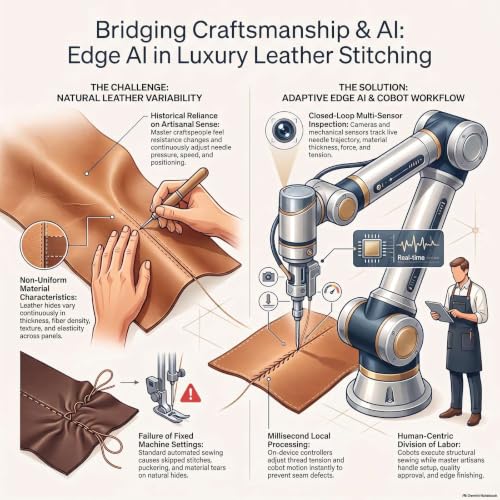
    Automating traditional double-needle saddle stitching in luxury leather goods has historically been difficult because premium hides naturally feature inconsistent thickness, texture, and elasticity. Unlike manufactured textiles that allow for stable mechanical settings, natural leather requires constant, real-time adjustments to prevent defects and ensure structural integrity. Edge AI vision and collaborative robotics solve this challenge by using high-speed optical sensors and mechanical feedback to evaluate local material resistance on the fly. This advanced technology processes data locally at millisecond speeds, allowing the system to dynamically adjust thread tension, needle timing, and feeding velocity. By mimicking the adaptive sensitivity of master artisans, cobot-assisted stitching preserves the unique visual rhythm and natural character of handcrafted leather goods. Ultimately, this approach empowers luxury workshops to improve production repeatability and reduce waste while allowing human craftsmen to focus on high-touch finishing and design.

    Support the show

    Afficher plus Afficher moins
    20 min
  • AI Persona Swarms in Luxury Assortment Decision
    Oct 19 2026

    Send us Fan Mail


    AI Persona Swarms in Luxury Assortment Decision

    Luxury fashion brands are increasingly utilizing multi-agent persona swarms powered by artificial intelligence to evaluate prospective clothing collections before finalizing large-scale production or wholesale agreements. These autonomous agent ecosystems simulate diverse groups of prospective buyers across various global locations, factoring in variables like purchasing habits, lifestyle preferences, and spending capacities to stress-test merchandising decisions. By analyzing simulated responses regarding price points, regional vulnerabilities, and potential cannibalization, merchandising teams can uncover hidden risks and refine their product offerings early in the design cycle. This technology does not replace human creativity, physical evaluation, or direct client research, but rather provides a structured simulation environment to protect commercial resources and preserve brand equity. Establishing credible models requires strict data governance, ongoing calibration against real-world evidence, and continuous human oversight to prevent bias and maintain creative innovation.

    Support the show

    Afficher plus Afficher moins
    19 min