Épisodes

  • Episode 271: The Financial Blind Spots Holding You Back
    Oct 21 2026

    Making more money doesn't automatically create wealth. The real difference comes from knowing how to keep it, plan for it, and use it to build the future you actually want.

    In this episode of the Registered Investment Advisor Podcast, Seth Greene interviews Rebecca Irey, Founder of Blue Skye Financial and Certified Financial Fiduciary®, who shares how her personal experiences with financial uncertainty shaped her mission to help women and families become more confident and informed about money. She explains why financial planning should be based on real-life circumstances rather than ideal scenarios, how proactive tax planning can change future outcomes, and why retirement planning should address potential tax increases well before required minimum distributions begin. Rebecca also discusses building a virtual family office by coordinating financial, tax, and legal professionals and emphasizes the importance of trusting yourself to take an active role in your financial future.

    Key Takeaways:

    → Financial planning should focus on the person and their goals rather than the amount of money in their account.

    → Building a strong financial foundation requires planning beyond simply paying off debt and maintaining an emergency fund.

    → Financial blind spots can include assuming there will always be more time to address important financial decisions.

    → Women can benefit from becoming more confident and actively involved in managing their financial futures.

    → Earning more money does not necessarily create wealth if spending continues to rise with income.

    Rebecca Irey is the founder of Blue Skye Financial and a Certified Financial Fiduciary® dedicated to empowering women to make smarter, more intentional decisions about their money. She specializes in retirement and life design, tax-efficient wealth strategies, and helping women and families move from financial uncertainty to confidence and action.

    Connect With Rebecca:

    Website: https://blueskyefinancial.com/

    Facebook: https://www.facebook.com/blueskyefinancial/

    X: https://x.com/blueskyewealth

    Afficher plus Afficher moins
    15 min
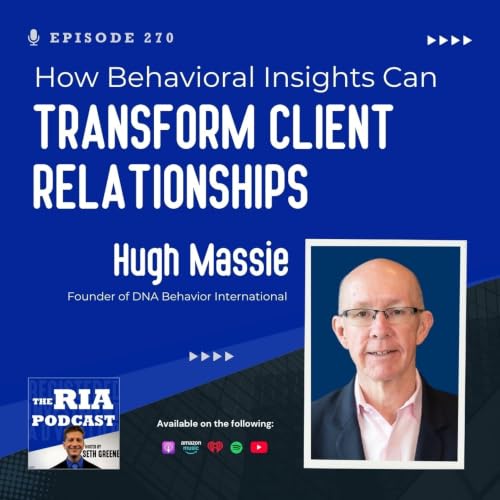
  • Episode 270: How Behavioral Insights Can Transform Client Relationships
    Oct 14 2026

    What if financial advisors could understand how a prospect thinks, makes decisions, and responds to money before the first meeting even begins?

    In this episode of the Registered Investment Advisor Podcast, Seth Greene interviews Hugh Massie, Founder of DNA Behavior International, who explains how behavioral insights can help financial advisors understand clients beyond their assets and financial circumstances. He shares how psychometric assessments and AI-powered digital scans can uncover decision-making tendencies, communication preferences, and money behaviors that advisors can use to personalize client interactions and improve prospect conversion. Hugh also discusses using behavioral data to match prospects with the right advisor, create warmer first meetings, and build more personalized long-term client relationships.

    Key Takeaways:

    → Understanding a client’s behavior and relationship with money can help advisors create a more personalized experience.

    → DNA Behavior’s assessment uses behavioral data to identify tendencies such as saving habits, emotional responses under pressure, mental accounting, and decision biases.

    → AI-powered digital scans can create behavioral profiles from publicly available information before a prospect meets with an advisor.

    → Advisors can use behavioral profiles to better understand their own decision-making styles and how they work with clients.

    → Behavioral insights can help advisory teams bring complementary perspectives into client meetings rather than relying on a single advisor’s communication style.

    A Titan 100 CEO, Behavioral Solutions Architect, and Behavioral Economics Pioneer, Hugh helps leaders build people-centric businesses by using behavioral data, AI-driven technology, and personalized insights to improve decision-making, culture, performance, and financial behavior.

    Connect With Hugh:

    Website: https://www.hughmassie.com/

    https://dnabehavior.com/

    https://www.godna.ai/

    Instagram: https://www.instagram.com/dnabehavior/

    LinkedIn: https://www.linkedin.com/in/hughmassie/

    YouTube: https://www.youtube.com/@DNABehavior

    https://www.youtube.com/@BehavioralEconomicsToday

    Afficher plus Afficher moins
    14 min
  • Episode 269: The Hidden Benefits of Private Placement Life Insurance
    Oct 7 2026

    What if there was a wealth strategy designed to help high-net-worth individuals grow assets more efficiently, reduce taxes, and create a more powerful legacy plan?

    In this episode of the Registered Investment Advisor Podcast, Seth Greene interviews Michael Malloy, CLU, TEP, RFC, Founder & Chief Advisor of EWP Financial, who explains how private placement life insurance (PPLI) works and why it has become an advanced planning strategy for high-net-worth individuals and families. He shares how PPLI combines tax planning, estate planning, and investment strategies to help clients pursue tax-efficient growth and generational wealth transfer. Michael also discusses who PPLI is designed for, why clients should understand the strategy before implementing it, and how educated clients can determine whether it aligns with their financial goals.

    Key Takeaways:

    → What private placement life insurance (PPLI) is and why many successful entrepreneurs have never heard of it.

    → How PPLI can combine advanced tax planning and estate planning strategies into one structure.

    → Why PPLI is often compared to an “unlimited Roth IRA” for certain high-net-worth clients.

    → Who may be an ideal candidate for PPLI and who may not benefit from the strategy.

    → How investor control rules and diversification requirements impact PPLI structures.

    With more than 40 years of experience, Michael advises ultra-high-net-worth families on international tax planning, asset protection, risk management, and cross-border wealth strategies.

    Connect With Michael:

    Website: https://www.ewp-financial.com/

    LinkedIn: https://www.linkedin.com/in/michael-malloy-clu-tep-rfc7331a744/

    X: https://x.com/EwPfinancial

    YouTube: https://www.youtube.com/@EWP-Financial

    Afficher plus Afficher moins
    12 min
  • Episode 268: From Small Startup to Global Financial Platform
    Sep 30 2026

    What does it take to transform a small startup into a global financial services company while building a culture that can scale through constant change?

    In this episode of the Registered Investment Advisor Podcast, Seth Greene interviews David Johnson, CEO & Founder of Vervent, who shares how he built Vervent from a small loan servicing company into a global financial services platform serving lenders, lessors, and credit providers. He explains the leadership principles that guided the company’s growth, including embracing discomfort, building strong teams, integrating acquisitions successfully, and evolving as an organization. David also discusses the future of financial services, including Vervent’s enterprise-wide AI transformation and how technology can create new efficiencies, opportunities, and better client outcomes.

    Key Takeaways:

    → Starting a company during challenging economic conditions can reveal whether a business idea has true market demand.

    → Great leaders must evolve as their companies grow by shifting from having all the answers to building teams of capable people who can contribute expertise and perspective.

    → “Comfort with discomfort” can become a powerful cultural principle that helps organizations handle difficult conversations and challenging situations.

    → Successful acquisitions require more than cost-cutting. Companies create value by integrating people, culture, and capabilities to move the organization forward.

    → The hardest part of acquisitions is often the people integration, not the technology.


    David Johnson spearheads the bold leadership that Vervent brings to clients and the industry. He drives our business and people forward with a penchant for innovation, a talent for developing expert teams, and a passion for creating impactful results.

    Connect With David:

    Website: https://www.vervent.com/

    Facebook: https://www.facebook.com/Vervent/

    Instagram: https://www.instagram.com/VerventSD/

    LinkedIn: https://www.linkedin.com/company/verventsd/

    X: https://x.com/verventSD

    YouTube: https://www.youtube.com/channel/UCR5iV1H4bK4FNp-5JbAmz2Q

    Afficher plus Afficher moins
    17 min
  • Episode 267: The Exit Planning Mistakes Owners Make Too Late
    Sep 23 2026

    Selling a business can create life-changing wealth, but without the right planning, the transaction itself may be the easiest part of the transition.

    In this episode of the Registered Investment Advisor Podcast, Seth Greene interviews Michael “Mic” Lundon, CEPA®, J.D., Founder and Managing Director of Evertern Wealth, who shares what business owners should consider years before a potential sale, including financial planning, tax strategy, estate planning, succession, and reducing the company’s dependence on the founder. He explains why a successful exit requires more than getting the highest offer and how owners can determine whether a sale will actually support the life they want afterward. Michael also explores how to manage wealth after a liquidity event, build the right advisory team, prepare for the emotional transition out of the business, and plan for future generations.

    Key Takeaways:

    → Business owners should begin preparing for an eventual exit several years before they expect to sell, rather than waiting until a transaction is already approaching.

    → Exit planning should coordinate financial, business, tax, and estate planning so major decisions are not made under time pressure.

    → Entrepreneurs often have much of their wealth concentrated in their businesses and may need to relearn investing, tax planning, and estate planning after a liquidity event.

    → A successful exit depends on thoughtful planning, not simply completing the sale of the company.

    → Reducing dependence on the founder can make a business more transferable by creating strong management, documented processes, and broader organizational responsibility.

    Michael “Mic” Lundon is the Founder and Managing Director of Evertern Wealth, where he provides portfolio management, financial planning, and guidance on estate, trust, and business transition matters. He works closely with business owners, senior executives, and multigenerational families, delivering personalized advice for clients with complex financial needs.

    Connect With Michael:

    Website: https://www.everternwealth.com/

    LinkedIn: https://www.linkedin.com/company/everternwealth/

    https://www.linkedin.com/in/michael-lundon-661b681/

    Afficher plus Afficher moins
    14 min
  • Episode 266: Why Financial Planning Must Go Beyond Taxes
    Sep 16 2026

    A strong financial life is not just about what you earn today, but whether your family has a clear plan for what happens next.

    In this episode of the Registered Investment Advisor Podcast, Seth Greene interviews Vishaw Sondhi, Founder and President of Vishaw Sondhi, CPA P.C., who shares why financial planning should extend far beyond tax preparation to include retirement income, family preparedness, business succession, and long-term tax strategy. He explains why business owners need an exit plan, why families should regularly evaluate their financial readiness, and how starting earlier gives people more options when preparing for retirement and unexpected life events. Vishaw also discusses the importance of coordinating tax, retirement, and financial decisions around each family’s unique situation rather than relying on a one-size-fits-all approach.

    Key Takeaways:

    → Financial planning should address more than annual taxes by considering retirement, family needs, and long-term financial security.

    → Families can benefit from planning well before a crisis occurs so spouses and children understand what to do if something unexpected happens.

    → Starting retirement planning earlier gives time a greater opportunity to work in your favor, but it is still valuable to begin even if you feel behind.

    → A periodic “financial checkup” can help people identify whether they are still on the right path as laws, products, and personal circumstances change.

    → One of the biggest financial risks for business owners is not having a clear exit or succession plan.

    Vishaw Sondhi is the founder and president of Vishaw Sondhi, CPA P.C., a firm that provides comprehensive wealth management, tax planning, and accounting services for business owners and individuals. He is a Certified Public Accountant (CPA) a Retired Income Certified Professional (RICP®), and a Personal Financial Specialist (PFS) with over 35 years of experience in the financial industry.

    Connect With Vishaw:

    Website: https://www.vsondhicpa.com/

    Facebook: https://www.facebook.com/vsondhicpa

    LinkedIn: https://www.linkedin.com/in/vishaw-sondhi-cpa-pfs-ricp%C2%AE-ab717b26/

    Afficher plus Afficher moins
    15 min
  • Episode 265: How to Talk Your Book Into Existence
    Sep 9 2026

    Financial advisors can have decades of expertise, but if prospects do not recognize that expertise, it may never translate into trust, differentiation, or new business.

    In this episode of the Registered Investment Advisor Podcast, Seth Greene interviews Michael Giannulis, Founder of Dictate, who shares how experts can turn the knowledge already in their heads into books that demonstrate authority, communicate their expertise, and support lead generation. He explains the difference between simply being an expert and being recognized as an authority, and why publishing gives professionals a tangible way to showcase what they know in an increasingly crowded marketplace. Michael also discusses how AI-powered interviewing can reduce the friction of writing a book while keeping the author’s own ideas, experiences, and voice at the center of the finished product.

    Key Takeaways:

    → Being knowledgeable and being perceived as an authority are two different things, and professionals need a way to make their expertise visible to the marketplace.

    → A book can give advisors and other experts a tangible asset that demonstrates their knowledge beyond short-form social media content.

    → Professionals who have a defined process, philosophy, or methodology already possess much of the intellectual property needed to create a book.

    → Books can support lead generation by helping service professionals package and communicate their expertise to prospective clients.

    → Many experts find it easier to explain what they know when answering questions than when staring at a blank page and trying to write from scratch.

    Michael Giannulis has spent over 20 years in direct response marketing, producing copy and building systems for hundreds of clients across financial services, real estate, coaching, and professional consulting, with combined attributed revenue exceeding $25 million. He is the founder of Dictate, an AI-powered interview-to-book platform, as well as Appendment (AI sales intelligence) and RunFrame. He is currently pursuing his PhD in Bible Exposition at Liberty University.

    Connect With Michael:

    Website: https://onlyonemike.com/

    Facebook: https://www.facebook.com/MikeGiannulis/

    Instagram: https://www.instagram.com/mikegiannulis

    LinkedIn: https://www.linkedin.com/in/michaelgiannulis

    X: https://x.com/mikegiannulis

    Afficher plus Afficher moins
    14 min
  • Episode 264: Why April 15 Is Not the Most Important Tax Deadline
    Sep 2 2026

    The biggest tax-saving opportunities often disappear long before your return is due.

    In this episode of the Registered Investment Advisor Podcast, Seth Greene interviews Jake Birnberg, Chief Tax Strategist of Deduction Detectives, Inc., who shares why proactive tax planning can be especially important for business owners, property sellers, retirees, and others facing significant tax liabilities. He explains why December 31 can matter more than April 15 for planning purposes, how waiting too long can eliminate available strategies, and why tax decisions should be coordinated with both financial and life goals. Jake also discusses combining multiple tax strategies, using cash flow mapping to improve outcomes, and the importance of getting tax advice from someone who can defend that advice before the IRS.

    Key Takeaways:

    → Tax planning is most effective when it happens before a major financial transaction rather than after the tax year has already closed.

    → December 31 can be more important than April 15 because many planning opportunities disappear once the tax year ends.

    → Selling a business, selling appreciated property, retiring with significant pretax assets, or earning substantial business income can create major tax-planning needs.

    → Waiting until after a property is listed or sold can eliminate strategies that might otherwise have been available.

    → Tax advice is more valuable when it comes from a professional who understands how to defend the strategy if the IRS challenges it.

    Jake Birnberg, EA, graduated with a degree in finance from UC Berkeley in 1988. His career has spanned investment banking, retirement planning/wealth management, and tax planning/representation at firms such as Dean Witter, Shearson Lehman, and Hambrecht & Quist. As an IRS Enrolled Agent (EA), he is licensed to prepare taxes in all 50 states and to represent people before the IRS. He builds systems that integrate tax and financial planning to minimize taxes over his clients’ lifetimes and maximize the retirement income available for spending.

    Connect With Jake:

    Website: https://deductiondetectives.com/

    LinkedIn: https://www.linkedin.com/in/jakebirnberg/

    Afficher plus Afficher moins
    11 min