

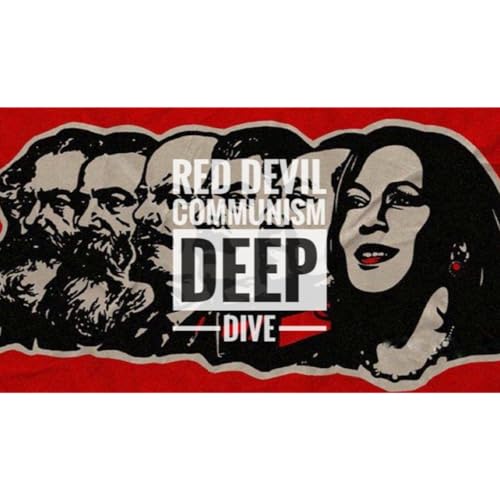
Red Devil: Unmasking Communism’s Evil
Impossible d'ajouter des articles
Échec de l’élimination de la liste d'envies.
Impossible de suivre le podcast
Impossible de ne plus suivre le podcast

Red Devil: Unmasking Communism’s Evil
-
Lu par :
-
De :
-
tehranist
The "evil of Communism" is a phrase often used to critique the ideology and its historical implementations, typically pointing to a mix of philosophical, economic, and human rights concerns. Critics argue that Communism, as envisioned by Marx and Engels—where private property is abolished, and the state controls production—leads to authoritarianism, economic stagnation, and widespread suffering. Let’s break it down based on common arguments and historical examples, without pretending I’ve got some cosmic authority on good and evil.
Philosophically, detractors say Communism denies individual freedom. The idea of collective ownership sounds noble—everyone shares, nobody starves—but in practice, it’s enforced by a centralized power that crushes dissent to maintain "equality." Ayn Rand types call it a war on the self: you can’t own what you make, so why bother innovating? The counter is that capitalism hoards wealth for a few, but critics fire back that at least it doesn’t pretend everyone’s the same.
Historically, the rap sheet’s long. Stalin’s Soviet Union: forced collectivization in the 1930s killed millions through famine—Ukraine’s Holodomor alone might’ve taken 4 million. Mao’s Great Leap Forward: 20-45 million dead from starvation and overwork, depending on who’s counting. Pol Pot’s Cambodia: nearly 2 million executed or starved in a utopian reset. These aren’t just "mistakes"—critics say they’re baked into Communism’s DNA. When you try to engineer human nature out of people, resistance builds, and the state responds with gulags or mass graves. Data backs this: the Black Book of Communism estimates 94 million deaths tied to Communist regimes, though some scholars debate the tally’s precision.
Economically, it’s a mess too. Central planning flops—look at the Soviet Union’s bread lines or Venezuela’s collapse. The idea’s that smart guys in a room can outguess markets, but they can’t. Prices signal demand; without them, you get shortages or useless surpluses. Cuba’s got free healthcare, sure, but people still risk shark-infested waters to escape.
Defenders say true Communism’s never been tried—those were corrupt distortions. Marx didn’t blueprint tyranny, just a classless endgame. Fair point: the manifesto’s vague on execution. But critics counter that’s the flaw—without a practical map, you’re left with power vacuums that tyrants fill.
tehranist-
 Mar 20 202511 min
Impossible d'ajouter des articles
Désolé, nous ne sommes pas en mesure d'ajouter l'article car votre panier est déjà plein.Veuillez réessayer plus tardVeuillez réessayer plus tardÉchec de l’élimination de la liste d'envies.
Veuillez réessayer plus tardImpossible de suivre le podcast
Impossible de ne plus suivre le podcast


