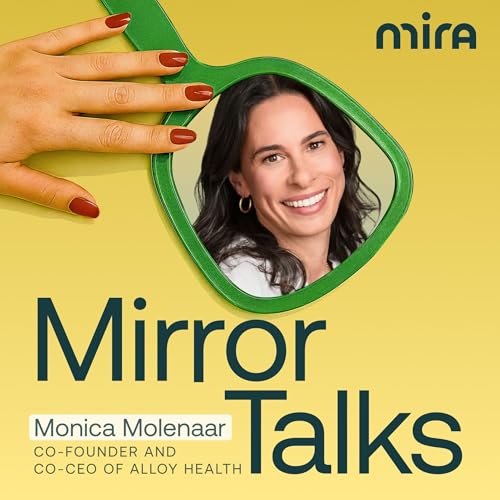
Couverture de Mirror Talks

Mirror Talks

Mirror Talks

De : Mira
Écouter gratuitement

À propos de ce contenu audio

Mirror Talk explores the stories of trailblazing women and how they sparked breakthrough in science, business, mental health, physical health, leadership, and more. Each episode features a key voice: founders, health experts, leaders, doctors, and creatives who have turned personal insight (and many times, self-doubt) into purposeful action toward a better world for women. Together, we explore what they’ve learned, what they wish more women knew, and how they got through moments of doubt and were able to reinvent themselves.2025-2026 Mirror Talks Développement personnel Hygiène et vie saine Maladie et pathologies physiques Réussite personnelle Sciences sociales
Épisodes
  • Ep 6. “Nobody Told Me I Was Going Into Menopause the Next Day” — Monica Molenaar on Hormone Therapy
    Mar 10 2026

    In this episode, Monica shares what surgical menopause really feels like — and what no one prepared her for. She talks openly about losing estrogen overnight, trying every form of hormone therapy available, and why so much fear around estrogen is based on outdated information.

    We discuss the lasting impact of the Women’s Health Initiative study, the black box warning that shaped a generation of doctors, and why only a small percentage of OB-GYNs are formally trained in menopause care. Monica explains why hormone therapy is not just about hot flashes — but about brain, bone, heart, skin, and long-term health.

    She also shares how her personal struggle led to building Alloy — a menopause telehealth platform connecting women to licensed OB-GYNs across the U.S., reducing years of suffering to days of access.

    You’ll hear about:

    • What happens to your body in surgical menopause — beyond hot flashes
    • Every form of estrogen Monica has tried: compounded creams, patches, pills, pellets, sprays, gels — and how each one worked for her
    • How to know if your hormone therapy dose is wrong — and when to switch
    • The difference between oral and transdermal estrogen — and the myths around safety
    • Vaginal estrogen: incontinence, UTIs, dryness, and why it’s often overlooked
    • Perimenopause symptoms to watch for — anxiety, sleep loss, heavy bleeding, weight gain
    • When birth control pills make sense in perimenopause — and when they don’t
    • The black box warning, what changed, and what women need to know now
    • Why progesterone, testosterone, and thyroid hormones also matter in midlife
    • How hormone therapy, strength training, sleep, and nutrition together support long-term health and quality of life in menopause

    This podcast is powered by Mira — a hormone health monitor that empowers women to track their hormones at home and make confident, informed decisions about their health and future.

    Follow us on Instagram @mirafertility and visit miracare.com to learn more.

    If this episode resonated with you, follow Mirror Talks wherever you listen to podcasts — and share it with someone who needs to hear Sylvia’s story. You can also join Mira’s community for more stories, resources, and guidance on your hormone health journey.

    Hosted by Teo, a menstrual cycle coach helping women reconnect with their cycles, tune into their hormones, and live more in sync with their bodies.

    Produced by Hatch Up podcasts.

    Afficher plus Afficher moins
    1 h et 35 min
  • Ep 5. “We Are Swimming in the Sea of Misogyny”: Farideh, on breaking the silence about women’s bodies and medical gaslighting
    Dec 22 2025

    Farideh writes songs from things most music ignores: diagnoses, symptoms, and sentences women repeat to each other when they’re trying to make sense of their bodies. In this conversation, she explains how her songs are built — from lists of conditions, overheard phrases, and moments when something finally clicks.

    She talks about living with PCOS for years before it had a name, about motherhood as a shift into a fuller female experience, perimenopause as another stage of bodily change, and 12 Breakdowns of Christmas — her sketch series about mental load, burnout, and the emotional work behind the holidays.

    This episode is about turning what women live through into music — and trusting the body when it keeps asking to be heard.

    You’ll hear about:

    • How Farideh’s songs are built from diagnoses and real conversations
    • Early PCOS symptoms and medical dismissal
    • Turning The Female Body into music
    • You Are Such a Good Dad and invisible labor
    • Comment sections as shared spaces for women’s stories
    • Motherhood as an embodied shift
    • Perimenopause and ongoing hormonal change
    • 12 Breakdowns of Christmas and holiday mental load

    Follow Farideh on Instagram.

    This podcast is powered by Mira — a hormone health monitor that empowers women to track their hormones at home and make confident, informed decisions about their health and future.

    Follow us on Instagram @mirafertility and visit miracare.com to learn more.

    If this episode resonated with you, follow Mirror Talks wherever you listen to podcasts — and share it with someone who needs to hear Sylvia’s story. You can also join Mira’s community for more stories, resources, and guidance on your hormone health journey.

    Hosted by Teo, a menstrual cycle coach helping women reconnect with their cycles, tune into their hormones, and live more in sync with their bodies.

    Produced by Hatch Up podcasts.

    Afficher plus Afficher moins
    1 h et 6 min
  • Ep 4. “Perimenopause Isn’t the Villain”: Dr. Carrie Jones, Women’s Health Educator, on Perimenopause
    Dec 4 2025

    Perimenopause often begins in the late 30s or early 40s — earlier than many think. In this episode, Dr. Carrie Jones explains what those early years actually look like: the 3 a.m. wake-ups, the sudden irritability, the phantom smells that send women checking the kitchen for burning wires, or maybe itchy ears from low estrogen — and all the symptoms we’ve been trained to call “stress”.

    She also breaks down which hormone tests are useful in this phase, why daily pattern-tracking can show what a single blood draw can’t, and what the WHI study did — and didn’t — prove about the safety of HRT. Dr. Carrie talks through the tools she relies on most, from magnesium and herbal supports to boundary-setting and getting the nervous system out of permanent alert mode.

    You'll hear about:

    • The age range when perimenopause typically begins (late 30s–40s)
    • Why progesterone drops first — and how that affects sleep and mood
    • Phantom smells, itchy ears, and other hormone-driven symptoms most women misinterpret
    • Which tests actually help map hormonal patterns
    • What the WHI study really found about HRT and breast cancer
    • The lifestyle changes Carrie sees move the needle most
    • How to track hormones without entering a cycle-tracking obsession
    • The difference between true stress and hormone-driven stress symptoms

    Follow Dr. Carrie Jones on Instagram.

    This podcast is powered by Mira — a hormone health monitor that empowers women to track their hormones at home and make confident, informed decisions about their health and future.

    Follow us on Instagram @mirafertility and visit miracare.com to learn more.

    If this episode resonated with you, follow Mirror Talks wherever you listen to podcasts — and share it with someone who needs to hear Sylvia’s story. You can also join Mira’s community for more stories, resources, and guidance on your hormone health journey.

    Hosted by Teo, a menstrual cycle coach helping women reconnect with their cycles, tune into their hormones, and live more in sync with their bodies.

    Produced by Hatch Up podcasts.

    Afficher plus Afficher moins
    1 h et 21 min
Aucun commentaire pour le moment