Épisodes

  • 1 in 20 Women Have PMDD: Why Your Hormone Tests Come Back Normal | The Connection with Autism, ADHD, Endometriosis, PMOS | The Science Behind PMS and PMDD with Neuroscientist Dr Emilė Radytė
    Sep 24 2026
    Send us Fan Mail"Every Two Weeks You Are No Longer Yourself"Dr Emilė Radytė is a Harvard and Oxford-trained neuroscientist and the co-founder and CEO of Samphire Neuroscience, where she builds neurotechnology for women's health. Her work treats PMS, PMDD and menstrual pain as conditions of the brain, not just the hormones. She was named in Forbes 30 Under 30 for healthcare in 2024.TW: We discuss depression and suicide in this epsiode. 💬 Top quotes"If you live with PMDD, it means every two weeks you are no longer yourself, so you lose literally half of all of your reproductive life.""When most women test their hormones, they find out it's perfectly fine. The reason they have those symptoms is because of how their brains respond to those hormones.""For years, depression was called hysteria in women, and so I think the idea that women could have something specific is already relatively new.""A stable job expects you to show up the same way every day, and is built for a male-like cycle, where women, we know we're not the same every day anyway.""Hormones are just the way that our bodies talk to us, and I think if anyone gets anything from this talk, that should be the key."🧠 The bit nobody explains properlyWhy PMDD is a recognised medical condition, not a bad mood, and how it differs from PMS even when the symptoms overlapWhy most women with PMDD have completely normal hormone levels, and what that really meansThe two weeks before your period, explained: why the part of your brain that regulates emotion goes offline, and why that isn't a character flawWhy women with PMDD often thrive in the first half of their cycle, and can be twice as productive as everyone elseThe woman who writes a resignation letter every single month, and what it tells us about impulsivity in PMDDProgesterone, allopregnanolone and GABA: why a hormone that calms most women can do the opposite for someWhy your pain threshold drops during your period, so you feel more pain and have more to feelWhy it took so long to be taken seriouslyPMDD was only recognised as a depressive disorder in 2014, which means most psychiatrists trained before it existedHow depression in women was once called hysteria, and how long that shadow has beenWhy a diagnosis can still take years, and what makes PMDD so hard to catch in a ten-minute appointmentThe reason your symptoms vanish the week your appointment finally arrives, and what to do about itThe stuff you've probably triedWhether "balancing your hormones" is a real thing, and where the idea goes wrongWhat the evidence actually says about supplements, and whether they reach your brain at allThe pill and PMDD: what it does, what it doesn't, and why options matter more than answersHow brain stimulation works, whether it lasts, and what neuroplasticity really meansThe connections nobody joins upWhy ADHD and PMDD so often show up together, and what's happening in the prefrontal cortexThe link between stress, your brain and the timing of your cycleWhy hormones are the message, not the cause, including in PMOS (PCOS)What we still don't know about PMDD and long-term brain healthThe part that affects your whole lifeWhy so many women with PMDD end up freelancing, and what that says about workplaces built for a body that doesn't changeWhat's happening in women's careers in their 30s, and why senior roles are where it showsIf you think this might be you: the one thing to start doing today, where to find free self-screening tools, and how to walk into your GP's appointment preparedWhy this episode is worth hearing even if you don't have PMDD📊 The research behind the episodePMDD affects around 1 in 20 women, or 3 to 8% depending on the criteria used. Source: Samphire Neuroscience; figure consistent with DSM-5 estimates.In a global study of 599 people with a confirmed PMDD diagnosis, 72% reported suicidal thoughts at some point in their lives, 49% had made a plan, and 34% had attempted suicide during a PMDD episode. Eisenlohr-Moul et al., BMC Psychiatry, 2022. Caveat: participants were self-selected through an online survey, so the sample likely reflects more severe experiences than the wider PMDD population.A 2026 systematic review of 18 studies covering around 2.6 million people found rates of suicidal thoughts in PMDD ranging from 26% to 86%. Zhitnik et al., Administration and Policy in Mental Health. Caveat: the wide range reflects very different study designs and definitions, which is why no single number tells the whole story.Around 41% of women with ADHD screen positive for PMDD. Broughton et al., British Journal of Psychiatry, 2025. Caveat: this is a cross-sectional survey using provisional screening rather than clinical diagnosis, and it measures PMDD among women with ADHD, not the reverse.PMDD was added to the DSM-5 as a depressive disorder in 2013 to 2014, which is why many clinicians trained before then had no formal teaching on it.⚠️ One correction to noteIn the episode, Emilė says 70% of ...
    Afficher plus Afficher moins
    40 min
  • Could your Gut Health be causing PMOS/PCOS, Endometriosis, Severe Period Pain, Inflammation? Research & Solutions with Gut & Menstrual Cycle Nutritionist!
    Jul 6 2026

    Send us Fan Mail

    Jo sits down with Rocsi — menstrual cycle nutritionist and the woman who focuses her life's work on reducing period pain, irregular cycles, PMS, PCOS symptoms, and more — through one thing: gut health.

    What if everything you thought you knew about period pain was wrong?

    Not your uterus. Not your hormones. Not bad luck - instead, maybe its in your gut?

    The science is emerging, but the results so far are undeniable.

    Why You Need to Listen to This Episode

    • You've been blaming your luteal phase — but it's not the end of the problem
    • You struggle with anxiety, PMS and your mood before your period
    • You have a recent PMOS/ PCOS diagnosis
    • You have heavy, painful periods

    📋 What We Cover

    • 🦠 What the gut microbiome is — and why it's the missing piece in women's health
    • 🔄 The bidirectional relationship between gut health and your menstrual cycle — moving from correlation to causation
    • 🩺 The three monthly cycles your body runs every single month — and why most women have never been told about them
    • 💩 Period poops explained — the prostaglandin and progesterone interplay
    • 🌀 The estrobolome — the group of gut bacteria that controls how much oestrogen circulates in your body
    • 😤 PMS and the gut — why dysbiosis makes PMS significantly worse, and what to do about it
    • 🧠 The gut-brain axis — how serotonin, dopamine, and GABA are made in the gut and what happens when they can't be
    • 🌸 PCOS and the gut — 70% of PCOS patients have insulin resistance, and the gut microbiome directly influences insulin and androgen levels
    • ⚡ Endometriosis and the gut — a landmark double-blind RCT on a gut-derived metabolite (sakuranin) that could change everything for endo patients
    • 🥗 The cycle syncing myth — why eating differently every week is burning women out, and what the research actually says
    • 📱 Fibre maxing and gut scrub — what TikTok gets right and wrong
    • 🌿 Rocsi's three non-negotiables for gut health that everyone can start today
    • 🌙 The 10–12 hour overnight fast — what happens in your gut while you sleep (the "night crew" is coming)
    • 🥦 The crucial rule on cruciferous vegetables — don't start here if you're new to fibre
    • 🫙 Pickles in vinegar vs. brine — why this one detail matters
    • 📊 Three real client case studies — from irregular periods to pain-free cycles
    • 🐟 The five oily fish that could transform your period (and the sardine recipe that converts the haters)
    • ⚡ What changed Rocsi's own health forever — the plant tracker that revealed she wasn't eating as well as she thought

    💛 Resources & Further Support

    • Her Aligned Hub — Rocsi's practice for menstrual health nutrition: heralignedhub.com
    • Endometriosis UK — patient support and information: endometriosis-uk.org
    • PCOS UK — support, information, and advocacy: pcosuk.org
    • NICE Endometriosis Guidelines — updated November 2024: nice.org.uk/guidance/ng73
    • NHS: Heavy periods — nhs.uk/conditions/heavy-periods
    • NHS: PMOS update - https://www.nhs.uk/conditions/polyendocrine-metabolic-ovarian-syndrome-pmos/

    📲 Follow & Subscribe

    If this episode made you see your period — and your gut — differently, please share it with a woman in your life who needs to hear it. 💚

    🎧 Available on: Spotify | Apple Podcasts | All major platforms

    Living Hellth is a women's health podcast committed to honest, evidence-led conversations — because every woman deserves access to the information that could change how she feels in her own body, prevent and manage chronic disease

    Support the show

    We've reached 1.3 million views across all platforms, proudly covering some of the most chronic and confusing conditions and diseases that disproportionately affect women.

    Help us keep the podcast going by following us on Instagram or TikTok, or subscribe via YouTube.

    Afficher plus Afficher moins
    56 min
  • Krupa's Living Hellth Story: 12 Years Fertility Journey, 4 Rounds of IVF, Travelling the World for Answers, Endometriosis and Twins at 43 years old
    Jun 18 2026

    Send us Fan Mail

    Krupa's fertility journey spans 12 years, four rounds of IVF, two countries, endometriosis diagnosis that finally came through fertility investigations, a near-fatal surgical complication, a pandemic, and ultimately — twins, born at 32 weeks, at 43 years old.

    But it also spans something else: 20 years of painful, heavy periods dismissed as normal in a South Asian community where menstruation was a secret and fertility struggles were unspoken.

    She then had to build her own support network from scratch — anonymously on Instagram and in a secret Facebook group — because nowhere else felt safe enough to ask the questions she needed answered.

    This is nothing short of remarkable!

    🩸 Heavy, painful periods dismissed for 20 years — and the endometriosis diagnosis that finally came through fertility investigations, not GP care

    🏥 The NHS fertility system — IUI as a precursor to IVF, how funding works, and why IUI was the wrong treatment for Krupa's diagnosis from the start

    💉 Four rounds of IVF — across NHS, private London clinics, and ultimately Athens — and what drove the decision to keep going (and to stop)

    🚨 Ovarian torsion: the near-fatal complication — a surgical error during egg retrieval that left Krupa unable to walk for months and changed everything

    ✈️ IVF abroad — why Krupa went to Athens, what to look for in an international clinic, and why regulation matters more than location

    🧠 The mental health reality of IVF — anxiety, withdrawal from friends, the trauma of a 12-year journey, and why she was placed under perinatal mental health care during pregnancy

    💑 Sustaining a relationship through fertility treatment — couples counselling, fertility counsellors, and staying on the same page through the hardest years

    🌸 Endometriosis, diet and lifestyle — how changing her diet had more impact on her pain than surgery did

    🤫 The South Asian community and fertility taboo — periods as shameful secrets, counselling as a cultural taboo, and the anonymous Facebook group she built for 200 Indian women who had nowhere else to go

    📱 Building community when there is none — the TTC Instagram community, anonymous Facebook groups, and why connection with strangers became her lifeline

    👶 Twin boys at 43, born at 32 weeks — the NICU journey, the emergency C-section under general anaesthetic, and the PTSD that arrived after

    💛 Life on the other side — her role as a Bliss trustee, her advisory work in women's health, and the calls she still gets from South Asian women who need someone safe to talk to


    💛 Resources Mentioned

    • Bliss — charity for babies born premature or sick; Krupa is now a trustee: bliss.org.uk
    • Peanut App — fertility and motherhood community app: peanut-app.io
    • NHS Subfertility Units — your GP can refer you; ask specifically about the subfertility unit in your local trust
    • NHS GUM Clinics — anonymous STI testing in every postcode; ask your GP
    • HFEA (Human Fertilisation and Embryology Authority) — UK fertility regulator; clinic ratings, evidence ratings for add-ons: hfea.gov.uk
    • Fertility counsellors — available through most IVF clinics, NHS and private; ask your unit about access
    • Perinatal Mental Health Teams — available through NHS for those with significant anxiety or trauma during pregnancy; ask your midwife or consultant to refer you
    • Endometriosis UK — patient support and information: endometriosis-uk.org


    Support the show

    We've reached 1.3 million views across all platforms, proudly covering some of the most chronic and confusing conditions and diseases that disproportionately affect women.

    Help us keep the podcast going by following us on Instagram or TikTok, or subscribe via YouTube.

    Afficher plus Afficher moins
    46 min
  • Ami's Living Hellth: What Nobody Tells You About IVF, Male Infertility, Post-Birth PMDD, the Sibling Guilt, and the Beautiful Life We Built Instead
    Jun 17 2026

    Send us Fan Mail

    When we talk about IVF, we tend to talk about the basics. Most people know there are injections and the egg collections involved, but we talk far less about the detail on how it actually works and everything that happens around it - including how you maintain a relationship, and how you can manage hearing a friend's happy pregnancy news whilst still in the middle of your own journey.

    This week, Jo sits down with Ami for a conversation about the parts of IVF that nobody prepares you for.

    Ami and her partner dealt with male infertility, three rounds of IVF, a pregnancy loss at nine weeks, developing postpartum depression and anxiety, and then PMDD, the guilt of providing a sibling for her son and then a final decision to close that chapter.

    What We Cover in This Episode

    • 💊 Twelve years on the pill — and how Ami's body felt when she came off it
    • 🔬 The test results: male factor infertility, type of IVF they went for, and what that cost them
    • 🏥 The NHS IVF postcode lottery — what disqualified them entirely from receiving funding
    • 💉 What ICSI actually involves — explained honestly and clearly
    • 🧠 The psychological weight of IVF
    • 💑 What IVF does to a relationship — the conversations, the fractures, and the things that held them together
    • 😔 Postpartum depression, postpartum anxiety, and PMDD — and the GP who told her to "wait two weeks"
    • 🎄 A Christmas Day egg collection, a chest infection, and round two that felt nothing like round one
    • 💔 The nine-week scan she went to alone — and what happened next
    • 🌿 Choosing to stop — and how Ami and her partner decided to stop, and built a life they genuinely love
    • 👦 The guilt of the sibling that never came — and how she holds that grief alongside genuine gratitude
    • 💬 What Ami wishes she had known at the start


    💛 Resources & Support

    • Fertility Network UK — UK's leading patient fertility charity, including support for those who stop treatment: fertilitynetworkuk.org
    • The Miscarriage Association — support for pregnancy loss at any stage: miscarriageassociation.org.uk
    • More to Life — support network specifically for people living without children after infertility: moretolife.co.uk
    • IAPMD — International Association for Premenstrual Disorders (PMDD): iapmd.org
    • Mind UK — mental health support including postpartum depression: mind.org.uk
    • NHS IVF information — eligibility and funding guidance: nhs.uk/conditions/ivf

    📲 Follow & Subscribe


    If this episode resonated with you — or if it helped you feel less alone in something you're carrying — please share it with someone who needs to hear it. 💛

    Following Living Hellth on your podcast platform is the biggest thing you can do to help us keep making episodes like this one.

    🎧 Available on: Spotify | Apple Podcasts | All major platforms

    Support the show

    We've reached 1.3 million views across all platforms, proudly covering some of the most chronic and confusing conditions and diseases that disproportionately affect women.

    Help us keep the podcast going by following us on Instagram or TikTok, or subscribe via YouTube.

    Afficher plus Afficher moins
    47 min
  • Everything You Need to Know About Fertility + IVF, Endometriosis, PCOS, STIs, male fertility and much more - with expert Dr. Anu Chawla
    Jun 10 2026

    Send us Fan Mail

    *I would highly encourage you to watch the video version on YouTube or Spotify as there are definitions and important disclaimers on screen that will help listeners understand the more complex discussion points*


    🎙️
    This time on Living Hellth Jo Doyle sits down with Dr. Anu Chawla — one of London's leading fertility specialists — for a comprehensive, no-nonsense conversation about fertility.

    Whether you're in your twenties and not thinking about it yet, navigating a diagnosis of PCOS or endometriosis, considering IVF or egg freezing, or trying to understand what your male partner might need to think about themselves — this episode is for you.

    🔬 What We Cover in This Episode

    📊 Why global fertility rates are at an all-time low

    🧪 How fertility is tested: AMH, Antral follicle count, and 3D ultrasounds

    👩‍⚕️ What every woman in her 20s should know about fertility

    💊 Hormonal birth control and fertility — what the science actually says, coming off contraception and thinking about fertility

    🧫 PCOS and endometriosis: how they affect fertility and what your options are

    🏥 IVF vs natural IVF — what's the difference and which is right for you?

    🥚 Egg freezing: is it really biological insurance? An honest answer

    🌿 Environmental toxins, fragrance, carpets, and plastic — do they really affect fertility?

    🚹 Male fertility: the 50% factor no one talks about enough

    🩺 Abortion and fertility — the truth behind the myths and long term impacts

    💛 Advice for women about to start their fertility or IVF journey

    Dr. Chawla's areas of expertise span PCOS, endometriosis, repeated IVF failures, egg freezing, reproductive immunology, fibroids, and male infertility. She's a globally recognised voice in fertility medicine, regularly invited to speak at OBGYN and fertility conferences worldwide.

    Resources Mentioned:


    NHS GUM Clinics — anonymous STI testing in every postcode; ask your GP

    RCOG Patient Information Leaflets — rcog.org.uk

    Daisy Network — support group for Premature Ovarian Insufficiency (POI)

    HFEA — UK fertility regulator; FAQs, clinic ratings, add-on evidence ratings — hfea.gov.uk

    You can find Dr Chawla and more information here: https://www.dranuchawla.co.uk/

    Support the show

    We've reached 1.3 million views across all platforms, proudly covering some of the most chronic and confusing conditions and diseases that disproportionately affect women.

    Help us keep the podcast going by following us on Instagram or TikTok, or subscribe via YouTube.

    Afficher plus Afficher moins
    1 h et 1 min
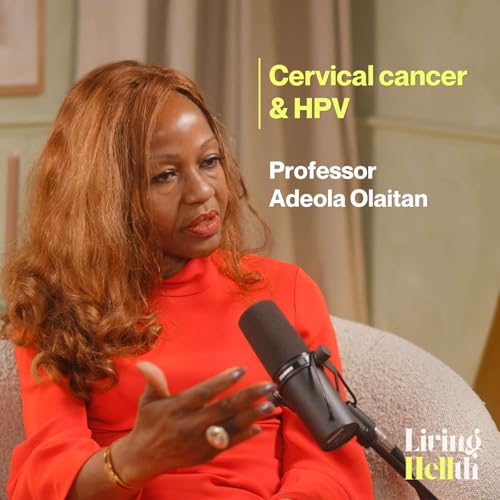
  • Cervical cancer expert: Everything You Need to Know About HPV and Cervical Cancer — with Professor Adeola Olaitan
    May 18 2026

    Send us Fan Mail

    5 million women in the UK and 1 in 4 eligible women in the US are not up to date with their cervical screening.

    In this episode, we sit down with one of the UK's leading cervical cancer experts, Professor Adeola Olaitan, a gynaecological oncology surgeon with over 20 years of experience in the diagnosis and surgical treatment of cervical cancer.

    We cover the science, the stigmas, the screening, and the solutions — from what HPV actually is, to the cutting-edge innovations that could completely change how we approach cervical cancer prevention.

    Key take aways

    • 4 in 5 women will have HPV at some point. It is not a reflection of sexual behaviour.
    • HPV can lie dormant for years — which is why you must keep going for screening even if you've been negative before.
    • Vaccination + screening = the most powerful combination for eliminating cervical cancer.
    • Symptoms should never be ignored — even with a recent clear cervical screening / smear result.
    • If you've had a LLETZ, tell your obstetrician at your first pregnancy booking.
    • The Eve Appeal is the go-to resource for accurate, non-alarmist information on all five gynaecological cancers.

    What we cover:

    - HPV & Cervical Cancer: The Basics

    - HPV Dormancy, Transmission & Relationships

    - Symptoms & Warning Signs

    - The HPV Vaccine: is it's still worth getting vaccinated in your 30s or 40s

    - Cervical Screening: Smear Tests, HPV testing and cervical cancer diagnostics

    - Lifestyle, Immune Health & Clearing HPV

    - The "Menopause Spike" in HPV

    - Cultural Stigma, Ethnicity & Closing the Screening Gap

    - HPV Myths & Misconceptions

    - Adenocarcinoma: When Symptoms Are Dismissed

    - Can endometriosis or adenomyosis mask cervical cancer symptoms?

    - Pregnancy, Fertility following HPV or cervical cancer

    - Innovation & the Future of Cervical Screening

    - Treatment, Survival & Life After Cervical Cancer

    Support the show

    We've reached 1.3 million views across all platforms, proudly covering some of the most chronic and confusing conditions and diseases that disproportionately affect women.

    Help us keep the podcast going by following us on Instagram or TikTok, or subscribe via YouTube.

    Afficher plus Afficher moins
    30 min
  • V’s Cervical Cancer story: Discovering endometriosis & adenomyosis following a HPV and cervical cancer diagnosis, lifesaving treatment and navigating high-risk pregnancy
    May 11 2026

    Send us Fan Mail

    In this episode, we sit down with Vijaya Varilly, now an Eve Appeal Ambassador, who faced a life-changing diagnosis at the age of 31, just before the start of the 2020 pandemic.

    V shares her private and honest journey—from her heavy periods and pain being dismissed by doctors, which was later discovered to be endometriosis and adenomyosis, to then receiving the news regarding a rare cervical cancer diagnosis, threatening her life as she knew it and dreams of becoming a mother.

    We dive deep into the stigmas surrounding HPV, especially within the Southeast Asian communities, the complexities of a rare cancer that smear tests often miss, and her incredible resilience she used to navigate treatment, IVF and a high-risk pregnancy.

    Cervical cancer is the fourth most common cancer among women globally, claiming 350,000 lives every year. However the HPV vaccine and regular screenings could mean it is a disease that could be eradicated within our lifetime.

    In This Episode, We Discuss:

    • The Warning Signs: Why you shouldn’t ignore heavy bleeding, even if your smear test comes back clear.
    • The Rare Detection: Understanding adenocarcinoma, a type of cervical cancer that develops in the canal and is harder to detect.
    • Breaking the Stigma: Confronting the shame associated with HPV and the cultural barriers within the South Asian community.
    • The Path to Dylan: V’s fertility journey, including unexplained infertility, successful IVF, and the "emergency stitch" that saved her pregnancy.
    • Advocacy in Action: How V turned her trauma into the award-winning "Don't Miss Your Pap" campaign to help bridge the gap between the 5 million women who have missed their screenings.


    Support the show

    We've reached 1.3 million views across all platforms, proudly covering some of the most chronic and confusing conditions and diseases that disproportionately affect women.

    Help us keep the podcast going by following us on Instagram or TikTok, or subscribe via YouTube.

    Afficher plus Afficher moins
    49 min
  • Expert on longevity vs personalised lifestyle medicine: Many women are living longer, but are we living better?
    Mar 23 2026

    Send us Fan Mail

    Dr. Clare Nieland joins the Living Hellth podcast to break down the science of staying fitter, healthier and,inevitably younger, for longer. And how lifestyle medicine can be used to prevent chronic disease and conditions - with a special focus on women's health.

    Whether you're navigating pre-pregnancy tips, managing PCOS, or simply want to ensure your "Second Spring" menopause phase is your strongest yet, this episode provides the data-backed roadmap you’ve been looking for!

    In this episode of Living Hellth, host Johanna Doyle sits down with Dr. Clare Nieland to discuss how we’re moving past "reactive" healthcare and into preventive, personalised lifestyle medicine.

    In this episode, we cover:

    🩸 The #1 test to determine a woman's lifespan
    👯‍♀️ How lack of social connection could be draining your health
    🏋️ Why grip strength and muscle mass are non-negotiable as we age
    🥗 The 6 pillars of a lifestyle medicine
    🩺 The Difference Between Longevity and Lifestyle Medicine
    🧬 We discuss how lifestyle medicine can be used to prevent dementia and Alzheimer’s, Osteopenia and Osteoporosis, Cardiovascular Disease and Type 2 Diabetes
    🧘🏼‍♀️The simple and free lifestyle changes that actually predict our health
    💊 The supplements she couldn't live without - and the trends that have no scientific backing!

    With women spending 25% more of their lives in poor health than men, Dr. Nieland reveals why we need to start tracking the biomarkers that actually predict our future.

    Whether you're navigating pre-pregnancy tips, managing PCOS, or simply want to ensure your "Second Spring" menopause phase is your strongest yet, this episode provides the data-backed roadmap you’ve been looking for.

    Support the show

    We've reached 1.3 million views across all platforms, proudly covering some of the most chronic and confusing conditions and diseases that disproportionately affect women.

    Help us keep the podcast going by following us on Instagram or TikTok, or subscribe via YouTube.

    Afficher plus Afficher moins
    48 min