Épisodes

  • Why the DSM-5 Definition of ADHD Never Defined Me
    Apr 23 2026

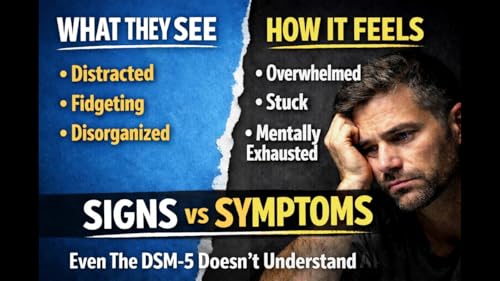
    Most people only see ADHD from the outside. The DSM-5 is the same way. It defines ADHD by “symptoms” that are actually medical signs, things other people can observe, instead of the internal symptoms we actually live with.

    In this video, I break down the difference between signs and symptoms, show how the DSM-5 quietly rewired ADHD into a list of “bad behaviors,” and explain why that creates so much confusion, shame, and the “everyone’s a little ADHD” takes.

    If you’ve ever felt like the official definition of ADHD unfairly defined you, or like people around you just do not get it, this one’s for you.

    Afficher plus Afficher moins
    7 min
  • ADHD Is Not An Excuse, It’s My Shield
    Apr 16 2026

    ADHD excuse or explanation? Let’s talk about how ADHD becomes a shield to avoid vulnerability.

    People tell us we “use ADHD as an excuse.”

    In this video, I’m admitting something hard: they’re not totally wrong… but not in the way they think.

    I walk through how a lot of us use ADHD as a shield, not to dodge responsibility, but to dodge something way scarier: being fully seen. If you grew up feeling “too much,” “not enough,” or only loved when you were useful, it can feel safer to hide behind symptoms, jokes, or productivity than to risk real closeness.

    We’ll talk about:

    – The difference between context and excuse with ADHD

    – How masking turns into a full-time performance

    – Why letting people see the real you feels “fatal”

    – The quiet belief underneath it all: “I’m not worthy of being loved as I am”

    I’m Bill, and this is Just Human ADHD. I make honest videos about what ADHD actually feels like so you don’t have to feel like the only one.

    Scattered Minds: The Origins and Healing of Attention Deficit Disorder, by Gabor Maté: https://a.co/d/07kzig5o

    Afficher plus Afficher moins
    7 min
  • ADHD Hack: Stop the Shame Spiral in Seconds
    Apr 9 2026

    ADHD can turn one small mistake into a full-on shame spiral.

    - You’re late once…

    - You forget something…

    - You misread a text…

    And your brain instantly goes:

    - “I’m a failure.”

    - “I’m the worst.”

    - “I always do this.”

    In this video, I’ll show you a simple ADHD mindset shift that stops that spiral fast:

    Think like a GPS.

    When you miss a turn, your GPS doesn’t shame you.

    It doesn’t bring up every mistake you’ve ever made.

    It just says: “Rerouting.”

    That’s the tool.

    What you’ll learn:

    - Why ADHD turns mistakes into identity attacks

    - The 3-step “Rerouting” method (Pause → Understand → Adjust)

    - How to stop the spiral in real time

    - Real examples from relationships, work, and everyday ADHD struggles

    Try this today:

    Next time ADHD trips you up, don’t say “I suck.”

    Say:

    “Okay… rerouting.”

    Then take one small next step.

    That’s it.

    Comment below:

    What’s your most common “shame spiral” trigger?

    - Being late

    - Forgetting things

    - Overthinking

    - Misreading people

    Subscribe for more:

    Real ADHD content. No shame. Just tools that actually help.

    Afficher plus Afficher moins
    6 min
  • If you think everyone has ADHD… Listen To This First
    Apr 3 2026

    If you think everyone has ADHD… watch this first.

    A lot of people say ADHD feels like distraction, procrastination, or losing focus — and yeah, those things are part of it.

    But the hardest parts?

    The parts that actually affect people every day?

    You don’t see those.

    In this video, we break down:

    The hidden struggles most people miss

    Why ADHD isn’t just “being distracted”

    What it actually feels like behind the scenes

    If you’ve ever thought “everyone has ADHD these days”…

    this might change how you see it.

    👍 Like & subscribe for real conversations about ADHD

    💬 Comment — what’s something people don’t understand about it?

    Afficher plus Afficher moins
    7 min
  • Comparison is the thief of joy, and for ADHD brains, that comparison can feel brutal.
    Apr 1 2026

    In this video, we talk honestly about how ADHD can make you feel like you’re constantly falling behind… even when you’re trying your hardest. Many people with ADHD grow up carrying shame from inconsistency, overwhelm, and feeling like they should be doing better, and social media only amplifies that pressure by showing curated “perfect” lives you can never measure up to.

    We explore why comparison hits ADHD brains so hard, how shame gets wired into the experience, and how to step out of the cycle so you can start measuring success in ways that actually make sense for your brain.

    This isn’t about productivity hacks or pretending everything is easy. It’s about understanding your brain, letting go of unrealistic standards, and reclaiming your joy.

    If you’ve ever felt like a failure because you don’t match someone else’s timeline… this video is for you.

    Topics covered:

    ✔ ADHD and shame

    ✔ The comparison trap

    ✔ Social media distortion

    ✔ Emotional overwhelm

    ✔ Self-compassion and reframing

    ✔ Measuring real progress

    You’re not broken. You’re human with an ADHD brain navigating a world that rarely explains how that brain works.

    Subscribe for more honest ADHD conversations focused on support, understanding, and real-life tools.

    Afficher plus Afficher moins
    24 min
  • 10 Things I’d Tell My Childhood Self After Being Diagnosed with ADHD Late in Life.
    Apr 1 2026

    Being diagnosed with ADHD later in life can feel like someone finally handed you the missing piece to your story.

    In this video, I share 10 things I would tell my childhood self if I could go back in time, things I wish someone had explained when I was growing up feeling behind, confused, or like I just couldn’t keep up. From understanding why focus is inconsistent, to learning that struggling doesn’t mean you’re incapable, this conversation is about replacing shame with clarity and compassion.

    This isn’t about fixing who you are — it’s about understanding how your brain works and realizing that ADHD is part of being human, not a personal flaw.

    Whether you were diagnosed recently, years ago, or are still figuring things out, this video is a reminder:

    👉 You’re not broken

    👉 You’re not lazy

    👉 You’re not alone

    👉 And your brain deserves understanding, not judgment

    If any of this resonates with you, welcome — this is a space built around support, inclusion, and honest conversations about ADHD.

    Afficher plus Afficher moins
    18 min
  • Hostile Intent Bias & ADHD – Why You Always Think They’re Mad
    Apr 1 2026

    Do you constantly assume people are mad at you?

    You read a short text and think, “I messed up.”

    Someone says, “We’ll talk later,” and your brain goes straight to worst-case scenario.

    If you have ADHD, this may not just be anxiety — it could be something called Hostile Intent Bias.

    In this video, we break down:

    • What Hostile Intent Bias actually is

    • Why ADHD brains are wired to scan for rejection

    • The connection to Rejection Sensitivity (RSD)

    • Why ambiguity feels threatening

    • How emotional reactivity plays a role

    • Practical tools to interrupt the spiral

    ADHD isn’t about being dramatic or insecure.

    It’s about how the brain processes uncertainty, emotion, and perceived threat.

    You’re not broken.

    You’re patterned.

    And patterns can change.

    If this resonates, comment: “Assumed it again.”

    Let’s normalize this experience.

    Subscribe for more ADHD conversations rooted in understanding, emotional regulation, and growth — not shame.

    Because ADHD isn’t a flaw.

    It’s part of being human.

    Support My Work: https://buymeacoffee.com/fishacat

    #ADHDemotionalregulation, #HostileIntentBias #ADHD, #RejectionSensitivityDysphoria, #ADHDanxiety

    Afficher plus Afficher moins
    13 min
  • ADHD and Identity: Why You Don’t Recognize Yourself Anymore
    Apr 1 2026

    Ever feel like you’ve lost yourself?

    For many people with ADHD, life can become a cycle of masking, people-pleasing, hyperfocus, burnout, and trying to be who everyone else needs you to be. Somewhere along the way, you may start to feel disconnected from who you really are.

    In this video, we talk about something that doesn’t get discussed enough in the ADHD community: losing your sense of identity.

    You might recognize some of these experiences:

    • Feeling like you’re constantly performing for others

    • Becoming completely consumed by interests or work, then crashing

    • People-pleasing because rejection hits so hard

    • Not knowing what you actually want anymore

    • Feeling like the real “you” disappeared somewhere along the way

    The truth is: you didn’t lose yourself — you adapted to survive.

    This video explores why ADHD can make identity feel unstable and how you can start reconnecting with the person underneath the masking and expectations.

    If you’ve ever thought, “I don’t know who I am anymore,” this conversation is for you.

    Topics covered:

    ADHD and identity struggles

    Masking and people-pleasing

    Rejection Sensitivity (RSD)

    Hyperfocus and burnout cycles

    Rediscovering your authentic self

    Join the conversation:

    Have you ever felt like ADHD made you lose yourself? Share your experience in the comments — your story may help someone else feel less alone.

    If this video resonated with you, consider liking and subscribing to Just Human ADHD for more honest conversations about ADHD, mental health, and personal growth.

    #ADHD #ADHDLife #MentalHealth #ADHDAwareness #JustHuman #ADHDIdentity #Neurodiversity

    Afficher plus Afficher moins
    16 min