• Digital Asset Pioneer - Inside Bank Frick
    Oct 8 2026
    Ten years ago, Bank Frick launched Europe's first crypto-backed note. Today, they're building the regulated infrastructure that will make tokenization invisible to the market, as essential and taken for granted as SWIFT. In this episode, Raphael Haldner, Head of Banking Solutions at Bank Frick, shares the full journey from 2017 to today and offers a compelling vision for the next decade of capital markets. The conversation reveals how institutional client demands have fundamentally transformed. What began as demand for basic trading and custody access has evolved into sophisticated requests for regulated banking infrastructure that seamlessly integrates fiat and stablecoin accounts, permissioned blockchain environments, and compliance-first product development. Raphael explains why money market funds on-chain, brought to market by Franklin Templeton, BlackRock, and others, represent a treasury revolution, with interest paid on a minute-by-minute basis rather than daily or quarterly settlement cycles. A critical insight emerges: the early tokenization experiments of 2018 failed not because of technology, but because of missing infrastructure. Regulated secondary markets, standardized stablecoins, and institutional market makers were the missing pieces. Now that players like Seturion are building these solutions, the market is finally ready to scale. Raphael also discusses how DeFi and TradFi are converging in permissioned environments regulated blockchains where users are identified but the infrastructure remains decentralized. Bank Frick's approach combines innovation with rigorous compliance, using a gated product development process to ensure every new offering withstands regulatory scrutiny.
    Afficher plus Afficher moins
    26 min
  • Neue Episode
    Sep 24 2026
    When Thomas Moser started his career, he had no idea he'd end up at the Swiss National Bank—let alone leading one of the most ambitious central bank blockchain projects in the world. But sometimes the most interesting paths aren't planned. In this conversation, Moser walks us through the SNB's bold strategy on digital assets: why they're betting on wholesale CBDC over retail, how Project Helvetia is transforming settlement infrastructure, and why open, composable blockchains might be more important than the technology itself. We explore the tensions between public and private blockchains, the real threat stablecoins pose to traditional banking, and a future where intraday interest payments on assets become routine. Most importantly, Moser reveals why collaboration and ecosystem building matter more than technological innovation alone.
    Afficher plus Afficher moins
    25 min
  • The Money Market Playbook – a conversation with Mike Reed, Franklin Templeton
    Sep 10 2026
    In this in-depth conversation, we sit down with Mike Reed, Head of Digital Assets Client Engagement at Franklin Templeton, to explore how the world's leading asset managers are transforming finance through tokenization and blockchain technology. Mike's story is a masterclass in institutional innovation. Having started in the mail room at Franklin Templeton decades ago, he worked his way through trading, sales, and fixed income—all while developing a quiet passion for emerging technologies. That passion led to the creation of Benji, one of the most sophisticated tokenized money market funds in existence. This episode is not about cryptocurrency speculation. It's about institutional-grade infrastructure that solves real problems for treasurers, exchanges, hedge funds, and global financial institutions.
    Afficher plus Afficher moins
    32 min
  • The Nasdaq x Seturion Alliance: A conversation with Roland Chai [EN]
    Jul 2 2026
    Digital assets, tokenized assets and regulated market infrastructure are becoming increasingly relevant for capital markets. In this episode of Inside Digital Assets, Host Lidia Kurt speaks with Roland Chai, President European Markets and Head of Digital Assets at Nasdaq, about tokenization, DLT and the future of financial market infrastructure. The conversation explores why the impact of tokenization may be strongest beyond trading itself: in post-trade processes, collateral management, asset servicing and the broader lifecycle of financial instruments. Roland Chai also discusses why structured products can be a practical starting point for tokenized market infrastructure, how fragmentation in European capital markets affects issuance and custody, and why interoperability and common standards are essential to avoid new digital silos. The episode also looks at developments in the US and Europe, including regulated frameworks for tokenized securities, digital-native infrastructure and the importance of connecting liquidity, transparency and price discovery across market structures. For institutional market participants, financial institutions, issuers and infrastructure providers, this episode offers a focused perspective on how tokenization is moving from experimentation towards implementation in regulated capital markets. Inside Digital Assets is going on a summer break. New episodes will be available again from September.
    Afficher plus Afficher moins
    30 min
  • Solving the Digital Islands Problem - a conversation with Frank Frank Seibold, Chainlink [EN]
    Jun 18 2026
    Digital assets, tokenized assets and blockchain infrastructure are becoming increasingly relevant for institutional capital markets. In this episode of Inside Digital Assets, Lidia Kurt speaks with Frank Seibold (Managing Director and Global Head of Banking and Capital Markets at Chainlink). The conversation focuses on the infrastructure needed to make tokenized assets usable beyond digital representation. Key topics include trusted data for smart contracts, the oracle problem, interoperability between blockchain networks, real-time data, smart NAV, corporate actions, settlement and the coexistence of traditional finance and on-chain systems. Frank Seibold explains why tokenization alone is not enough. For digital assets to become relevant in capital markets, they need utility: reliable pricing, efficient settlement, interoperability and integration with existing financial infrastructure.
    Afficher plus Afficher moins
    34 min
  • The rational for a shared ledger - a conversation with Ivica Aračić, SWIAT [EN]
    Jun 4 2026
    How can digital assets scale in regulated capital markets? In this episode of Inside Digital Assets, host Lidia Kurt speaks with Ivica Aračić (CTO of SWIAT) about the role of distributed ledger technology in the future of financial market infrastructure. The conversation explores why shared ledgers matter, how tokenized securities can move from pilot projects to productive use, and what is needed for digital assets to become part of everyday capital markets. Key topics include SWIAT’s approach to regulated digital asset infrastructure, the concept of Regulated Layer One, the importance of interoperability, and the role of central bank money in settlement. Ivica also discusses initiatives such as Appia and Pontes, the relevance of delivery versus payment, and why DLT-based financial instruments still need to become “first-class citizens” compared to traditional securities. This episode is for anyone interested in digital assets, tokenization, DLT, shared ledger infrastructure, securities settlement and the future of regulated capital markets.
    Afficher plus Afficher moins
    33 min
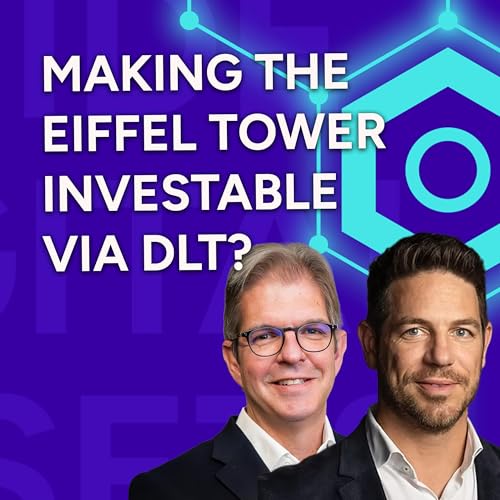
  • Making the Eiffel Tower investable via DLT? A converstion with Tom Rieder (ISP Group) [EN]
    May 21 2026
    What does it take for tokenization to create real value in capital markets? In this episode of "Inside Digital Assets", host Claudio Tognella speaks with Tom Rieder (Head of Digital Assets at ISP Group), about the practical implementation of tokenization and the role of digital assets in the future of capital market infrastructure. Tom explains why tokenization should not be an end in itself. Before an asset is tokenized, issuers need to understand the business case, the rights being represented, the target investors and the concrete benefits for all parties involved. The conversation covers real-world use cases such as real estate projects, pre-IPO shares, private equity and fund structures. It also explores why tokenized assets do not automatically become liquid and why secondary markets, custody solutions, distribution channels, market makers and reliable settlement infrastructure are essential. The episode also looks at the role of regulated infrastructure providers such as BX Digital and Seturion, and why banks, brokers and custodians may be key to making tokenized securities accessible to a broader investor base. A practical conversation about tokenization, digital assets, secondary markets and the next phase of capital market infrastructure.
    Afficher plus Afficher moins
    23 min
  • Warum Europas Kapitalmarkt neue Infrastruktur braucht: Ein Gespräch mit Dirk Grunert von Morgan Stanley [DE]
    May 7 2026
    In dieser Folge von «Inside Digital Assets» spricht Host Lidia Kurt, CEO von BX Digital und Seturion, mit Dirk Grunert, Managing Director bei Morgan Stanley, über den technologischen Wandel im Kapitalmarkt und die Frage, warum neue Infrastruktur für Europa immer wichtiger wird. Dirk Grunert gibt Einblicke in das Geschäft mit strukturierten Produkten und erklärt, wie Derivate dabei helfen, Risiken zu verteilen und abzusichern. Gleichzeitig blickt er auf die Entwicklung des Bankings zurück: von physischen Wertpapieren, manuellen Prozessen und Röhrenmonitoren auf dem Trading Floor bis hin zu Online-Banking, Neo-Brokern und digitalen Marktprozessen. Im Zentrum der Episode steht die Tokenisierung von Wertpapieren und Vermögenswerten. Welche Rolle spielen Digital Assets für Banken, Emittenten und Anleger? Warum reichen bestehende Abwicklungs- und Verwahrstrukturen langfristig nicht mehr aus? Und wie kann moderne Settlement-Infrastruktur dazu beitragen, Kapitalmärkte effizienter, transparenter und skalierbarer zu machen? Ein weiterer Schwerpunkt ist Europa: Dirk Grunert spricht über die Fragmentierung des europäischen Kapitalmarkts, die Bedeutung einheitlicher Standards und die Chancen einer pan-europäischen Abwicklungsinfrastruktur. Dabei wird deutlich: Tokenisierung ist nicht nur ein technologisches Thema, sondern auch eine Frage von Wettbewerbsfähigkeit, Skalierung und neuen Geschäftsmodellen. Eine Folge über strukturierte Produkte, Digital Assets, Settlement, Tokenisierung, europäische Kapitalmarktinfrastruktur und die Zukunft des Wertpapierhandels.
    Afficher plus Afficher moins
    19 min