Épisodes

  • EP Edge Newsletter Part II: Pulsed Field Ablation Trials — ADVENT, PULSED AF, Sphere-9, VARIPULSE, VOLT, INSIGHT, and PULSAR
    Feb 18 2026

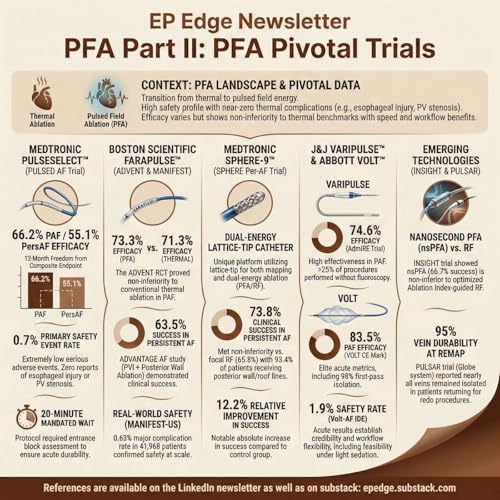
    In this episode of the EP Edge Newsletter Podcast, we analyze the pivotal clinical trials that established pulsed field ablation (PFA) as a major technological advancement in atrial fibrillation ablation. We examine the foundational FDA-approval studies, including the PULSED AF trial evaluating the Medtronic PulseSelect system and the ADVENT randomized trial comparing FARAPULSE pulsed field ablation with conventional radiofrequency and cryoballoon ablation. These trials demonstrated that pulsed field ablation achieves high rates of acute pulmonary vein isolation with freedom from atrial arrhythmia recurrence comparable to thermal ablation, while maintaining a favorable safety profile and procedural efficiency. Importantly, these studies defined modern clinical endpoints for catheter ablation success, including composite measures incorporating arrhythmia recurrence, antiarrhythmic drug use, cardioversion, and repeat ablation.

    PFA Part II

    We also explore next-generation pulsed field ablation platforms, including the Sphere-9 lattice-tip catheter, VARIPULSE system, and VOLT balloon-in-basket catheter, each designed to improve lesion durability, catheter stability, and procedural reproducibility. These studies demonstrate consistently high rates of pulmonary vein isolation, favorable safety outcomes, and evolving workflow advantages, including reduced fluoroscopy use and efficient lesion delivery. We then examine the latest randomized and investigational trials, including INSIGHT, which compared nanosecond pulsed field ablation with optimized ablation-index guided radiofrequency ablation, and the PULSAR IDE trial evaluating spherical array catheter design for durable pulmonary vein isolation. These trials highlight a critical reality in atrial fibrillation ablation: long-term success is determined not only by energy source, but by catheter design, tissue contact, lesion geometry, and pulmonary vein isolation durability.

    PFA Part II

    Full references, detailed discussion, figures, and graphical summaries are available on the EP Edge Newsletter on LinkedIn, as well as the complete long-form article on Substack at epedge.substack.com. If you have questions, suggestions, or feedback, please contact epedgecast@gmail.com.

    Afficher plus Afficher moins
    42 min
  • EP Edge Newsletter Part I: Pulsed Field Ablation (PFA) — Electroporation, Biophysics, Engineering, Tissue Selectivity, and Lesion Formation
    Feb 11 2026

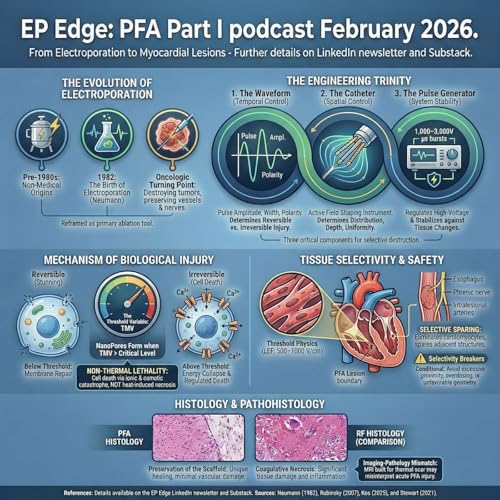
    In this foundational episode of the EP Edge Newsletter Podcast, we examine the scientific and engineering principles underlying pulsed field ablation (PFA), a transformative advance in catheter ablation for atrial fibrillation. Unlike radiofrequency or cryoablation, which rely on thermal injury, pulsed field ablation produces myocardial lesions through irreversible electroporation, a non-thermal mechanism that disrupts the cell membrane by applying precisely controlled electric fields. This represents a fundamental shift in ablation biology, where lesion formation is governed not by heat, but by transmembrane voltage thresholds, membrane destabilization, and controlled cellular injury.

    This episode traces the history of electroporation, from its origins in physics and industrial biotechnology to its adoption in oncology as a non-thermal tumor ablation modality and eventual translation into cardiac electrophysiology. We then explore the Engineering Trinity of pulsed field ablation—the waveform, catheter, and pulse generator—and how these components interact to determine lesion size, safety profile, tissue selectivity, and procedural effectiveness. Understanding this integrated engineering system is essential to interpreting differences between pulsed field ablation platforms and explains why voltage alone does not define lesion durability or procedural success.

    We also examine the cellular and molecular mechanisms of PFA lesion formation, including nanopore creation within the lipid bilayer, calcium influx, ATP depletion, mitochondrial dysfunction, and regulated cell death pathways. These membrane-driven injury mechanisms produce lesions that differ fundamentally from thermal ablation, preserving extracellular architecture while eliminating cardiomyocytes. This unique biology underlies one of the most important advantages of pulsed field ablation—tissue selectivity, where myocardial cells demonstrate greater susceptibility to irreversible electroporation compared with surrounding structures such as the esophagus, nerves, and vasculature, enabling effective ablation with reduced collateral injury risk.

    Finally, we review the histopathology and structural evolution of pulsed field ablation lesions, including sharply demarcated injury zones, preserved tissue scaffolding, and progressive fibrocellular remodeling over time. These distinctive lesion characteristics explain both the safety profile and long-term behavior of pulsed field ablation and provide critical insight into how electrophysiologists should interpret acute procedural endpoints and long-term durability.

    Full references, detailed discussion, figures, and visual summaries are available on the EP Edge Newsletter on LinkedIn, as well as the full long-form edition on Substack at epedge.substack.com.

    If you have questions, suggestions, or feedback, please email epedgecast@gmail.com

    Afficher plus Afficher moins
    20 min
  • Cannabis and the Heart: Atrial Fibrillation, Arrhythmias, Stroke, Myocardial Infarction and Sudden Cardiac Risk Explained
    Dec 22 2025

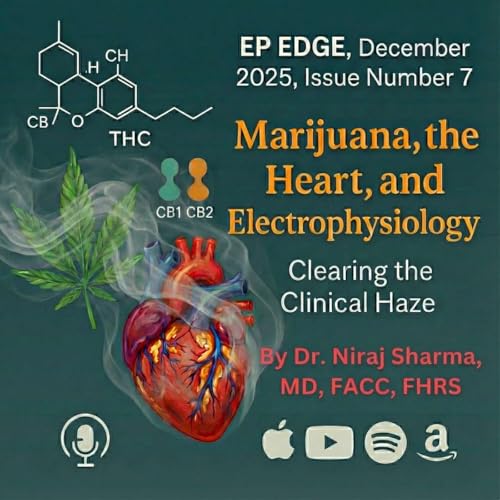
    In this EP-EDGE podcast episode, Dr. Niraj Sharma, cardiac electrophysiologist, breaks down the latest evidence linking modern high-THC cannabis to cardiovascular and electrophysiologic risk. Drawing from large real-world datasets, mechanistic studies, and global meta-analyses, this episode explains how today’s cannabis products—vapes, edibles, dabs, and synthetic cannabinoids—are very different from the low-potency marijuana of the past.

    We explore the science behind CB1 receptor activation, autonomic imbalance, endothelial dysfunction, platelet activation, and how these mechanisms translate into real-world clinical outcomes—including:

    • Atrial fibrillation and supraventricular tachycardia
    • Premature atrial and ventricular beats
    • Ventricular tachycardia and ventricular fibrillation
    • Myocardial infarction and stroke in young adults
    • Endothelial dysfunction as an early vascular warning sign
    • Why high-potency THC and route of use (vaping, edibles, dabs) matter

    This episode reviews landmark studies from JACC Advances, Heart, JAMA Cardiology, European Heart Journal, and Heart Rhythm, including massive EHR-based cohorts involving millions of patients. We also address common misconceptions, including why some older studies show neutral risk—and why those findings do not apply to modern high-potency cannabis use.

    Whether you are a cardiologist, electrophysiologist, primary care clinician, or an informed patient, this episode provides a clear, evidence-based framework to understand why modern cannabis is not cardiovascularly benign and how it should be discussed in clinical practice—especially in patients with atrial fibrillation, ventricular arrhythmias, or unexplained cardiac events.

    References, infographics, and detailed study breakdowns are available in the EP-EDGE LinkedIn Newsletter (December 2025 issue).

    Afficher plus Afficher moins
    24 min
  • When Atrial Fibrillation Ablation Fails: Have We Reached the Limit or Just the Wrong Target?
    Nov 23 2025

    In this issue, we trace the fascinating evolution of atrial fibrillation (AF) therapy — from the Cox Maze procedure to Haïssaguerre’s discovery of pulmonary vein ectopy, through Pappone’s wide antral isolation, and onward to the era of pulse field ablation (PFA).

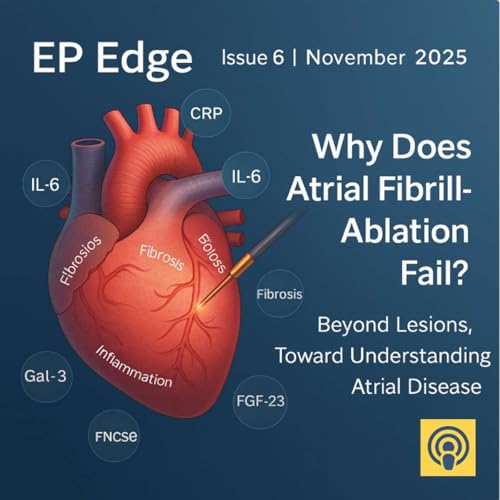
    We explore how ablation technologies have transformed — radiofrequency, cryo, and PFA — yet the success rates remain stubbornly static. Why do some ablations fail? Are we reaching the limits of substrate modification, or simply targeting the wrong mechanisms?

    Join Dr. Sharma as he dissects the mechanistic layers of ablation failure — from pulmonary vein reconnection and atrial substrate remodeling to inflammation, fibrosis, and autonomic imbalance. The discussion looks ahead to next-generation strategies that may redefine success in AF therapy.

    If you enjoy this episode, subscribe and share the podcast to help grow the EPH community.
    For questions, suggestions, or collaboration ideas, reach out at EPEdgeCast@gmail.com

    Afficher plus Afficher moins
    12 min
  • Targeting the Intrinsic Pathway: Is Factor XI Inhibition Poised to Redefine Stroke Prevention in AF: EP Edge August 2025 Issue 4A
    Oct 28 2025

    What if stroke prevention in atrial fibrillation no longer meant trading protection for bleeding risk?

    Factor XI inhibition—led by trials like AZALEA–TIMI 71, LILAC–TIMI 76, and LIBREXIA–AF—is poised to rewrite the anticoagulation playbook. By targeting the intrinsic pathway, these agents may decouple thromboembolic protection from major bleeding, potentially reshaping the role of left atrial appendage occlusion (LAAO) in stroke prevention strategies.

    In this episode of EP Edge, Dr. Niraj Sharma breaks down the evolving data, drug classes, mechanistic rationale, and implications for future guidelines—while also looking at where structural interventions may still fit in this shifting landscape.

    For: Source data/infographics see EPEDGE Newsletter on LinkedIn
    For feedback, collaborations, or questions, email Dr. Niraj Sharma at epedgecast@gmail.com or connect on LinkedIn

    Afficher plus Afficher moins
    10 min
  • First-Line VT Ablation: Trials, Tools & Timing: EP Edge Newsletter June 2025
    Oct 28 2025

    The paradigm is shifting. Ventricular tachycardia (VT) ablation is stepping out of the shadows—from rescue therapy to first-line strategy, driven by landmark trials like VANISH2, PAUSE-SCD, and PARTITA. Meanwhile, pulse field ablation (PFA) continues its rapid evolution—crossing over from atrial to ventricular applications—but questions about durability and embolic safety persist.

    In this episode of EP Edge, Dr. Niraj Sharma takes you through the key data shaping modern electrophysiology, from trial outcomes to emerging technology, including injectable light-activated pacemakers and telomere-targeting strategies that may redefine longevity and prevention.

    Whether you’re an EP, a general cardiologist, or in allied research, this episode offers evidence-based insights and forward-looking perspectives on where rhythm science is heading.
    For: Source data/infographics see EPEDGE Newsletter on LinkedIn
    For feedback, collaborations, or questions, email Dr. Niraj Sharma at epedgecast@gmail.com

    or connect on LinkedIn

    Afficher plus Afficher moins
    8 min
  • Left Atrial Appendage Occlusion (LAAO): Where We Stand in 2025: EP Edge Newsletter 4B August 2025
    Oct 28 2025

    Left atrial appendage occlusion (LAAO) has evolved from a niche option for oral anticoagulation–intolerant patients to a frontline procedural strategy for stroke prevention in atrial fibrillation. Landmark trials like OPTION, SWISS‑APERO, and COMBINATION are redefining how and when we use these devices.

    In this episode of EP Edge, Dr. Niraj Sharma walks through the historical arc of LAAO, key evidence shaping contemporary practice, procedural complications often under-recognized (like silent cerebral lesions), and where the field is headed with AI, new device designs, and competition from Factor XI inhibitors.

    This is essential listening for electrophysiologists, interventional cardiologists, and rhythm specialists navigating the next era of stroke prevention.

    For: Source data/infographics see EPEDGE Newsletter on LinkedIn
    For feedback, collaborations, or questions, email Dr. Niraj Sharma at epedgecast@gmail.com or connect on LinkedIn

    Afficher plus Afficher moins
    9 min
  • Pulse Field Ablation: Promise, Peril, and the AI Revolution in EP: EP Edge Newsletter May 2025
    Oct 28 2025

    Pulse field ablation (PFA) has been hailed as the next frontier in atrial fibrillation therapy—nonthermal, ultra-selective, and lightning fast. But as new data emerges, important questions are rising about its systemic effects, cerebral safety, and vascular complications.

    In this episode of EP Edge, Dr. Niraj Sharma unpacks the latest findings from the NEMESIS-PFA registry, explores silent cerebral lesion data, reviews a rare case of catastrophic coronary spasm, and introduces how AI—through models like DeePRISM—is changing how we think about ablation strategy.

    Whether you’re in the lab, in clinic, or leading research, this episode offers a critical look at where the field is heading next.
    For: Source data/infographics see EPEDGE Newsletter on LinkedIn
    For feedback, collaborations, or questions, email Dr. Niraj Sharma at epedgecast@gmail.com

    or connect on LinkedIn

    Afficher plus Afficher moins
    9 min