

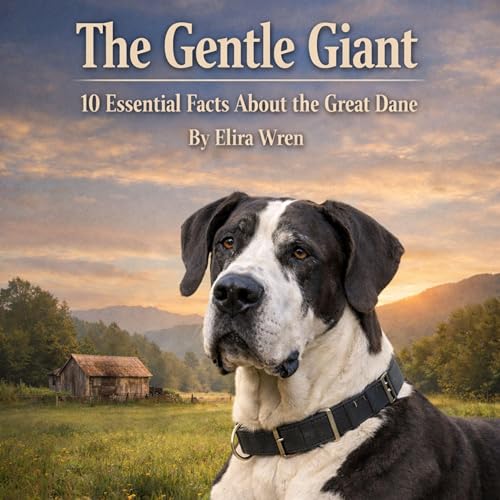
The Gentle Giant
10 Essential Facts About the Great Dane (Mans Best Friend)
Impossible d'ajouter des articles
Échec de l’élimination de la liste d'envies.
Impossible de suivre le podcast
Impossible de ne plus suivre le podcast
Bénéficiez gratuitement de Standard pendant 30 jours

The Gentle Giant
Acheter pour 11,99 €
-
Lu par :
-
Richard Bryce Wallis
-
De :
-
Elira Wren
The Great Dane, as we know it today, stands as one of the most recognisable and distinctive dog breeds in the world. Its towering height, long limbs, and calm expression give it an almost noble appearance, one that seems far removed from the rough and demanding environments in which its ancestors once worked. To fully understand this breed, it is essential to look beyond its modern role as a companion and examine the long, deliberate journey that shaped it.
The origins of the Great Dane are not tied to a single moment or place, but rather to a gradual process of development that took place over centuries. Large, powerful dogs have existed in various forms throughout European history, often bred for specific tasks that required strength, speed, and resilience. Among these tasks, hunting large game was one of the most demanding. It required dogs capable of tracking, pursuing, and holding animals that were not only fast but also dangerous.
In earlier periods, particularly during the Middle Ages and into the early modern era, hunting was not simply a pastime. For many, it was a necessity and, for others, a display of status and skill. Large estates and noble households maintained packs of specialised dogs, each bred for a particular role. Among these were the early forms of what would eventually become the Great Dane.
These dogs were not identical to the breed we recognise today, but they shared certain key characteristics. They were tall, muscular, and capable of moving with speed despite their size. Their role often involved pursuing large animals such as boar, a task that required not only physical strength but also courage and determination. This was not a passive activity. A dog that hesitated or lacked confidence could be injured or killed. As a result, early breeding placed a strong emphasis on both physical ability and mental steadiness.
©2026 Deep Vision Media t/a Zentara UK (P)2026 Deep Vision Media t/a Zentara UK