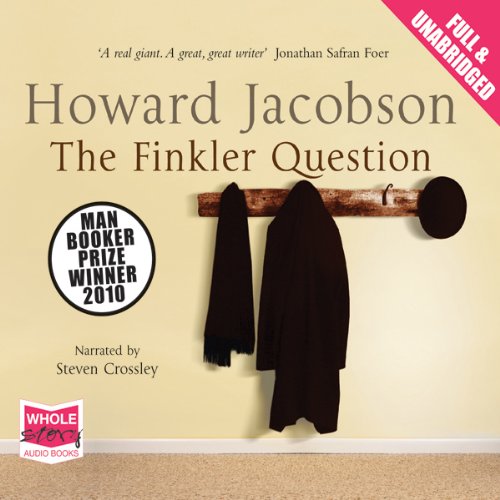
Couverture de The Finkler Question

The Finkler Question

Aperçu
Essayez pour 0,99 €/mois Essayer pour 0,00 €
Offre valable jusqu'au 29 janvier 2026 à 23 h 59.
Jusqu'à 90% de réduction sur vos 3 premiers mois.
Écoutez en illimité des milliers de livres audio, podcasts et Audible Originals.
Sans engagement. Vous pouvez annuler votre abonnement chaque mois.
Accédez à des ventes et des offres exclusives.
Écoutez en illimité un large choix de livres audio, créations & podcasts Audible Original et histoires pour enfants.
Recevez 1 crédit audio par mois à échanger contre le titre de votre choix - ce titre vous appartient.
Gratuit avec l'offre d'essai, ensuite 9,95 €/mois. Possibilité de résilier l'abonnement chaque mois.

The Finkler Question

De : Howard Jacobson
Lu par : Steven Crossley
Essayez pour 0,99 €/mois Essayer pour 0,00 €

3 mois pour 0,99 €/mois, puis 9,95 €/mois. Possibilité de résilier chaque mois. Offre valable jusqu'au 29 janvier 2026 à 23 h 59.

9,95 € par mois après 30 jours. Résiliez à tout moment.

Acheter pour 19,98 €

Acheter pour 19,98 €

3 mois pour 0,99 €/mois

Après 3 mois, 9.95 €/mois. Offre soumise à conditions.

À propos de ce contenu audio

Man Booker Prize, Fiction, 2010

Julian Treslove and Sam Finkler are old school friends. Despite a prickly relationship and very different lives, they've never quite lost touch with each other - or with their former teacher, Libor Sevick. Now all three are recently widowed, in their own way, and spend sweetly painful evenings together reminiscing. Until an unexpected violent attack brings everything they thought they knew into question.

©2010 Howard Jacobson (P)2010 W F Howes Ltd
Fiction Fiction contemporaine
Les membres Amazon Prime bénéficient automatiquement de 2 livres audio offerts chez Audible.

Vous êtes membre Amazon Prime ?

Bénéficiez automatiquement de 2 livres audio offerts.
Bonne écoute !

    Avis de l'équipe

    This Booker Prize-winning novel doesn’t cover a lot of thematic ground; like Jane Austen, Howard Jacobson likes to explore a narrow field of study. In his case, it is the UK’s Jewish population especially as focussed around north London. But also like Austen, Jacobson’s miniaturist observations can illuminate and touch on universal questions, and has room for multi-layered comedy.

    Julian Treslove is an unspectacular television producer of arts programs and a celebrity impersonator, with two failed marriages behind him and two distant, resentful sons. A gentile convinced that a Jewish identity would offer asylum from his identity crisis, Treslove is acutely envious of his old school friend Sam Finkler, now a highly successful author of glib pop-philosophy best sellers with titles like “The Existentialist in the Kitchen”. For Treslove, Finkler comes to represent Jewish identity: The ‘Jewish question’ (in all its loaded historical ambivalence) becomes the Finkler question, at once sanitized and personalized. Both men regularly meet with their former teacher, Libor Sevcik, a colorful Mittel-European transplant who serves as the book’s heart (as well as narrator Steven Crossley’s finest achievement). He is crotchety, funny, and touching in his devotion to his dead wife, even while on hilariously awkward dates.

    Jacobson has great fun in pitting his character’s different approaches to Jewishness against each other, particularly Treslove’s gauche appropriation (“He looked like Topol; that’s how Treslove knew he was a Jew.”). There is a sense that the three male leads are facets of one personality with a schismatic approach to Jewishness: Crossley, however, is able to give each one their own unique voice. In fact, with The Finkler Question, Crossley gives a masterclass in narration. His characterizations are colorful without lapsing into caricature, and he unfailingly gets the intent behind each line, each rhetorical question, each instance of passive-aggressive indignation (and there’s a lot of that). Especially with this book, the narrator has an important task: the physical attack that kicks off Treslove’s identity crisis hinges on a linguistic confusion, and Crossley’s obsessive delivery of each permutation of the attacker’s garbled words is just one very funny moment in an excellent performance.

    Aucun commentaire pour le moment