

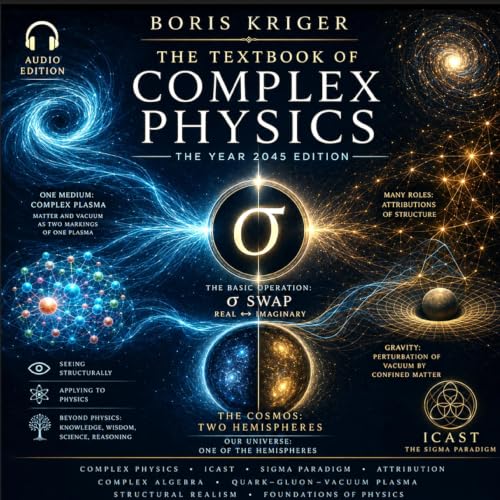
THE TEXTBOOK OF COMPLEX PHYSICS
THE YEAR 2045 EDITION (SCIENCE AND COSMOS)
Impossible d'ajouter des articles
Échec de l’élimination de la liste d'envies.
Impossible de suivre le podcast
Impossible de ne plus suivre le podcast
Bénéficiez gratuitement de Standard pendant 30 jours

THE TEXTBOOK OF COMPLEX PHYSICS
Acheter pour 17,99 €
-
Lu par :
-
David A. Martin
-
De :
-
Boris Kriger
For most of human history, people have asked what the world is made of. Atoms, said the ancients. Particles and fields, said the moderns. Vibrating strings, said the late twentieth century. Each answer named some kind of substance — a stuff out of which everything is built. Each answer ran, in the end, into the same wall: a list of unsolved problems that could not be addressed without inventing more substances, more particles, more dimensions of stuff.
The framework presented in this book takes a different route. It begins from a simple recognition: what we have called things are, on closer examination, roles. The world is not made of substances. It is made of attributions — structural markings imposed on a single underlying medium — and the basic operation by which these markings are transformed is a swap of real and imaginary components, called sigma. From this one operation, applied at different levels of structure, the contents of physics follow: matter and vacuum as two markings of one plasma; light and the forces as connections between configurations; gravity as the perturbation of vacuum by confined matter; the cosmos as a two-hemisphere structure with our universe one of the hemispheres.
The Textbook of Complex Physics: The Year 2045 Edition presents this framework as it is now taught at the foundational level, without specialist mathematics, with the clarity that a settled paradigm permits. The book is in three parts. The first part teaches how to see the world structurally. The second part applies this seeing to physics, from atoms to cosmology. The third part extends the way of thinking beyond physics, to knowledge, wisdom, the architecture of the sciences, and the conduct of reasoning. The book carries the reader from the simplest observation about the world — that what looks like things is, on closer examination, roles — to the structural understanding on which the present generation's intellectual life is built.
©2026 Boris Kriger (P)2026 Boris KrigerPoursuivre la série


