

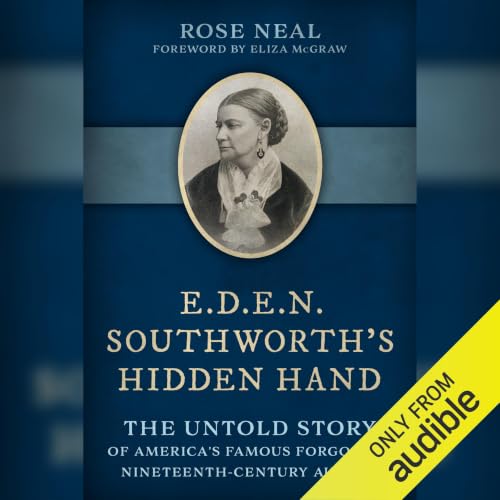
E.D.E.N. Southworth's Hidden Hand
Impossible d'ajouter des articles
Désolé, nous ne sommes pas en mesure d'ajouter l'article car votre panier est déjà plein.
Veuillez réessayer plus tard
Veuillez réessayer plus tard
Échec de l’élimination de la liste d'envies.
Veuillez réessayer plus tard
Impossible de suivre le podcast
Impossible de ne plus suivre le podcast
Bénéficiez gratuitement de Standard pendant 30 jours
5,99 €/mois après la période d’essai. Annulation possible à tout moment

E.D.E.N. Southworth's Hidden Hand
Lu par :
Virtual Voice
Acheter pour 14,99 €
-
Lu par :
-
Virtual Voice
-
De :
-
Rose Neal

Ce titre utilise une narration à voix virtuelle
La voix virtuelle est une narration générée par ordinateur pour les livres audio.
E.D.E.N. Southworth (Emma Dorothy Eliza Nevitte) was one of the nineteenth century’s most prolific and successful authors, with more novels to her credit than Nathaniel Hawthorne, Herman Melville, and Mark Twain combined. Readers loved her feisty heroines who rode horses, shot pistols, captured notorious villains, became sea captains, and had other such grand adventures. In 1859, countless readers named their daughters Capitola after their favorite character in Southworth’s best-selling The Hidden Hand.
In her fifty-plus novels, Southworth wrote about unspeakable topics for the time, including alcoholism, domestic violence, poverty, and capital punishment—all nicely tucked away within the pages of her “domestic fiction.” Despite being raised in a slave-owning family, she wrote for The National Era (a known abolitionist magazine), supported emancipation, and encouraged her longtime friend Harriet Beecher Stowe to publish Uncle Tom’s Cabin. Southworth also advocated for better education for girls and better living conditions for the poor and joined the early women’s rights movement.
Although Southworth achieved international fame in her lifetime, knowledge of her work virtually disappeared as readers were drawn to the new Modernist literature. Because Southworth never discussed her progressive views publicly—a necessity as a single mother who made a living by her pen—she has long been incorrectly categorized as being against causes she in fact supported. Now, by combining details from Southworth’s novels, newspapers, and personal letters, Rose Neal has set the record straight, piecing together the fascinating life of a woman who was as determined as the heroines she created.(P)2026 Lyons Press
adbl_web_anon_alc_button_suppression_t1
Aucun commentaire pour le moment


