Couverture de (un)Trustables

(un)Trustables

(un)Trustables

De : Darrell O'Donnell
Écouter gratuitement

3 mois pour 0,99 €/mois

Après 3 mois, 9.95 €/mois. Offre soumise à conditions.

À propos de ce contenu audio

Dive deep into the evolving world of digital trust with the (un)Trustables Podcast. Join us as we unravel the complexities of the internet's missing trust layer, featuring conversations with thought leaders from startups, crypto realms, enterprises, and even (dare we say) government sectors. With each episode, we take a step closer to understanding how we can craft an internet truly worth our trust. Whether you're an industry professional, tech enthusiast, or just curious about the future of the web, the (un)Trustables is your essential guide. Subscribe now and be part of the change we want to see online.2023 Continuum Loop Inc. Economie
Les membres Amazon Prime bénéficient automatiquement de 2 livres audio offerts chez Audible.

Vous êtes membre Amazon Prime ?

Bénéficiez automatiquement de 2 livres audio offerts.
Bonne écoute !
    Épisodes
    • Decoding Digital Trust Ecosystems with Sezoo
      May 21 2024
      Have you ever struggled to grasp the complexities of digital identity and trust?In this episode of The (un)Trustables Podcast, host Darrell O'Donnell is joined by Jo Spencer and John Phillips from Sezoo, a boutique consultancy specializing in digital trust ecosystems.They delve into the intricate world of verifiable credentials, guardianship, and the challenges of governing trust ecosystems. With real-world examples from their work with the New South Wales government and other clients, Jo and John share their expertise in distilling complex concepts into simple, digestible explanations.Guests:Jo Spencer is a technology executive with over 30 years of global experience in software, product design, consulting, architecture, and strategy, specializing in payments and banking systems. As a co-founder of Sezoo, Jo has spent the last 3 years promoting verifiable credentials and decentralized interaction models to enhance commercial offerings and customer relationships. Jo is also a Partner at 460degrees, leading financial services and architecture activities, collaborating with fintechs, banks, regulators, and product vendors in payments and banking innovation. Previously, Jo led technical strategy, enterprise architecture, and solution design at ANZ Banking Group across 32 countries, focusing on payments, open banking, blockchain, digital identity, compliance, and messaging solutions. Jo has a strong track record of building businesses, solutions, and commercial products for banks and software suppliers globally. John Phillips is an expert in Digital Trust frameworks, including Self-Sovereign Identity, and is a co-founder of Sezoo. He leads the 460degrees Ventures, Emerging Technology, and Education practices. With over 30 years of international experience in high technology industries and management consulting, John has worked across 10 countries in sectors ranging from Space to Government, Finance, Utilities, and more. He believes in the potential of open-standards technologies like verifiable credentials and decentralized identifiers to radically improve digital trust on personal, social, and global scales. John authored the chapter on explaining the value of SSI to business in the "Self-Sovereign Identity Decentralized digital identity and verifiable credentials" book. Since co-founding Sezoo in 2021, he has worked on digital trust projects with Australian Federal and State governments, major financial institutions, scheme operators, and medical data research organizations. John also serves as a co-chair of the Sovrin Working Group on Guardianship and collaborates with the Trust over IP foundation on human-centric technology design.Here are some valuable topics covered:Understanding the nuances of verifiable credentials and digital walletsNavigating the complexities of guardianship and delegation in digital interactionsStrategies for governing trust ecosystems and managing stakeholder interestsThe art of creating effective "explainers" for decision-makersDon't miss this opportunity to gain insights from two seasoned experts in the field of digital trust. Tune in to learn how to navigate the intricacies of this ever-evolving landscape.Key Insights:Verifiable credentials allow for the digital representation of existing credentials, like driving licenses or first aid certificates, without disrupting existing governance frameworks.Guardianship and delegation in digital interactions are complex areas that require careful consideration of existing legal frameworks and cultural norms.Effective governance of trust ecosystems involves managing stakeholder interests, collaboration, and competition within and across ecosystems.Creating simple, visual "explainers" using everyday objects can be a powerful way to help decision-makers grasp complex concepts.Strategies:Use the Trust Over IP governance architecture as a framework for designing ecosystem governance.Avoid overcomplicating digital solutions; keep them aligned with existing physical processes for easier adoption.Authenticate content and communications to build trust with customers and prevent scams.Additional ResourcesSezooTrust Over IP FoundationSpecifications for ToIP-compliant governance frameworks"Thing Explainer: Complicated Stuff in Simple Words" by Randall MunroeThe Design SquiggleNew South Wales Digital Identity and Verifiable Credentials ConsultationNew South Wales Digital Birth CertificateJo Spencer: LinkedInJohn Phillips: LinkedIn
      Afficher plus Afficher moins
      1 h et 11 min
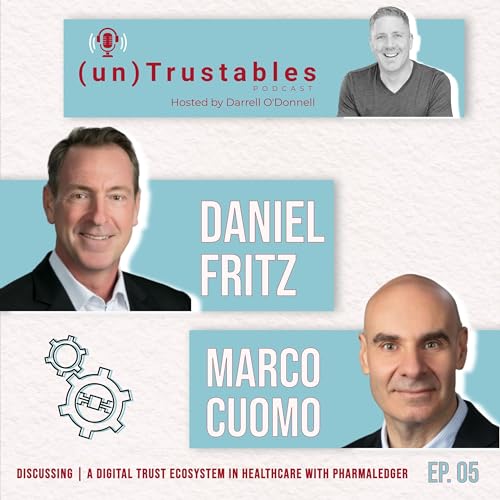
    • Enabling a Digital Trust Ecosystem in Healthcare with PharmaLedger
      Apr 2 2024

      How can we build a healthcare system that fosters trust, transparency, and collaboration between diverse stakeholders? In this episode of The (un)Trustables, host Darrell O'Donnell sits down with Daniel Fritz, Executive Director, and Marco Cuomo, Chief Technology Officer of the PharmaLedger Association.

      PharmaLedger is pioneering a digital trust ecosystem in healthcare, leveraging blockchain. But with players as varied as pharmaceutical giants, patient advocacy groups, NGOs, and technology vendors, how do you align interests and drive consensus?

      Guests:

      Daniel Fritz: Dan is the Executive Director of the PharmaLedger Association, a not-for-profit based in Switzerland with the purpose of enabling and fostering a Digital Trust Ecosystem (DTE) in healthcare. The Association is the result of a 3-year, 30-member public-private PharmaLedger consortium where Dan served as the Industry Project Leader. Dan worked at Novartis in Switzerland and Germany for 20 years in supply chain, manufacturing, and systems architecture. He has over 30 years of leadership and supply chain IT experience in the US Army, financial, and pharma industries. He holds a B.S. from the United States Military Academy at West Point and an MBA from Duke’s Fuqua School of Business.

      Marco Cuomo: Marco is the Chief Technology Officer of the PharmaLedger Association, responsible for defining the platform technology for a Digital Trust Ecosystem in healthcare to bring the benefits of blockchain to patients and partners. He was previously with Novartis in Switzerland for more than 17 years, where he served as the Director of Tech Products & Innovation, responsible for exploring, engineering, and implementing emerging technologies, with a focus on blockchain and its application in the healthcare industry. He began his career as a programmer in software development in the financial industry and has had roles in engineering, operations, service management, solution design and digital strategy.

      In this conversation, Daniel and Marco discuss:

      • The challenges of uniting competitors around a shared vision
      • Overcoming resistance to new paradigms and decentralized models
      • Using real-world use cases to illustrate blockchain's transformative potential
      • Designing governance to represent all stakeholders' voices
      • The imperative shift from "ownership" to "influence" in ecosystem thinking

      Tune in for a candid look at the triumphs and growing pains of catalyzing change across an industry often set in its ways. You'll gain a deeper appreciation for the rewards of cross-sector collaboration in tackling healthcare's most complex problems.

      Key Insights

      • PharmaLedger brings together pharmaceutical companies, technology vendors, patient groups, and other healthcare stakeholders to build shared digital solutions based on blockchain and decentralized architectures
      • The vision is to create a digital trust ecosystem that enables transparency, security, and efficient information exchange across the healthcare value chain
      • Achieving consensus among diverse members with competing interests is an ongoing challenge that requires compromise, long-term vision, and inclusive governance
      • Focusing on clear value propositions for each stakeholder, rather than evangelizing specific technologies, generates more buy-in
      • Transitioning from centralized, "ownership" mindsets to collaborative "influencing" is a paradigm shift essential for ecosystem success

      Strategies

      • Developing proofs-of-concept using tangible, high-impact use cases (like digital product information tracking)
      • Structuring the association with varied membership classes and equitable board representation
      • Creating an innovation lab to explore and iterate on new ideas in a low-risk environment
      • Remaining technology-agnostic and focusing communications on solving core business needs
      • Designing projects for ecosystem-wide mutual benefit rather than competitive advantage

      Process

      • Transitioning PharmaLedger from an EU-funded initiative to an independent Swiss Association
      • Evolving the association's governance model to empower individual project's autonomy
      • Introducing new stakeholder groups gradually as shared understanding matures
      • Pivoting messaging from "blockchain-enabled healthcare" to "digital trust ecosystems"
      Afficher plus Afficher moins
      58 min
    • Revolutionizing Workforce Credentials with Blockchain
      Mar 12 2024

      Guest:

      Dror Gurevich is the Founder and CEO of Velocity Network Foundation, bringing over 25 years of experience in workforce technology. As a leader and entrepreneur, Dror has been at the forefront of several successful companies in the sector, demonstrating a profound understanding of the industry’s evolution. His current role at Velocity Network Foundation highlights his commitment to innovating workforce tech, specifically utilizing blockchain technology to transform how career credentials are managed globally. Recognized as a thought leader, Dror is a sought-after keynote speaker, sharing his insights on the Future of Work and innovations in workforce technology.

      In this episode of the (un)Trustables podcast, host Darrell O'Donnell engages in a comprehensive conversation with Dror Gurevich, CEO of Velocity Network Foundation. The discussion covers various aspects of the Velocity Network, its impact on the global labour market, and the innovative use of blockchain technology in workforce credential verification.

      Key Topics:

      • Introduction and Background of Velocity Network (Early in the episode): The podcast begins with an introduction to Velocity Network Foundation, explaining its mission and the role of blockchain technology in transforming workforce credential verification.
      • Global Inclusivity and Open Source Protocol (Approximately at 01:03:50): Gurevich discusses the creation of a globally inclusive, open-source public protocol owned by no single entity. This protocol is crucial for building applications that enable the trusted exchange of individuals' proofs​​.
      • Venture Capital Funding and Public Infrastructure (Approximately at 31:49): The conversation touches upon the role of venture capital in funding the research and development of the Velocity Network. Gurevich explains how this funding facilitated the creation of a public infrastructure that serves as a social good and the necessity of having a private operator on top of this infrastructure​​.
      • Disruption in the Job Market and the Role of Velocity Network (Approximately at 01:00:53): Gurevich highlights the challenges posed by the changing nature of employment and the increasing number of international migrants disrupting job markets. He emphasizes the need for a globally inclusive infrastructure to mitigate these megatrends and the potentially dire future if these trends are not addressed​​.
      • Tokenization and Fiat On-Ramps (Discussion throughout the episode): The use of tokens in the Velocity Network and the challenges of integrating them into traditional financial systems are discussed. Gurevich addresses the concerns of companies unfamiliar with token usage and the need for fiat on and off-ramps to facilitate transactions​​.
      • The Role of Notary Issuers (Discussed in the latter part of the episode): The podcast covers the significance of notary issuers in the Velocity Network, who are responsible for auditing and issuing credentials. This segment sheds light on the costs and value of participating in this process​​.

      Throughout the episode, O'Donnell and Gurevich delve into the technicalities, challenges, and future prospects of the Velocity Network. They discuss the network's potential to revolutionize how credentials are verified and shared globally, making it a crucial tool for addressing current and future challenges in the labour market. The episode is rich with insights into the intersection of blockchain technology and workforce development.

      Remember to subscribe to the (un)Trustables podcast for more conversations on technology and trust.

      Additional Resources:

      • Velocity Network Foundation
      • World Employment Confederation
      • American Council on Education
      • Schellman: IT Compliance Attestation Services
      • The Wallet Report
      • Read Write Own - Chris Dixon
      • Dror Gurevich LinkedIn
      Afficher plus Afficher moins
      1 h et 10 min
    Aucun commentaire pour le moment