Couverture de nCast: The Cloud Optimization Podcast from nOps

nCast: The Cloud Optimization Podcast from nOps

nCast: The Cloud Optimization Podcast from nOps

De : nOps
Écouter gratuitement

3 mois pour 0,99 €/mois

Après 3 mois, 9.95 €/mois. Offre soumise à conditions.

À propos de ce contenu audio

Introducing nCast, the cloud optimization podcast. Each episode features thought leaders and cloud industry experts sharing their real-world experiences and knowledge about cloud management, FinOps, AWS optimization and more. Listen now for tech news, cloud engineering insights, and anecdotes from engineering leaders on the front lines of cloud innovation.nOps Politique et gouvernement
Les membres Amazon Prime bénéficient automatiquement de 2 livres audio offerts chez Audible.

Vous êtes membre Amazon Prime ?

Bénéficiez automatiquement de 2 livres audio offerts.
Bonne écoute !
    Épisodes
    • #14: How Sonos Mastered Spot: Karpenter GA, KubeCon & More
      Nov 7 2024

      Karpenter has achieved GA and is disrupted the autoscaling game, with data pointing to accelerated adoption.

      Today, Josh Cypher, DevOps leader at Sonos, joins us to talk about some unexpected byproducts of adopting Karpenter at Sonos. Josh dives into his favorite features and efficiency gains, from node consolidation to better disruption controls.

      The public cloud bill is a massive operational expense for tech organizations, yet tracking the success of optimization efforts often frustrates engineers. Josh and James explore these challenges and how to address them effectively.

      As big-time Spot adopters, Sonos has unlocked impressive savings (50%?!) by focusing on high-impact, low-overhead strategies. Josh explains how visibility brought them quick wins and paved the way for further optimization across Sonos’s infrastructure.

      Plus, Josh and James preview what they’re looking forward to at KubeCon, including key conversations on Kubernetes, AI, and cloud sustainability.

      Afficher plus Afficher moins
      44 min
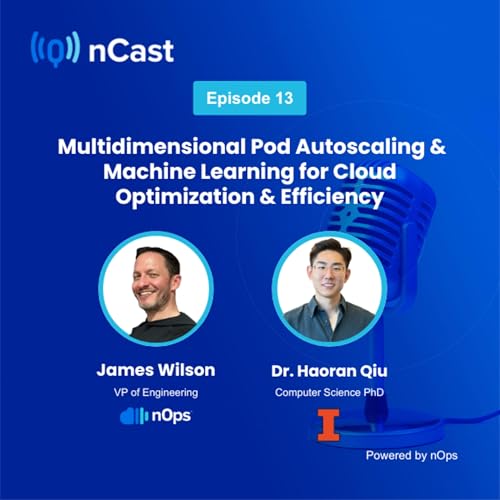
    • #13: Multidimensional Pod Autoscaling & Machine Learning for Cloud Optimization
      Jul 15 2024

      Dr. Haoran Qiu, a fresh PhD from the University of Illinois Urbana-Champaign, joins our host James Wilson, VP of Engineering at nOps. They’re diving into multidimensional autoscaling, an area in which Haoran’s pioneering research is making waves in the Kubernetes community.

      Some workloads work better with Horizontal Pod Autoscaler (HPA), others with Vertical Pod Autoscaler (VPA). Running them together can create conflicts, but using only one limits efficiency gains. A Multidimensional Pod Autoscaler solves this dilemma by combining the benefits of both VPA and HPA to dynamically adjust both the number and size of pods.

      But is MPA poised to redefine resource optimization? What problems does it solve, and what fresh complexities are involved in its implementation?

      Haoran and James dig into these questions while debating traditional heuristic versus Machine Learning approaches, industry versus academia, and other hot topics in Kubernetes.

      Listen now to discover if MPA is the holy grail of cloud optimization as we discuss the evolution of autoscaling technologies and their impact on cost, sustainability, and developer experience.

      Chapters:

      0:00 - 2:20: Haoran Chu and the state of cloud resource management

      2:20-6:00: Historical evolution of autoscaling

      6:01 - 10:45: HPA, VPA and Multidimensional Autoscaling

      10:46 - 18:50: Challenges of MPA: heuristics versus machine learning

      18:51 - 24:20: How to quantify excess capacity?

      24:21 - 32:16: The state of ML in autoscaling

      32:16 - 37:37: Operationalizing ML in production environments
      37:37 - 42:01: The near-term future of autoscaling

      Afficher plus Afficher moins
      44 min
    • #12: Optimizing for Sustainability
      Apr 19 2024

      Tech thought leader and host of the Kubernetes Unpacked podcast Kristina Devochko joins nCast today to talk all things cloud cost optimization, Kubernetes and green tech.

      We start by talking about the fact that many companies aren’t even using HALF of their compute resources. But does slashing your AWS bill necessarily mean that you’re saving the plant? We delve into cost optimization and how it aligns (or not) with sustainability.

      Kristina shares her insights on measuring your cloud carbon footprint and the tools you need (KEDA, Karpenter, Kepler) to increase cloud sustainability. We discuss key practical ways to get started cutting unnecessary cloud waste, from eliminating orphaned resources to scheduling during off hours.

      Plus, we're revealing how nOps has managed to run our production on Spot instances — talk about recycling!

      0:00 - 1:09: Introduction

      1:10 - 4:20: Sustainability at Kubecon Europe and other recent events

      4:21 - 9:31: Is cost optimization the same as sustainability?

      9:32 - 12:53: Green data centers and your carbon footprint

      12:54 - 15:21: Portability and the downsides of over-committing to pricing plans

      15:22 - 19:51: Measuring your organization’s cloud sustainability

      19:53 - 26:51: KEDA, Karpenter, Kepler and the tools you need

      26:52 - 31:12: Leveraging available Spot capacity and choosing instances

      31:13 - 37:15: Running production environments on Spot

      37:15 - 44:46: Continual rightsizing and automated tools

      44:47 - 48:18: Carbon-efficient Karpenter scaling

      Show notes

      • GitHub issue for proposal of carbon-efficient design to Karpenter that needs some community support

      • Kepler project

      • Carbon-aware KEDA operator

      • Cloud Carbon Footprint open source tool

      • BoaviztAPI open source API for environmental impacts of ICT

      • APIs that provide electricity data, data on carbon emissions and electricity sources: https://app.electricitymaps.com and https://watttime.org

      • CNCF TAG Environmental Sustainability

      • Contact Kristina Devochko

      • Kristina Devochko’s Tech blog

      Afficher plus Afficher moins
      51 min
    Aucun commentaire pour le moment