Épisodes

  • Episode 20: Stephanie Austin
    Jan 25 2026

    In this episode, host Will Rose speaks with author Stephanie Austin about her debut novel, Burn, which will be released on February 3, 2026, from Cowboy Jamboree Press.


    Stephanie reflects on the novel’s remarkable twenty-year journey to publication, tracing how the story evolved across drafts, forms, and decades before finally finding its true shape. She discusses why returning the book's setting to the 1990s was essential -- not as nostalgia, but as a narrative necessity -- and how themes of longing, miscommunication, and self-discovery depend on a world without constant digital access. The conversation also explores Stephanie’s relationship with her protagonist, the sense of grief that comes with finishing a long-gestating book, and the challenges of letting a beloved character go.


    You can learn more about Stephanie Austin and her books at https://www.stephanieaustin.net/.

    Afficher plus Afficher moins
    30 min
  • Episode 19: Jeff Roche
    Jan 18 2026

    In this episode of Words on a Wire, host Will Rose speaks with historian Jeff Roche, author of The Conservative Frontier: Texas and the Origins of the New Right (University of Texas Press), about how West Texas became one of the most conservative regions in American political life. Roche traces the roots of modern conservatism back to the late nineteenth century, beginning with the rise of ranching culture after the displacement of Indigenous peoples and the collapse of the bison economy. He explains how the entrepreneurial, anti-state ethos of early ranchers—embodied by figures like Charles Goodnight—combined with the mythology of the cowboy to form a durable regional identity centered on self-reliance, individualism, and suspicion of government authority.


    The conversation also explores the defining role of geography and environment in shaping West Texas culture, from its flat, arid plains to its chronic vulnerability to drought. Roche highlights the Dust Bowl as a turning point that shattered faith in agricultural abundance while deepening resentment toward federal intervention. The episode concludes with a discussion of Barry Goldwater’s influence on the rise of the New Right, showing how West Texas conservatives helped redefine American conservatism in the mid-twentieth century and laid the groundwork for the modern Republican Party.


    Afficher plus Afficher moins
    29 min
  • Episode 18: Christian Iglesias (@ChristianChurches)
    Jan 9 2026

    In this episode of Words on a Wire, host Will Rose speaks with El Paso–based photographer and videographer Christian Iglesias, widely known on social media as @ChristianChurches. Iglesias has built a devoted following by documenting the landscapes, people, and everyday moments of the borderlands.


    The conversation traces Iglesias’s journey from shooting high school football games at Eastwood High School to becoming one of the most recognizable visual storytellers in the El Paso region. With roots in journalism, Iglesias explains how the discipline of photojournalism—speed, relevance, and presence—continues to shape his approach.


    Iglesias also shares insights into the craft itself, discussing camera gear, lenses, and the enduring belief that great photography is driven by the artist’s eye rather than expensive equipment. He reflects on the rise of social media as a platform for documentary storytelling and how the pandemic pushed him to fully commit to sharing his work online.


    At the heart of the conversation is a deep love for El Paso. Iglesias speaks passionately about the people of the borderlands, the city’s resilience, and the quiet beauty that is often overlooked.

    Afficher plus Afficher moins
    29 min
  • Episode 17: Scótt Russell Dúncan
    Jan 3 2026

    In this episode of Words on a Wire, host Daniel Chacón speaks with writer, editor, and cultural critic Scótt Russell Dúncan about identity, futurity, and the politics of who gets to imagine the future. Dúncan discusses Chicanx futurism as an act of reclamation—of land, history, and possibility—pushing back against dominant narratives that exclude brown and Indigenous communities from visions of tomorrow. Through examples drawn from science fiction, publishing, and popular culture, he reflects on how mainstream media reinforces colonial power while marginalizing Chicanx voices.


    The conversation also explores Dúncan’s work as an editor and publisher, including his commitment to community-centered storytelling through Mais Poppin Press and the Puertas del Pueblo writing workshops. He speaks candidly about gatekeeping in the publishing industry, the pressure for Chicanx writers to filter their work for white audiences, and the importance of writing to one’s community rather than explaining it to outsiders. Grounded, critical, and hopeful, the episode highlights literature and collective imagination as essential tools for cultural survival and self-determination.

    Afficher plus Afficher moins
    51 min
  • Episode 16: Roberto Avant-Mier
    Jan 3 2026

    In this episode of Words on a Wire, host Daniel Chacón sits down with Dr. Roberto Avant-Mier, Chair of the Communication Department at the University of Texas at El Paso and a leading scholar of Chicano film. Their wide-ranging conversation uses Wim Wenders’ film Perfect Days as a point of entry into deeper reflections on cinema, music, memory, and meaning. Avant-Mier discusses how music functions as an emotional and narrative force in film, shaping human connection and inner life in ways that often go unnoticed, while Chacón reflects on his own experience of watching the film and the demands it places on attention and interpretation.

    From there, the discussion expands into broader cultural terrain: punk rock, horror films, Latino representation on screen, and the fundamental role music plays in human identity and community. The episode closes on a deeply personal note as Avant-Mier recounts his roots in Smeltertown, the now-vanished industrial community along the U.S.–Mexico border in El Paso, and his ongoing work volunteering at the community cemetery. What emerges is a conversation about art, place, and history—how they persist, resonate, and refuse to disappear, even when the physical spaces themselves are gone.

    Afficher plus Afficher moins
    1 h et 5 min
  • Episode 15: Max Perry Mueller
    Dec 13 2025

    In this episode of Words on a Wire, host Will Rose speaks with historian Max Perry Mueller about his groundbreaking new book, Wakara’s America: The Life and Legacy of a Native Founder of the American West. Mueller uncovers the complicated, often misunderstood history of Chief Wakara, the influential Ute leader whose life intersected with Mormon settlers, the expanding American state, and the violent transformations of the 19th-century West.


    Through a conversation that blends archival detective work with storytelling, Mueller explains how Wakara shaped trade networks, diplomacy, intertribal relations, and the contested borderlands of the Great Basin. The discussion explores Wakara not as a mythic figure or a villain—as he has often been depicted—but as a strategist navigating colonial pressures while protecting his people’s interests.

    Afficher plus Afficher moins
    29 min
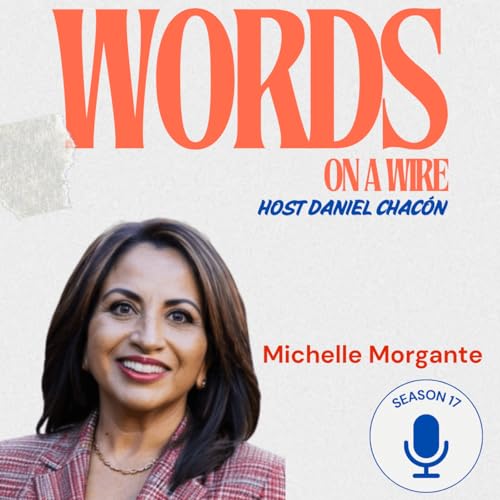
  • Episode 14: Michelle Morgante
    Dec 13 2025

    In this episode of Words on a Wire, host Daniel Chacón speaks with writer and journalist Michelle Morgante about her journey from a small agricultural town in California’s San Joaquin Valley to a globe-spanning career in journalism, and ultimately, to fiction writing.

    Morgante begins by reflecting on her childhood in Lindsay, California, a tiny, heavily agricultural town she describes as a real-life “Mayberry.” She shares vivid memories of biking across town, a deeply segregated school environment, and how being a mixed-heritage kid positioned her literally and symbolically in the “in-between”—a role that crystalized when she became the school dance DJ mediating between racial groups through music. This early experience of living between worlds seeded her lifelong fascination with liminal spaces, a theme that now shapes much of her creative work.

    Chacón and Morgante explore how magical realism, borderland identity, and Gloria Anzaldúa’s concept of nepantla inform their artistic perspectives. Morgante describes how Latino culture sees the magical and the mundane as intertwined, a worldview that deeply influences her fiction.

    From there, the conversation moves into Morgante’s wide-ranging journalism career with the Associated Press, taking her to Detroit, Denver, New York, Miami, Mexico City, Portland, San Diego, and beyond. She recalls the unexpected beauty and sorrow she saw in places like Detroit, the artistic vibrancy of Mexico City’s Condesa neighborhood in the 1990s, and how newsroom layoffs and the decline of local media brought her back to the Valley. She and Chacón also discuss the impact of AI on journalism, the growing importance of human-created writing, and why authentic storytelling will matter more than ever.


    Afficher plus Afficher moins
    30 min
  • Episode 13: (Part 2) The Storykeeper: Olga Talamante
    Dec 13 2025

    Listen to part 2 of Tim Z. Hernandez's conversation with Olga Talamante. Be sure to catch part 1 right here on the Words on a Wire podcast.

    Afficher plus Afficher moins
    26 min