Épisodes

  • Repo Man (1984, Alex Cox) with James Chestnut - Criterion Spine #654
    Feb 9 2026

    "Otto is Forrest Gump."

    In this episode of Why This Film?, I'm joined by assistant director James Chestnut to dive into Repo Man (1984), Alex Cox's punk-rock, sci-fi, anti-Reagan cult classic that refuses to sit still or make sense in a conventional way.

    Released in 1984, Repo Man follows Otto, a disaffected LA punk who stumbles into a world of car repossession. He soon finds himself caught up in conspiracies, aliens, the government, and the "lattice of coincidence." The film moves with deliberate disorientation, treating genre, narrative, and meaning as things to be challenged.

    James brings a filmmaker's perspective to the conversation, helping unpack how Repo Man was made, why it looks and feels the way it does, and how its low-budget ingenuity, location shooting, and practical effects reinforce its punk nature. Together, we talk about Los Angeles as a character, the film's embrace of randomness, and why its refusal to explain itself is exactly the point.

    We discuss:

    • Alex Cox's collaborative approach to filmmaking
    • The mix of punk culture, science fiction, and political satire
    • Harry Dean Stanton's unforgettable monologues and personal philosophy overlapping with the film
    • How Repo Man uses confusion as a feature instead of a flaw
    • Why this film belongs in the Criterion Collection

    If you've ever watched Repo Man and thought, "I don't know what I just saw, but I loved it," this conversation is for you.

    You can also follow James's new YouTube project, One Man's Trash (linked below), where he documents cleaning up his Los Angeles neighborhood, one block at a time.

    One Man's Trash

    Send a text

    Hollywood ManeStays - Not a pin, not a clip. Just Better.

    Support the show

    Follow the Podcast:

    Instagram: @whythisfilmpod

    Afficher plus Afficher moins
    1 h et 14 min
  • Winchester '73 (1950, Anthony Mann) with Brady Crytzer - Criterion Spine #1248
    Jan 25 2026

    "The gun really doesn't mean anything until people start obsessing over it."

    In this episode of Why This Film?, I'm joined by historian and author Brady Crytzer to explore Winchester '73 (1950), Anthony Mann's landmark Western starring James Stewart. Released as Criterion Collection Spine #1248, Winchester '73 helped redefine the Western genre by shifting focus from frontier justice to obsession, revenge, and moral ambiguity in postwar America.

    Directed by Anthony Mann, Winchester '73 centers on a prized rifle known as "the gun that won the West" as it moves from person to person, leaving violence and obsession in its wake. Set against the backdrop of the American Centennial and the aftermath of the Civil War, the film uses the rifle as a symbolic object of desire, revealing how fixation and mythology shape both individual lives and national identity.

    Brady Crytzer brings his expertise in American frontier history to the conversation, helping unpack the historical realities behind the film's mythology. Together, we examine how Winchester '73 blends real historical figures with fiction, how it reflects changing American attitudes after World War II, and why James Stewart's performance marked a turning point in his on-screen persona.

    We discuss:

    • The myth of the "gun that won the West"
    • How the Western frontier functioned as a place of cultural blending, not just conflict
    • James Stewart's wartime experience and its influence on his postwar roles
    • The film's exploration of the themes of revenge, masculinity, and obsession
    • How Winchester '73 helped modernize the Western genre
    • Why this film belongs in the Criterion Collection

    Whether you're revisiting Winchester '73 or encountering it for the first time, this conversation explores why Anthony Mann's Western remains a crucial turning point in American film history.

    You can find more from Brady from the links below:

    The National Road: George Washington and America's First Highway West

    Whiskey Rebellion: A Distilled History of an American Crisis

    Brady Crytzer

    Send us a text

    Support the show

    Follow the Podcast:

    Instagram: @whythisfilmpod

    Afficher plus Afficher moins
    1 h et 8 min
  • After Hours (1985, Martin Scorsese) with Sheila O'Malley - Criterion Spine #1185
    Jan 3 2026

    "It's such an important film in his [Scorsese's] filmography. I'm so happy people are discovering it and Criterion decided to focus on it."

    In this episode of Why This Film?, Ron is joined by critic and writer Sheila O'Malley of RogerEbert.com to discuss After Hours, Martin Scorsese's dark comedy and anxiety-driven odyssey through late-night SoHo. Sheila also wrote the essay for Criterion's release of the film.

    Together, they walk through the film scene by scene, tracing how the evening spirals out of Paul's control. The poor guy just wants to go home. The discussion goes from Scorsese to Hitchcock to Kafka to Mr. Softee.

    And as always, Sheila answers the central question: Why is After Hours included in the Criterion Collection, and why does it still matter today?

    You can find more from Sheila from the links below:

    The Sheila Variations

    RogerEbert.com Archive

    Frankenstein by Sheila O'Malley

    Send us a text

    Support the show

    Follow the Podcast:

    Instagram: @whythisfilmpod

    Send us a text

    Support the show

    Follow the Podcast:

    Instagram: @whythisfilmpod

    Afficher plus Afficher moins
    1 h et 22 min
  • The Breakfast Club (1985, John Hughes) with Ciara Moloney - Criterion Spine #905
    Dec 26 2025

    In episode 3 of Why This Film?, Ron is joined by Ciara Moloney to discuss The Breakfast Club, John Hughes's defining 1980s teen film.

    Together, they walk through the film scene by scene, talking about why these characters still resonate 40 years later. They discuss the film's use of archetypes and how it reveals we are often more alike than we may seem on the surface.

    Along the way, they unpack the film's emotions, its humor, its blind spots, and why it continues to connect with audiences who didn't grow up in 1980s American suburbia.

    And, as always, Ciara answers the central question: why is this film included in the Criterion Collection and why does it still matter today?

    You can find more from Ciara from the links below:

    Bluesky

    https://ciaramoloney.net/
    _______________________________________________________

    Send a text

    Support the show

    Follow the Podcast:

    Instagram: @whythisfilmpod

    Afficher plus Afficher moins
    1 h et 8 min
  • Touchez pas au grisbi (1954, Jacques Becker) with Ginette Vincendeau - Criterion Spine #271
    Nov 24 2025

    "If retirement means you're in a lovely flat in Paris and your fridge is full of foie gras and champagne - I'm okay with that."

    In episode 2 of Why This Film?, Ron discusses Jacques Becker's Touchez pas au grisbi (1954) with Ginette Vincendeau, one of the most influential scholars of French cinema working today.

    Together, they explore how Grisbi reshapes the gangster genre through efficient storytelling and the routine life away from violent action. They move through the film's pacing, its focus on aging and friendship, and the authority of Jean Gabin's performance.

    Ginette brings her expertise to questions of women's roles in French cinema and society, masculinity, and filmmaking of this period.

    And as always, Ginette answers the central question: Why is this film included in the Criterion Collection and why does it still matter today?

    Send a text

    Support the show

    Follow the Podcast:

    Instagram: @whythisfilmpod

    Afficher plus Afficher moins
    1 h et 13 min
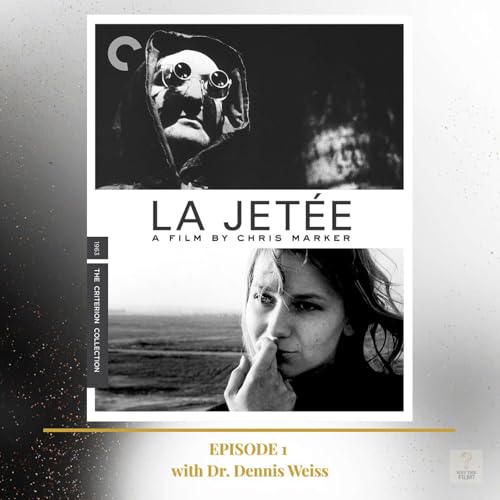
  • La Jetée (1962, Chris Marker) with Dr. Dennis Weiss - Criterion Spine #387
    Oct 6 2025

    “The past is dead!”

    In the premiere episode of Why This Film?, I sit down with Dr. Dennis Weiss to explore Chris Marker's La Jetée (1962), a groundbreaking French science fiction short film that redefined what cinema could be. Released as Criterion Collection Spine #387, this 28-minute masterpiece is composed almost entirely of still photographs, creating a meditation on memory, time, and human longing.

    Directed by Chris Marker and starring Jean Negroni, La Jetée tells the story of a man sent back in time. Shot in black and white with a photomontage technique, the film influenced Terry Gilliam's 12 Monkeys and continues to challenge our understanding of cinematic storytelling.

    Dr. Dennis Weiss is a retired philosophy professor and curator of the long-running Philosophy, Drinks, & Film series in Lancaster, Pennsylvania. He brings his expertise in philosophy and film theory to our conversation. Together, we examine how La Jetée uses form, sound design, and narrative structure to create emotion without traditional cinematic techniques.

    We discuss:

    • Why Marker chose still images over conventional filmmaking
    • The film's exploration of memory
    • Its influence on science fiction cinema
    • The philosophical questions it raises about time and fate
    • Why this film is included in the Criterion Collection.

    Whether you're discovering La Jetée for the first time or revisiting this experimental classic, this conversation offers fresh insights into one of cinema's most innovative works.

    Send a text

    Support the show

    Follow the Podcast:

    Instagram: @whythisfilmpod

    Afficher plus Afficher moins
    47 min