Couverture de WW II Gothic Line ghosts haunt modern day Italy, Europe

WW II Gothic Line ghosts haunt modern day Italy, Europe

WW II Gothic Line ghosts haunt modern day Italy, Europe

De : joe kirwin
Écouter gratuitement

À propos de ce contenu audio

Italy was on the wrong side of history in WW II and the campaign to defeat Nazis and Italian Fascists is known as the Forgotten Front. Launched after the liberation of Rome, the Gothic Line offensive barely gets a footnote in most military history annals. But it featured the most multinational, multi-racial army in WW II. Intertwined in this battle was a vicious Italian civil war and hundreds of civilian massacres - war crimes never prosecuted. Collective amnesia about this ugly past is a present political menace in the face of Italy's economic and defense challenges.joe kirwin
Les membres Amazon Prime bénéficient automatiquement de 2 livres audio offerts chez Audible.

Vous êtes membre Amazon Prime ?

Bénéficiez automatiquement de 2 livres audio offerts.
Bonne écoute !
    Épisodes
    • Righting the wrong of U.S. Army racial abuse faced by African American soldiers on the Gothic LineI
      Jan 22 2026

      Welcome again to the podcast and this second of a three-part series where we will look back at the story of African American soldiers who braved Nazi and Italian Fascist attacks but also white U.S. Army officer racist abuse while fighting on the Gothic Line. The first episode of the series included an interview with Solace Wales who published a book in 2020 titled Braided in Fire – Black GIs and Tuscan Villagers on the Gothic Line 1944. That episode was published earlier in this Gothic Line podcast series.

      The second part centers around an interview with military historian and author Daniel Gibran who the U.S. Department of Defense employed in the 1990s to do a report on why no U.S. African American, including those fighting on the Gothic Line, received a Medal of Honor, after WWII ended. As a result seven African American soldiers, including Lt. John Fox and Lt. Vernon Baker, were awarded the Medal of Honor by former U.S. President Bill Clinton at the White House in 1997. Fox received the medal posthumously while Baker was present at the WH East Room ceremony.

      The third part of the series includes an interview with Ed Valentin, the official historian of an ongoing, special U.S. Department of Defense POW/MIA Accounting Agency U.S. Army 92nd Infantry Division program to identify the unknown African American soldiers killed in combat on the Gothic Line more than eighty years ago and whose remains are buried in a U.S. military cemetery in Florence, Italy. As Valentin will tell us, racism played a major role in why the African American soldiers were not identified more than seven decades ago and are having such a difficult time today to identify the remains even though the special program was launched in 2014.

      Afficher plus Afficher moins
      27 min
    • Unsung Brothers in Arms, Gothic Line heroes: Indian troops side by side with Scottish Highlanders - Part 1
      Dec 12 2025

      There are many Gothic Line heroes who helped free Italy from Nazi and Italian Fascist tyranny but arguably some of the most unsung soldiers who fought and died for democracy even though they did not have it at home were the 50,000 Indians troops. They played a pivotal in the British-led Eighth Army on the Adriatic sector of the Allied Force campaign. Three Indian Divisions, each embedded with Scottish Highlander troops and sometimes other British soldiers, fought mainly in the rugged Apennine mountains to cover the flank of English, Canadian. Polish and Greek troops advancing up the Adriatic coastal plain. The bond forged between the Indians and British soldiers, especially with different divisions of the Scottish Highlander troops, is a multicultural success story .

      Daniel Cesaretti began a crusade 40 years ago to honor the Indian soldiers that fought in Italy and to inform his fellow Italian citizens of their noble efforts. During the past four decades he has visited every battlefield where Indian soldiers fought and where more than 5,000 of them died. His efforts have led to various memorials. He is now leading an effort to establish a Indian soldier memorial site outside the city of Rimini so their valor will never be forgotten.

      The story of the Indian soldiers is one that is not only an important historical landmark but also a vital reference point in today's politics when it comes to the debate over immigration in Europe. For the next two episodes of this podcast we will examine all of these issues in a two-part series dedicated to the Indian soldier story on the Gothic Line.

      Afficher plus Afficher moins
      1 h et 5 min
    • D-day Dodgers and the Senio River Crucible: the epitomy of the British Eighth Army frustrations, failures and blood-soaked Gothic Line breakthrough
      Nov 10 2025

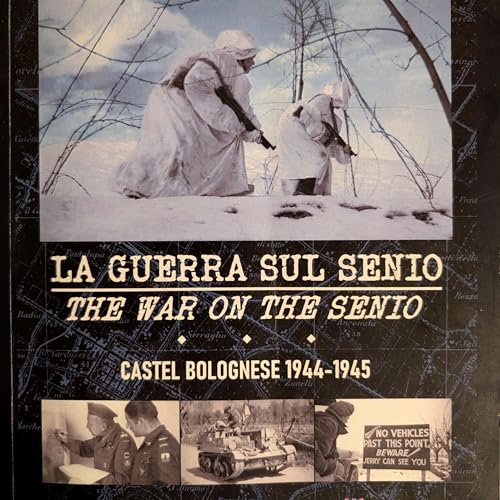
      From an early age 34-year-old Marco Dalmonte accompanied his father on field trips combing the Adriatic coastal plain and Apennine mountains searching for WWII artifacts and even body parts of soldiers that remained unidentified decades after the Allied Armies engaged in the Gothic Line Offensive. Since that time, Dalmonte's family has accumulated a massive collection of abandoned Army surplus. As he grew older Marco Dalmonte transitioned from combing the old battlefield sites to exploring WWII film archives as well as internet platforms where vintage film and photos are traded. As a result, he gathered a collection of original film material taken primarily by the British Army but also American forces as well as German Wehrmacht. In recent years he has collated the material and engaged on a tour with film presentations customized for more than 50 towns in the Adriatic hills and the coastal plain where the British Eighth Army slogged up northeastern Italy before hitting a brick wall in the form of approximately 500,000 German troops. They were under orders from Hitler to defend at all costs the Senio River that flows from the Apennines towards the Adriatic Sea. By December of 1944 the British Eighth Army, low on arms, soldiers and, perhaps most of all, morale, reverted to WWI tactics and dug in for a four-month battle of attrition. Along a 30-kilometer stretch of the river English, Scottish, Welsh, Irish, Canadian, New Zealander, Polish, Indian soldiers along with one of the first Jewish armies since Roman times hunkered down and engaged in a fierce, daily barrage of artillery exchanges as well as regular cat-and-mouse guerrilla fighting. Today the territory is still hazardous due to unexploded ordnance. Along with his travels across the region, Dalmonte can guide you along the banks of the Senio River and recount the stalemate that makes visitors understand the agony of battle and the enduring aftermath along one of WWII's least known but decisive military fault lines.

      Afficher plus Afficher moins
      49 min
    Aucun commentaire pour le moment