Couverture de Victors in Grad School

Victors in Grad School

Victors in Grad School

De : Dr. Christopher Lewis
Écouter gratuitement

À propos de ce contenu audio

Victors in Grad School explores what you can do to find success in your own graduate school journey no matter what you plan to do. Through experts and individual interviews you will be introduced to what it means to find success and tips on achieving success in graduate school.2024
Les membres Amazon Prime bénéficient automatiquement de 2 livres audio offerts chez Audible.

Vous êtes membre Amazon Prime ?

Bénéficiez automatiquement de 2 livres audio offerts.
Bonne écoute !
    Épisodes
    • Breaking the Perfection Myth: Real Talk for Graduate Students
      Feb 16 2026
      Are you a graduate student feeling the constant pressure to be flawless? Have you found yourself chasing impossible standards, believing that only perfect grades or perfect work will help you succeed? If this sounds familiar, you're not alone—and the new episode of "Victors in Grad School" is here to reassure and empower you. In a powerful conversation between Dr. Juanita Tookes and Dr. Christopher Lewis, Dr. Tookes shares a presentation about the Perfection Myth and dives deep into the experiences that graduate students face around perfectionism. The discussion is honest, validating, and filled with practical advice and heartfelt encouragement. Dr. Juanita Tookes shares her personal experience as a "recovering perfectionist," normalizing the struggle and reminding listeners that striving for perfection is a common—but ultimately unrealistic—desire. She explains that perfection is a constantly shifting, subjective concept defined by societal standards, cultural expectations, and comparison (especially in the era of social media). The elusive chase for perfection can leave students feeling anxious, burnt out, and always "less than," which is neither healthy nor sustainable. The podcast also digs into the impact of perfectionism on the brain, highlighting how a constant drive for flawlessness keeps students in a heightened state of fear and anxiety. This mindset, as Dr. Juanita Tookes explains, can deprive you of celebrating your achievements, push you toward burnout, and even negatively impact your mental and physical well-being. Listeners will appreciate the practical discussion of perfectionist behaviors—like overworking, fearing mistakes, avoiding help, and linking self-worth to performance. Dr. Christopher Lewis and Dr. Juanita Tookes reinforce that these behaviors are understandable in high-pressure environments like graduate school, especially when finances and career prospects are at stake, but they urge listeners to challenge these patterns for their own health and happiness. As the episode wraps up, you'll find wisdom in reframing mistakes as essential for growth, embracing imperfection as courageous, and celebrating persistence over unattainable perfection. There are even valuable resources recommended, including Brene Brown's "The Gifts of Imperfection." If you want to feel seen, inspired, and equipped to tackle grad school without the chains of perfectionism, this episode is a must-listen. Tune in and start your journey toward a more balanced, fulfilling academic life! TRANSCRIPT Dr. Christopher Lewis [00:00:01]: Welcome to Victors in Grad School, where. Dr. Christopher Lewis [00:00:03]: We have conversations with students, alumni, and. Dr. Christopher Lewis [00:00:06]: Experts about what it takes to find success in graduate school. Hello, everyone. Dr. Christopher Lewis [00:00:13]: Welcome. Really excited that you're here today, and I really appreciate you spending some time with us as we continue our student development series and partnership with our CAPS office on campus. And every term, I love being able to identify new topics that we can talk with you on to help you in the journey that you're on. And tonight I'm really excited because Dr. Juanita Tookes is back with us. And this topic, the topic that we're talking about tonight, is a really important one because a lot of times when I talk to graduate students, I hear many times that there are concerns and there's this feeling that you have to be perfect, that you have to get that a. That you always have to be at your best. And sometimes you can't always be at your best. Dr. Christopher Lewis [00:00:59]: Sometimes you have to be willing to be okay where you're at. And, you know, the myth of being able to be perfect all the time is definitely that it's just a Myth. So today, Dr. Tooks is going to talk about the perfection myth and how as graduate students, you can reframe and rethink about things in a little bit different way. And so I'm really excited to have her here and to have her talk with us tonight. To Tactor Tooks, I'll turn it over to you. Dr. Juanita Tookes [00:01:27]: Hello, everyone. I am so happy to be here again. As Dr. Lewis mentioned, this is a very valued partnership between the CAPS office and graduate studies. I love working with grad students, and a big part of my heart for grad students is because I remember being a grad student. I remember how hard it was. I am also recovering perfectionist. I don't know how many years in that I met that I'm at, but I will be the first to say that I suffer very badly with perfection. Dr. Juanita Tookes [00:01:57]: And we're going to get into kind of what that looks like, how it can show up in your graduate student experience. But what I hope that you can get from this ultimately is feelings of validation. If you have gone through any of the things that we've talked about, I assure you you are not the only one. That's why I was the first to raise my hand. And I encourage you ...
      Afficher plus Afficher moins
      56 min
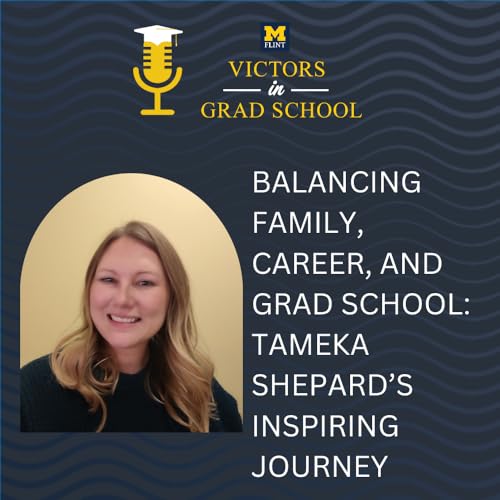
    • Balancing Family, Career, and Grad School: Tameka Shepard's Inspiring Journey
      Feb 9 2026
      Are you thinking about taking the leap into graduate school, or are you already on that journey and looking for reassurance and advice? In the latest episode of the "Victors in Grad School" podcast, host Dr. Christopher Lewis sits down with Tameka Shepard, Academic Advisor and Business Programs Recruiter at the University of Michigan-Flint, to explore her powerful story of balancing family, career, and her pursuit of an MBA. From the start, Tameka Shepard is candid about her motivations: a desire to give her children an example of lifelong learning, and a vision to one day open her own coffee shop. With a background in social work, she offers a unique perspective on how diverse educational experiences can complement each other—highlighting the value of understanding people in the business world. When it came to picking her MBA program, Tameka Shepard describes how flexibility was key. Western Governors University's online, self-paced structure made it possible for her to manage graduate school alongside raising kids, working full-time, and supporting a traveling spouse. Time management and setting boundaries were crucial tools for her success. Tameka Shepard shares how she carved out early mornings and late nights for study, and how open conversations with her family helped them support her goals—reminding listeners that prioritizing your education sometimes means missing out on other events, but the long-term benefits are worth it. The episode doesn't shy away from the challenges of grad school. Tameka Shepard bravely discusses facing imposter syndrome and struggling through a difficult class, ultimately persisting to show her children (and herself) the importance of not quitting. She highlights the freedom to take breaks to avoid burnout, and encourages others to listen to themselves—reminding us that there's no one "right" timeline for finishing a degree. Perhaps most valuable are Tameka Shepard's reflections on what she wishes she'd known: the importance of networking, communicating effectively, and not feeling guilty about progressing at your own pace. Her story is a compelling mix of practical advice, honest emotion, and hope for others who are considering or pursuing graduate education. Ready to be inspired by real-life experiences and actionable tips for success? Listen to the full episode with Tameka Shepard and let her journey motivate you to take the next step in yours. TRANSCRIPT Dr. Christopher Lewis [00:00:01]: Welcome to Victors in Grad School, where we have conversations with students, alumni and experts about what it takes to find success in graduate school. Welcome back to Victors in Grad School. I'm your host, Dr. Christopher Lewis, Director of Graduate programs at the University of Michigan, Flint. Really excited to have you back again this week. As always, every week we are on a journey together. And I call it a journey because it truly is a journey. Every person, every individual that is thinking about graduate school goes through a journey that is very unique to themselves, depending on the program, depending on who they are, where they are in their life. Dr. Christopher Lewis [00:00:40]: And no matter if you are just at the very beginning, just starting to think about graduate school, or if you have already applied or if maybe you've been accepted or you're in graduate school, doesn't matter, you're still on that journey. And we're on that journey together. That's why this podcast exists every week. I love being able to talk to you about ways in which you can find success in this graduate school journey that you're on. And I love introducing you to new people that have gone to graduate school before you that can give you some perspectives and some thoughts about what they had to do in that time in their own life. So today we have another great guest. Tameka shepherd is with us today, and Tameka is an academic advisor and business programs recruiter for the University of Michigan, Flint's School of Management. He's. Dr. Christopher Lewis [00:01:28]: And I am really excited to be able to have her here and to talk to her about her own journey in graduate school and to welcome her to the show. Thanks so much for being here, Tamika. Tameka Shepard [00:01:37]: Thank you for having me. Dr. Christopher Lewis [00:01:38]: It is my pleasure. I really appreciate that you are here today and I always love starting the show by taking you back in time. So I know that you did your undergraduate work at Spring Arbor University and then you graduated, you graduated, you went, you started work. And at some point between that time an undergraduate student and as you were going and working, you made a decision. You made a decision that you weren't done going to college, you wanted to continue your education and you decided to go back and get a graduate degree. Take me back to that point where you were starting that process for yourself. What made you decide that that was the right time in your...
      Afficher plus Afficher moins
      16 min
    • How Many Graduate Programs Should I Apply To? Expert Advice for Grad School
      Feb 2 2026
      Welcome to Victors in Grad School, where we have conversations with students, alumni, and experts about what it takes to find success in graduate school. Welcome back to Victors in Grad School. I'm your host, Dr. Christopher Lewis, Director of Graduate Programs at the University of Michigan, Flint. Really excited that you're back again this week. And today I don't have a guest. I am talking to you about some of the questions that I have gotten from over the time that we've been doing this podcast and over the years to try and help to answer some of your questions. And today, the question that we're going to be answering is, how many graduate programs should you apply to? If you've started researching graduate school, there's a moment that almost always happens. At first, it's exciting — you're exploring programs, imagining the possibilities, picturing yourself in a new career or stepping into a leadership role. You start bookmarking program pages, saving "how to apply" checklists, and telling yourself, Okay… I'm really doing this. And then… reality hits. You realize there are a lot of graduate programs out there. A LOT. You might find yourself asking: "Should I apply to just one program?""What if I only apply to two and don't get in?""What if I apply to ten and burn out halfway through?""What's the smart number?""What do people normally do?" If that's you — first, take a deep breath. You're not behind. You're not doing it wrong. And you're definitely not the only person trying to solve this puzzle. Today we're going to walk through this question together: How many graduate programs should you apply to? And I'll give you a clear recommendation — but even more importantly, I'll help you choose the right number for you. The honest answer: it depends… but not as much as you think I know "it depends" can be the most annoying answer ever, so let me say this upfront: Most prospective graduate students should apply to between 3 and 6 programs. That's not just a random number — it's the sweet spot where you: give yourself strong options,reduce risk of not getting in anywhere,and avoid overwhelming yourself with too many applications. But of course, there are reasons to apply to fewer… or more. So instead of giving you a number and sending you on your way, I want to help you decide: What's realistic for your time and energyWhat's appropriate for your fieldWhat's strategic for your goalsWhat gives you the best chance at admission and the best chance at success once you're in Because here's what I tell students all the time: Getting accepted matters… but choosing the right program matters more. Start with this: What kind of graduate applicant are you? Before we get into numbers, I want to ask you a question. When you picture applying to grad school, are you someone who: 1) Wants a clear, simple plan You want 2–3 strong options, you want to focus, and you want to avoid the stress of "too many choices." 2) Wants options and flexibility You want to be strategic, apply broadly, compare offers, and decide later. 3) Is feeling uncertain and trying to "make sure" You're not totally confident yet — and applying to more programs feels like a way to protect yourself. There's no wrong answer here. But knowing which one you are helps you choose your best number. A helpful framework: Dream, Fit, and Safe One of the best ways to build your graduate school list is to include three categories: Dream Programs These are highly competitive or highly selective. You would LOVE to get in — but you know it's not guaranteed. Fit Programs These are strong matches. Your academic background, experience, and goals align well. Safe Programs These are programs where you have a strong likelihood of admission. You'd still be happy attending — and they reduce anxiety. Now here's the magic: A strong grad application plan includes a mix of all three. That way you avoid the two biggest mistakes applicants make: applying only to the most competitive programsapplying randomly without a strategy So… how many programs should you apply to? Let's break it into realistic options. Option 1: Apply to 1–2 programs This is okay if… You are geographically limited (family, job, caregiver responsibilities)You are applying to a very specific program that only a few schools offerYou are already connected to a faculty member or advisorYou are 100% sure this is the right program for youYou have a backup plan if you don't get in This can work. But I'll be honest — the risk is higher. Because even strong applicants get denied sometimes for reasons that have nothing to do with them. Examples include: limited cohort sizefunding availabilityfaculty capacitytoo many qualified applicants So if you're applying to only one program, I encourage you to ask: "If I don't get in this cycle… what's my plan B?" If you have a good answer, applying to 1–2 programs can absolutely be a ...
      Afficher plus Afficher moins
      12 min
    Aucun commentaire pour le moment