Couverture de Urgent Futures with Jesse Damiani

Urgent Futures with Jesse Damiani

Urgent Futures with Jesse Damiani

De : Jesse Damiani
Écouter gratuitement

À propos de ce contenu audio

Welcome to the Urgent Futures Podcast, the show that finds signal in the noise. Each episode, I sit down with leading thinkers for dialogues that clarify the chaos, from culture to the cosmos.

www.realitystudies.coJesse Damiani
Sciences sociales
Les membres Amazon Prime bénéficient automatiquement de 2 livres audio offerts chez Audible.

Vous êtes membre Amazon Prime ?

Bénéficiez automatiquement de 2 livres audio offerts.
Bonne écoute !
    Épisodes
    • The Next Civil War, Mark Carney's Davos Speech, & Canada's View of the US - Stephen Marche | RR #21
      Feb 19 2026

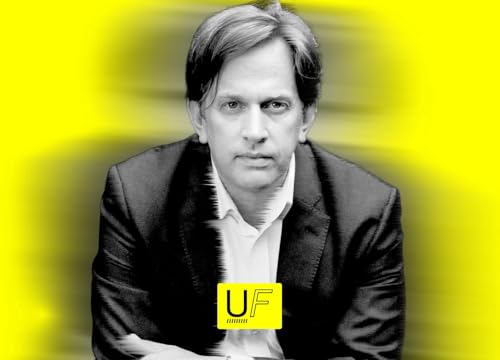
      My guest this week is Stephen Marche. Stephen is the author of The Next Civil War and On Writing and Failure. He frequently experiments with literary AI.

      Support the show by checking out: ProtonVPN (gold-standard VPN—fast and safe. Click the link to get 55% off VPN Plus: $4.49/mo). ZBiotics (Decrease impact of hangovers. Code: JESSEDAMIANI for 10% off), MUD\WTR (43% off starter kits), 1Password (simplify your life and increase digital safety), Mission Farms CBD (healthy, effective CBD for relief, sleep, and wellbeing—25% off with email).

      That modest bio doesn’t do justice to Stephen’s extensive writing and public intellectualism across culture, politics, and technology. We’ve been connected for a few years because of his early experiments with AI in writing—and as you’ll hear in the episode, he actually holds a number of historical firsts in this regard. In 2022, he published The Next Civil War, a book that is exactly what it sounds like: speculative scenarios rooted in rigorous research—including roughly 200 interviews with subject matter experts—about how the next American Civil War might transpire. It’s a bracing read, and unfortunately, much of what he put in that book is coming true.

      Grab your copy of The Next Civil War here!

      So it might also come as a surprise to discover that Stephen is Canadian, though he lived in the US for many years. This insider-outsider perspective is critical for discussing such a fraught topic. And his Canadian-ness is also what led me to host this rapid response episode—I’d been meaning to invite him on the show for a while to discuss the aforementioned, but then Canadian Prime Minister Mark Carney gave his address at the World Economic Forum. Fans of the channel will know that I have closely tracked the prospect of the “rules based” international order’s collapse, and Carney pretty baldly named this.

      If you haven’t watched the address or read about it, I encourage you to do so now. Suffice to say, it felt critical to foreground Stephen’s analysis. And then, toward the end of the episode, we also discuss his literary AI experiments, his take on the current state of affairs, and much more.

      CREDITS: This podcast is produced & edited by Adam Labrie & me, Jesse Damiani. Adam Labrie also edited the video version, which is available on YouTube.

      Find more episodes of Urgent Futures at: youtube.com/@UrgentFutures.


      Get full access to Reality Studies at www.realitystudies.co/subscribe
      Afficher plus Afficher moins
      1 h et 31 min
    • Biodiversity on the Brink: Ecological Rhythms & Human Urgency - Jonathan Tonkin | Rapid Response #20
      Feb 16 2026
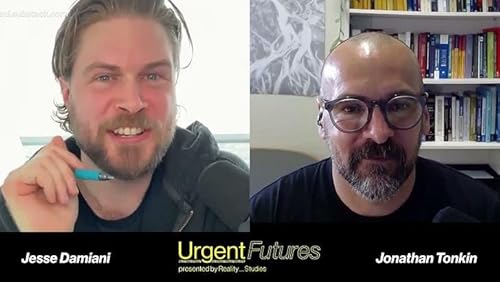
      For as much as I bemoan the attention fracture that occurs on social media, there are times I’m so grateful for it; I discovered the work of Jonathan Tonkin through a Substack Note about ecosystem services—the financial value that the natural world provides, which is vast and yet is barely ever accounted for under capitalist economics (on that note: please be sure to bookmark my conversation with Alyssa Battistoni on the ‘free gifts’ of nature).While we’re at it, please subscribe to his incredible newsletter, Predirections, right now: https://predirections.substack.com/Fast forward and I was lucky that he agreed to join me for a discussion on biodiversity, and in particular his research on freshwater biodiversity. This is one of those subjects that is massively important (to put it mildly!), yet doesn’t get quite as much airtime as more “charismatic” crises like climate change. As Jono explains: it's the "foundation for our very existence."Support the show by checking out: ProtonVPN (gold-standard VPN—fast and safe. Click the link to get 55% off VPN Plus: $4.49/mo). ZBiotics (Decrease impact of hangovers. Code: JESSEDAMIANI for 10% off), MUD\WTR (43% off starter kits), 1Password (simplify your life and increase digital safety), Mission Farms CBD (healthy, effective CBD for relief, sleep, and wellbeing—25% off with email).There’s a lot here, including a discussion about the wonder of braided rivers and broader questions around how we balance “human urgency” and “ecological rhythms,” advocating for what he calls “patient urgency.” We also get into his journey on Substack, and how he balances the differing demands of being an academic and a public communicator. Also he just got a new dog! All to say: if you’re like me, you’ll leave this conversation feeling both inspired and ready to take action in your own life to protect what is precious on this planet.BIO: I love that Professor Tonkin shares his bio in the first person, so I’m copying that here for you:I’m Jonathan Tonkin (Jono for short) — an ecologist and biodiversity scientist at the University of Canterbury in New Zealand, where I’m a Professor and Rutherford Discovery Fellow.My research has spanned continents and ecosystems, but I’ve always returned to one core question: How do we predict and adapt to environmental change in a way that supports life — all life?I’ve spent much of my career documenting biodiversity loss, especially in freshwater ecosystems. Now, I’m pivoting toward solutions: redirecting effort, exploring policy levers, and amplifying the science that can help us adapt. After publishing 100 peer-reviewed papers — including in Nature and Science — I want to share what I’ve learned beyond academia: translating the latest science into plain language, before it even reaches the headlines, to inform, inspire, and equip a wider community.I’m also a parent of two young kids. That perspective shapes everything I write.You can learn more about my research and lab at tonkinlab.org — we focus on biodiversity science for a changing world.🏆 Recently, I was honoured with the New Zealand Prime Minister’s MacDiarmid Emerging Scientist Prize.Find more episodes of Urgent Futures at: youtube.com/@UrgentFutures. Get full access to Reality Studies at www.realitystudies.co/subscribe
      Afficher plus Afficher moins
      1 h et 1 min
    • When, How, & Why Complex Societies Collapse - Joseph Tainter | #64
      Feb 12 2026
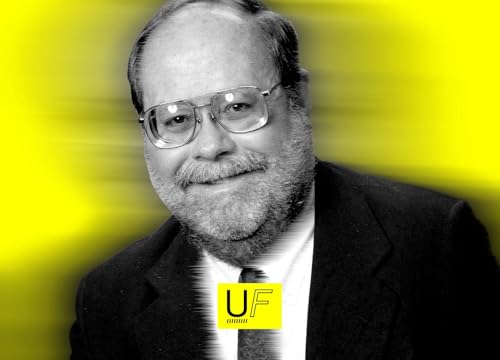
      Having researched the topic of collapse for more than half a decade, I can say with some confidence that interest in it has increased over the past few years. And it makes sense—wherever you look, be it politics, climate change, the economy, tech accelerationism, or otherwise, we’re getting a lot of scary signals. But collapse is a slippery word—what exactly does it mean? And what exactly qualifies a particular breakdown as collapse?Support the show by checking out: ProtonVPN (gold-standard VPN—fast and safe. Click the link to get 55% off VPN Plus: $4.49/mo). ZBiotics (Decrease impact of hangovers. Code: JESSEDAMIANI for 10% off), MUD\WTR (43% off starter kits), 1Password (simplify your life and increase digital safety), Mission Farms CBD (healthy, effective CBD for relief, sleep, and wellbeing—25% off with email).To get granular, I’m happy to share this conversation with collapsology legend, Joseph Tainter, who was researching collapse long before it was en vogue, notably authoring The Collapse of Complex Societies nearly forty years ago. Perhaps his most notable argument from this work is that collapse occurs when a civilization reaches a point of diminishing returns on complexity—that is, when increasing amounts of capital, energy, and resources are required just to sustain the system, until the cost of maintaining it outweighs the benefits.It’s a provocative argument, and folks like existential risk researcher Luke Kemp, who I had on the show late last year, have proposed alternative viewpoints—but which nevertheless build on Professor Tainter’s remarkable scholarly legacy. This argument is especially worth considering when we look at the current strain on the “rules-based” international order that the United States has (otherwise) maintained since the end of WWII.There’s so much in this conversation, drawing together his collapsology research with his contributions to energy and sustainability research—and much more, examining how it all fits together in today’s global context.BIO: Joseph Tainter is an anthropologist and retired professor, formerly at Utah State University. He is the author of The Collapse of Complex Societies, and co-author with Timothy F. H. Allen and Thomas W. Hoekstra of Supply-Side Sustainability. With Roderick and Susan McIntosh he edited The Way the Wind Blows: Climate, History, and Human Action. With Tadeusz Patzek he wrote Drilling Down: The Gulf Oil Debacle and Our Energy Dilemma. Dr. Tainter’s research has been used in over 50 countries and his books have been issued in 10 languages. His work has been consulted in the United Nations Environment Programme, UNESCO, the World Bank, the Rand Corporation, the International Institute for Applied Systems Analysis, the Beijer Institute of Ecological Economics, the Earth Policy Institute, Technology Transfer Institute/Vanguard, and the Highlands Forum. His research has been applied in economic development and energy.CREDITS: This podcast is produced & edited by Adam Labrie & me, Jesse Damiani. Adam Labrie also edited the video version, which is available on YouTube.Find more episodes of Urgent Futures at: youtube.com/@UrgentFutures. Get full access to Reality Studies at www.realitystudies.co/subscribe
      Afficher plus Afficher moins
      1 h et 1 min
    Aucun commentaire pour le moment