

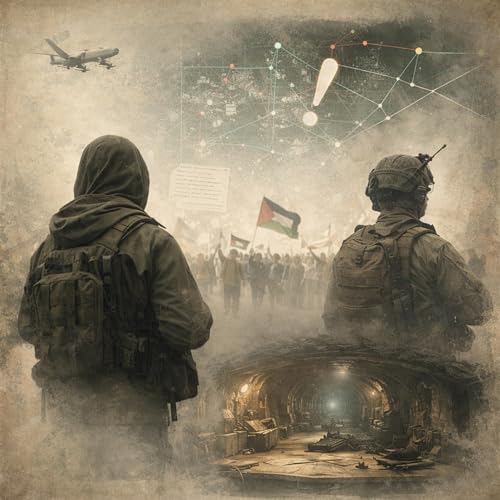
Understanding Resistance
Impossible d'ajouter des articles
Échec de l’élimination de la liste d'envies.
Impossible de suivre le podcast
Impossible de ne plus suivre le podcast

Understanding Resistance
-
Lu par :
-
De :
À propos de ce contenu audio
What does modern resistance actually look like?
In this episode, we examine Understanding Resistance, part of the Assessing Revolutionary and Insurgent Strategies (ARIS) series produced for the United States Army Special Operations Command . This volume explores the foundational mechanics of resistance movements — how they form, evolve, organize, legitimize themselves, and ultimately attempt to govern.
We unpack:
The phases of contemporary resistance — from clandestine organization to militarization and consolidation
Competing doctrinal models, including Mao’s construct, FM 3-24, ATP 3-05, Galula, and SORO
The determinants and variables that shape movement evolution — grievance levels, logistics capacity, finance, recruitment, clandestine behavior, and leadership dynamics
The “public component” — how insurgent groups build legitimacy through governance, social services, and political engagement
Thresholds of violence and the strategic transition from resistance to governance
Rather than viewing insurgency purely through armed struggle, this discussion highlights resistance as a dynamic system — blending political organization, psychological operations, underground networks, and shadow governance. The episode emphasizes the operational utility of understanding phasing models and organizational growth as tools for both enabling and countering resistance movements.
This episode offers a structured framework for analyzing how resistance movements develop — and how they succeed or fail.
Based on: Assessing Revolutionary and Insurgent Strategies: Special Topics in Irregular Warfare – Understanding Resistance
Full text is available on theresistancehub.com/assessing-revolutionary-and-insurgent-strategies-aris/


