

The Tomato Conspiracy
Impossible d'ajouter des articles
Désolé, nous ne sommes pas en mesure d'ajouter l'article car votre panier est déjà plein.
Veuillez réessayer plus tard
Veuillez réessayer plus tard
Échec de l’élimination de la liste d'envies.
Veuillez réessayer plus tard
Impossible de suivre le podcast
Impossible de ne plus suivre le podcast

The Tomato Conspiracy
-
Lu par :
-
De :
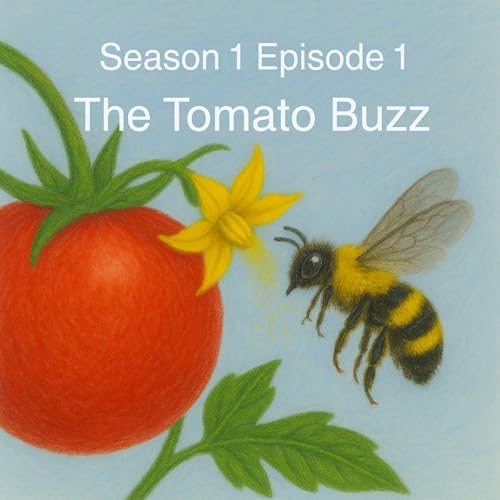
What most of America doesn't know - every single time you bite into a tomato, you're tasting the work of a pollinator that ISN'T a honeybee. In fact, honeybees are about as useful for tomato pollination as I am at parallel parking."
The fun podcast revealing secret pollinator heroes who are really feeding America. Spoiler: It's not honeybees - but we do love honey!
www.secretpollinators.com
KEY SOURCESBuzz pollination mechanics
- De Luca, P. A., & Vallejo-Marín, M. (2013). What's the buzz about? The ecology and evolutionary significance of buzz-pollination. Current Opinion in Plant Biology, 16(4), 429–435. DOI: 10.1016/j.pbi.2013.05.002
- Vallejo-Marín, M. (2019). Buzz pollination: studying bee vibrations on flowers. New Phytologist, 224(3), 1068–1074. DOI: 10.1111/nph.15666
- Vallejo-Marín, M. (2022). How and why do bees buzz? Implications for buzz pollination. Journal of Experimental Botany, 73(4), 1080–1092.
- Arroyo-Correa, B., Beattie, C. E., & Vallejo-Marín, M. (2019). Bee and floral traits affect the characteristics of the vibrations experienced by flowers during buzz pollination. Journal of Experimental Biology, 222: jeb198176.
- King, M. J., & Buchmann, S. L. (2003). Floral sonication by bees: mesosomal vibration by Bombus and Xylocopa, but not Apis, ejects pollen from poricidal anthers. Journal of the Kansas Entomological Society, 76(2), 295–305.
- Rosi-Denadai, C. A., et al. (2020). Buzz-pollination in Neotropical bees: genus-dependent frequencies and lack of optimal frequency for pollen release. Insect Science, 27(1), 133–142.
Tomato pollination and yield
- Cooley, H., & Vallejo-Marín, M. (2021). Buzz-pollinated crops: a global review and meta-analysis of the effects of supplemental bee pollination in tomato. Journal of Economic Entomology, 114(2), 505–519. DOI: 10.1093/jee/toab009 — meta-analysis of 71 experiments; supplemental buzz pollination increased tomato fruit weight by about 65% over no-pollination controls, and open pollination including buzz-capable bees by about 85%.
- Ohio State University Extension, ENT-0092, Bumble Bee Pollination in Tomato Greenhouses. ohioline.osu.edu — honey bees do not perform buzz pollination; five commonly reared Bombus species worldwide, with B. impatiens most widely used in North America.
- Banda, H. J., & Paxton, R. J. (1991). Pollination of greenhouse tomatoes by bees. Acta Horticulturae, 228, 194–198.
- Velthuis, H. H. W., & van Doorn, A. (2006). A century of advances in bumblebee domestication and the economic and environmental aspects of its commercialization for pollination. Apidologie, 37(4), 421–451.
Blueberries and other buzz-pollinated crops
- Javorek, S. K., Mackenzie, K. E., & Vander Kloet, S. P. (2002). Comparative pollination effectiveness among bees on lowbush blueberry (Vaccinium angustifolium). Annals of the Entomological Society of America, 95(3), 345–351.
- Isaacs, R., & Kirk, A. K. (2010). Pollination services provided to small and large highbush blueberry fields by wild and managed bees. Journal of Applied Ecology, 47(4), 841–849.
#GardenTruth #PollinatorFacts #MindBlown
#secretpollinators #nativebees #bumblebees #pollinatorpartnership #tomatoes #buzzpollination #gardens #wildbees
adbl_web_anon_alc_button_suppression_t1
Aucun commentaire pour le moment