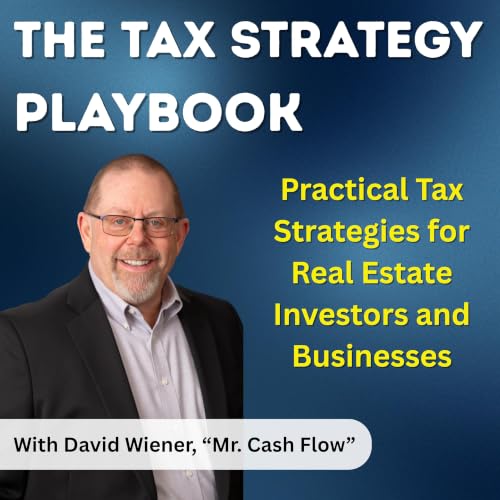
Couverture de The Tax Strategy Playbook

The Tax Strategy Playbook

The Tax Strategy Playbook

De : David Wiener "Mr. Cash Flow"
Écouter gratuitement

Offres de saison | 0,99 € par mois pendant les 3 premiers mois

5,99 €/mois par la suite. Des conditions s’appliquent. Annulation mensuelle possible.

The Tax Strategy Playbook is where real estate investors and business owners learn how to stop overpaying the IRS and turn taxes into an opportunity center instead of an annual pain point.

Each episode, host David Wiener (“Mr. Cash Flow”) sits down with CPAs, tax attorneys, cost segregation experts, and top investors to break down complex tax rules into clear, step‑by‑step strategies you can actually use.

You’ll hear real case studies, before‑and‑after numbers, and practical checklists on things like cost segregation, bonus depreciation, real estate professional status, short‑term rental strategies, entity structure, and more—without legalese or fluff. Expect straight talk, tactical advice you can hand to your CPA, and simple action items at the end of every show so you always know what to do next.

2026 David Wiener, "Mr. Cash Flow"
Economie Finances privées
Épisodes
  • Rental Property Depreciation Explained: How It's Calculated
    Oct 20 2026

    Rental property depreciation is the one deduction the IRS counts against you whether you take it or not. Here's how yours is calculated, line by line.

    In this solo episode of The Tax Strategy Playbook, David Wiener, Mr. Cash Flow, walks through real estate depreciation from the beginning. You'll see what goes into your cost basis and what stays out, how to split land from building using your county assessor's ratio instead of a flat 20 percent guess, why the clock starts on the placed in service date (the day the property is ready and available for rent) instead of the closing date, and how the mid-month convention shapes your first year. If you've ever searched how to calculate depreciation on rental property, the duplex example in this episode is the whole answer.

    Then David takes apart the advice to skip depreciation so you won't owe tax when you sell. The IRS lowers your basis by the depreciation allowed or allowable, whichever is greater, so the deduction you skipped still counts against you at the sale. Of all your rental property tax deductions, depreciation is the one that never costs you a check, and it still matters on a rental that shows a loss.

    Built for the investor with one to five rentals who has never looked at the depreciation line on their own return, the business owner who owns or is buying a rental or the building their company runs out of, and the tax professional who wants a plain English version to hand a client. It also covers converted homes, inherited rentals, short-term rentals (where 27.5 versus 39 years is a judgment call your tax professional makes), and when an engineering-based cost segregation study, with an in-person site visit, moves parts of the building onto 5, 7, and 15 year schedules. Every dollar figure in the episode is an illustration, not a client.

    CHAPTERS

    00:00 What is rental property depreciation? 27.5 vs 39 years explained

    05:12 How to find your cost basis and split land from building

    10:11 When does depreciation start on a rental? Placed in service and the mid-month convention

    13:12 How to calculate depreciation on rental property: a duplex example

    17:39 Repairs vs improvements: de minimis safe harbor and the old roof problem

    21:33 Do you have to depreciate rental property? Allowed or allowable and passive losses

    25:12 Depreciation on a converted home, inherited rental, short-term rental, or business building

    28:37 Cost segregation and 100% bonus depreciation on a rental property

    33:34 Rental property depreciation FAQ

    37:06 Your rental property depreciation playbook: five steps this week

    Nothing in this episode is tax advice for your situation. Your numbers are your numbers and they need a professional who knows them. Tax evasion is a crime, but tax avoidance is mandatory.

    Your host: David Wiener, "Mr. Cash Flow"

    https://davidhwiener.com

    David.wiener@cashflowstrategies.us

    770-224-8504x2

    Schedule a conversation or free consultation at

    https://calendly.com/david-wiener/initial-consultation

    Subscribe to The Tax Strategy Playbook Podcast Channel:

    https://www.youtube.com/@TaxStrategyPlaybookPodcast/?sub_confirmation=1

    Get updates, special episodes and live streams, and free resources on the latest tax strategies:

    https://www.taxstrategyplaybook.com/newsletter/

    #RentalPropertyDepreciation #RealEstateDepreciation #RentalPropertyTaxDeductions #CostSegregation #TaxStrategyPlaybook

    Afficher plus Afficher moins
    42 min
  • R&D Tax Credit for Startups: Get Paid Even If You're Losing Money
    Oct 13 2026

    The R&D tax credit can pay a startup that is losing money, through payroll taxes it already owes. Miss one box or one date and the cash waits, or never comes.

    Most small business tax credits aren't hidden. They're missed, because every one of them runs on a clock. In this solo episode of The Tax Strategy Playbook, David Wiener, Mr. Cash Flow, opens a four-part series on the research and development tax credit with the question founders ask most: we don't make money yet, does any of this help us? It does. A qualified small business, one under $5 million in gross receipts and within its first five years of receipts, can elect to use up to $500,000 a year of R&D credit against the employer share of Social Security and Medicare. David walks through the three clocks that decide whether that money shows up and when, including how a filing date moved one startup's $90,000 by nine months.

    Then the lens widens to the tax credits for businesses with employees: the SECURE 2.0 retirement plan credits, worth about $65,000 over five years for one 18-person company, the small employer health care credit, the paid family and medical leave credit that changed for 2026, and the credits that are gone for 2026 hires.

    Built for the founder or CFO of a young company paying engineers, developers or designers and not yet profitable, the owner of an established business with 10, 20 or 50 employees who has never been walked through the credits that come with having them, and the tax professional who wants to know where the traps sit in the middle of extension season.

    CHAPTERS:
    00:00 Small business tax credits: why they're missed, not hidden
    03:50 Tax credit vs tax deduction: which one saves you more
    05:53 What qualifies for the R&D tax credit (no lab required)
    09:20 R&D tax credit for startups: using it against payroll taxes
    10:37 Who qualifies for the R&D payroll tax offset: the $5 million and five-year tests
    14:24 When does the R&D payroll credit start? The filing date that costs nine months
    18:06 R&D tax credit example: a 12-person startup's $90,000, quarter by quarter
    22:28 Retirement plan tax credits for small business: SECURE 2.0 and Form 8881
    25:45 Small business health care tax credit and the paid family leave credit for 2026
    29:33 Is the Work Opportunity Tax Credit gone? FAQ and the Playbook

    Nothing in this episode is tax advice for your situation. Your facts are your facts, and they need a professional who knows them, so work with your own tax professional. Tax evasion is a crime, but tax avoidance is mandatory.

    Your host: David Wiener, "Mr. Cash Flow"

    https://davidhwiener.com

    David.wiener@cashflowstrategies.us

    770-224-8504x2

    Schedule a conversation or free consultation at

    https://calendly.com/david-wiener/initial-consultation

    Subscribe to The Tax Strategy Playbook Podcast Channel:

    https://www.youtube.com/@TaxStrategyPlaybookPodcast/?sub_confirmation=1

    Get updates, special episodes and live streams, and free resources on the latest tax strategies:

    https://www.taxstrategyplaybook.com/newsletter/

    #RDTaxCredit #SmallBusinessTaxCredits #StartupTaxes #PayrollTaxCredit #TaxStrategyPlaybook

    Afficher plus Afficher moins
    38 min
  • Why Nobody on Your Team Has Mentioned Cost Segregation
    Oct 6 2026

    Cost segregation is a real estate tax deduction many of the largest property owners never use. The reason has nothing to do with money. David Wiener, Mr. Cash Flow, sits down with DJ Van Keuren, founder of the Family Office Real Estate Institute and co-founder of Evergreen Property Partners, who has spent 25 years inside family office real estate. They cover why a cost segregation study so often never reaches the people who make the decisions, who actually brings a new tax strategy to a wealthy family, why DJ's annual family office study finds about 80 percent of families do not do 1031 exchanges, how 100% bonus depreciation changes the math when a deal is underwritten, how depreciation recapture works when you sell, and when not to do a cost segregation study at all.

    Built for the real estate investor who assumes a bigger portfolio means better tax planning, the business owner who owns the building the company runs out of and has never had anyone look at it closely, and the tax professional who knows how cost segregation works and wants a 25-year view of how these conversations start inside a family office, and who starts them.

    WHAT YOU WILL LEARN

    Why a missed cost segregation study is usually an oversight, not a decision, and who is most likely to raise it

    How wealthy families pick advisors by trust, and why a bigger team can mean fewer tax strategies reach you

    The five types of family office real estate investors and which ones have someone watching for cost seg

    When not to do a cost segregation study: a short hold, a sale without a 1031 exchange, losses you cannot use yet

    Why tax benefits belong in the real estate underwriting model, and how depreciation recapture works on the way out

    CHAPTERS

    00:00 Same tax code, different outcome: why big real estate owners miss cost segregation

    03:03 What is cost segregation? 27.5 and 39 years vs 5, 7, and 15 year property explained

    04:39 Why family offices underuse cost segregation, and what the callers asked

    05:56 Missed tax strategy: a decision or an oversight? Who wealthy families trust

    09:20 The five types of family office real estate investors and who handles cost seg

    13:18 How many families skip 1031 exchanges and opportunity zones

    18:24 When not to do a cost segregation study: short holds, small properties, passive losses

    20:30 Bonus depreciation in the underwriting model: how tax benefits change real estate returns

    24:26 Depreciation recapture, 1031 exchanges, and why cost seg cannot fix a bad deal

    29:24 Your cost segregation playbook: the question to ask your tax professional this week

    Nothing in this episode is tax advice for your situation. Your numbers are your numbers and they need a professional who knows them. Tax evasion is a crime, but tax avoidance is mandatory.

    Your host: David Wiener, "Mr. Cash Flow"

    https://davidhwiener.com

    David.wiener@cashflowstrategies.us

    770-224-8504x2

    Schedule a conversation or free consultation at

    https://calendly.com/david-wiener/initial-consultation

    Subscribe to The Tax Strategy Playbook Podcast Channel:

    https://www.youtube.com/@TaxStrategyPlaybookPodcast/?sub_confirmation=1

    Get updates, special episodes and live streams, and free resources on the latest tax strategies:

    https://www.taxstrategyplaybook.com/newsletter/

    #CostSegregation #FamilyOffice #RealEstateTaxStrategies #RealEstateInvesting #TaxStrategyPlaybook

    Afficher plus Afficher moins
    37 min
adbl_web_anon_alc_button_suppression_t1
Aucun commentaire pour le moment