• Airbnb Is Building a ‘Company Brain’ for AI Agents with Ahmad Al-Dahle - #781
    Oct 21 2026
    AI agents need the institutional knowledge experienced employees rely on: why a system works a certain way, which policies apply, and what never made it into the documentation. Capturing that knowledge is hard. Keeping it useful as people and agents add more may be harder. In this episode, Ahmad Al-Dahle, CTO of Airbnb, shares how his team is building Project Everest, a “company brain” that captures knowledge from employees’ workflows for AI agents. We explore stale information and context poisoning, why too much context can backfire, and how the team evaluates whether shared knowledge improves engineering work. We also discuss measuring AI productivity beyond token usage and PR counts, the limits of chat-based interfaces, and deploying support agents in a marketplace where resolving disputes means mediating between conflicting interests. 🗒️ Full show notes: https://twimlai.com/go/781.
    Afficher plus Afficher moins
    52 min
  • Your Ranking Model Is Optimizing the Wrong Thing with Zoe Weil - #780
    Oct 15 2026
    In this episode, Zoe Weil, co-founder and CEO of Sequen, joins us to discuss how ranking systems can use live behavioral signals to optimize for purchases rather than clicks or search relevance alone. Zoe explains why approaches developed at data-rich social platforms don’t necessarily translate to retailers and how Sequen uses scroll speed, hover duration, and other in-session interactions to infer shopper intent without relying on user identity. We explore the company’s large event models and its architecture of specialized models that transform streaming events into features for downstream rankers. Zoe describes the infrastructure required to serve dynamic rankings within milliseconds, why the team chose Rust for its backend, and how evaluation harnesses connect model improvements to business outcomes. We also discuss the tradeoffs between advertising and organic revenue, continuous model improvement, and the boundary between useful personalization and surveillance. 🗒️ Full show notes: ⁠⁠https://twimlai.com/go/780.
    Afficher plus Afficher moins
    53 min
  • Why Jev Is Changing How We Build With AI with Diogo Almeida - #779
    Oct 6 2026
    In this episode, Diogo Almeida, co-founder and CEO of TypeSafe, joins us to discuss Jev, TypeSafe’s recently released model for bringing fast, reliable intelligence directly into software. We explore the idea of “machine-native intelligence” and why Diogo believes models optimized for generating text are poorly suited to many of the decisions required for real-world automation. He explains how Jev differs from traditional classifiers and LLM-based approaches, the role of reinforcement learning from calibrated decisions (RLCD), and why calibration and reliability are central to making AI useful as a software primitive. We also discuss the relationship between models and code, why Diogo believes AI systems should become more engineered rather than relying on a single model to do everything, and how Jev-like models could reshape agents, tool use, and the architecture of AI-powered software. 🗒️ Full show notes: ⁠https://twimlai.com/go/779.
    Afficher plus Afficher moins
    1 h et 30 min
  • From Math Olympiads to Navier-Stokes: How Fast Is AI Progressing? with Greg Burnham - #778
    Sep 29 2026
    AI systems have gone from struggling with grade-school math to helping solve research problems that have resisted mathematicians for decades, including Navier-Stokes. In this episode, Greg Burnham, who leads AI capabilities research at Epoch AI, joins us to examine what that progress says about where AI is going. We look at how these systems are solving hard math problems, how much they rely on persistence and prior human work, and whether they are starting to produce genuinely new ideas. We also discuss how to measure progress as traditional benchmarks become less useful, why capability gains appear surprisingly steady across model generations, and where models still struggle with open-ended work, learning from experience, and identifying promising new research directions. 🗒️ Full show notes: https://twimlai.com/go/778.
    Afficher plus Afficher moins
    1 h et 8 min
  • From Voice Agents to AI Avatars with Alexander Smola - #777
    Sep 17 2026
    Voice AI has gotten remarkably good, but natural conversation remains a high bar. Small delays, awkward interruptions, or the wrong tone can quickly break the illusion—and adding vision and visual presence only raises the stakes. In this episode, Alex Smola, co-founder and CEO of Boson AI, explores the path from today’s voice agents to audiovisual agents and AI avatars. We discuss the technical tradeoffs behind real-time voice, including audio tokenization, latency, model size, and inference cost, as well as what changes when these systems can both see and be seen. We also explore the role of emotional intelligence in AI, how agents can learn from human interactions, and what it will take to move beyond impressive demos toward interactions that actually feel natural. 🗒️ Full show notes: https://twimlai.com/go/777.
    Afficher plus Afficher moins
    1 h et 5 min
  • Do AI Tokenomics Matter More Than Model Benchmarks? with Chris Potts - #776
    Sep 9 2026
    As reasoning models consume more tokens and AI systems become more expensive to run, understanding what those tokens actually buy is becoming increasingly important. In this episode, Stanford professor and Big Spin co-founder Chris Potts joins us to discuss AI tokenomics and his research into “tokenflation”—the possibility that token usage is growing faster than the measurable value those tokens produce. We explore how to measure the return on AI spending, why benchmarks alone provide an incomplete picture of model progress, and what inference-time scaling means for the economics of increasingly capable models. Chris also explains why expert AI users tend to get better results by challenging and iterating with models, how AI fluency affects outcomes, and why more efficient architectures could change the underlying economics. We also discuss DSPy, interpretability, the limits of today’s transformer architectures, and where Chris sees opportunities for more fundamental innovation in AI. 🗒️ Full show notes: ⁠⁠https://twimlai.com/go/776.
    Afficher plus Afficher moins
    59 min
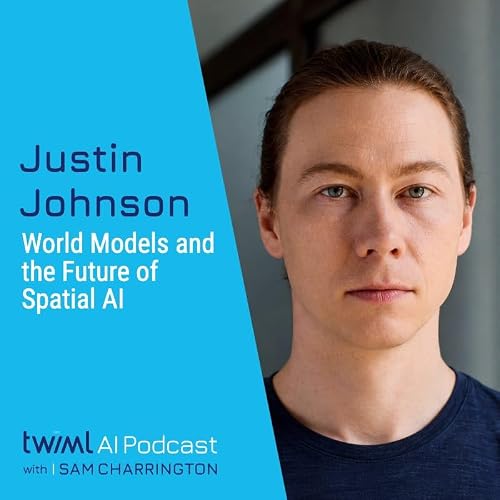
  • World Models and the Future of Spatial AI with Justin Johnson - #775
    Sep 1 2026
    In this episode, Justin Johnson, co-founder of World Labs, joins us to discuss world models and the emerging field of spatial AI. We explore why many researchers see capabilities beyond language as an important frontier for AI, and what it means to build models that can understand, generate, and simulate the environments around them. Justin explains the different approaches to world modeling, including explicit 3D representations and generative models, and why there is still no established recipe for building these systems. We also discuss World Labs’ Marble system, which can generate navigable 3D worlds from images and other inputs, the challenges of evaluating world models, and the role of simulation, planning, and action. Finally, Justin shares his vision for models that bring these capabilities together, supporting everything from interactive virtual environments to agents and robots that can operate in the physical world. 🗒️ Full show notes: ⁠https://twimlai.com/go/775.
    Afficher plus Afficher moins
    1 h et 6 min
  • Why the Next AI Breakthrough May Come from Physics with Max Welling - #774
    Aug 26 2026
    The conventional wisdom in AI is that the next breakthrough will come from more compute, more data, and larger models. But what if the next leap comes from somewhere else? In this episode, Max Welling—co-founder and CTO of CuspAI and professor at the University of Amsterdam—argues that physics may provide some of the ideas behind the next generation of AI systems. We begin with CuspAI’s work using generative AI to design entirely new materials for semiconductors, batteries, carbon capture, and clean energy. Max explains how foundation models for chemistry, agentic workflows, simulation, and automated experimentation are dramatically accelerating the search for new materials and reshaping scientific discovery. The conversation then broadens into a deeper question. Beyond giving AI new scientific problems to solve, can physics also teach us how to build better AI? Max explores surprising connections between machine learning and thermodynamics, why waves may become a new computational primitive for neural networks, and how concepts like symmetry breaking and statistical physics could inspire AI architectures beyond today’s scaling paradigm. 🗒️ Full show notes: https://twimlai.com/go/774.
    Afficher plus Afficher moins
    58 min