SpaceX Falcon 9 rocket. Photo: SpaceX via Wikimedia Commons.
I want to reflect today on a story I read recently, a story that, in a strange and heartbreaking way, speaks volumes about the limits of human aspiration and the enduring reality of God’s sovereignty over creation.
I confess, as a lifelong Trekkie, I have often imagined my own final journey, inspired by that famous, poetic burial of Mr. Spock in The Wrath of Khan. I dreamt of having my body reach for the cosmos, but after reading this story, I think I’ll settle for a more earthly resting place: a plot of dirt right here in Chicago’s Graceland Cemetery.
The story I read is of a final journey, one chosen by 166 souls: scientists, dreamers, and fans of the cosmos, who wished to make deep space their eternal resting place. In June of 2025, their cremated remains were aboard a special memorial capsule, designed to orbit our blue marble before its eventual return. It was meant to be the ultimate triumph of technology over finitude: an eternal memorial among the stars.
The imagination behind this is immense, and perhaps, beautiful. We all feel the desire to transcend the dirt, the rain, and the limits of the grave. But this journey, powered by one of the most advanced launch systems in the world, did not reach its planned destination.
Shortly after a failed attempt, completing its controlled re-entry to save the mission, the capsule’s parachutes failed to deploy. Instead of a soft landing, it crashed into the Pacific Ocean.
What was meant to be a burial among the stars became, instead, a burial at sea.
The memorial service, meant for the stars, was sharing space with companion payloads that included scientific instruments and, on this very commercial space mission carrying the remains, even cannabis seeds and plant matter intended for an extraterrestrial growth experiment.
There is a profound, almost biblical irony in that descent. In our Reformed tradition, we talk about the doctrine of creation, and the truth of imago Dei, that we are made in God’s image. We also acknowledge the consequence of human pride, the deep-seated impulse to be as God, to erase our limits, to conquer mortality itself.
This impulse, this striving to use technology to defeat the simple, humbling reality of “dust you are and to dust you shall return” is the very definition of modern hubris.
We believe that if we build a machine fast enough, powerful enough, and tall enough, we can finally escape the constraints placed upon us by our Creator. But when the sacred ritual of burial becomes a line item on a commercial manifest, sharing space with the purely mundane or experimental, we reveal a spiritual emptiness.
But creation, in its elemental power, is relentless. The ocean, often a symbol of chaos and untamable might in Scripture, reached up and reclaimed what the machine had tried to defy. The cold water, the immense pressure, the anonymity of the deep, these were the humbling realities that replaced the infinite promise of the void.
The lesson for us, as people of faith, is not to judge the desires of those families, but to understand our own spiritual geography. We are, after all, dreamers who look up and imagine an ultimate transcendent farewell.
Yet, our hope does not and cannot rest on the success of a rocket launch. The ultimate memorial for those we love is not located in any physical place, be it deep space or a churchyard plot. It rests in the unbreakable promise of the Resurrection, a promise that operates outside the laws of physics and the whims of technology.
In a world obsessed with transcendence through engineering, where we attempt to launch our dearest hopes alongside commercial crops, the failure of that spacecraft is a powerful, sorrowful reminder: our final journey is not dictated by NASA or SpaceX, but by the love and grace of the One who holds the stars and the sea in the palm of His hand. When the rocket fails, our faith must hold. And in the mystery of God, it always does.
Get full access to Not Quite Communist by Gerald Farinas at gerfarinas.substack.com/subscribe


 5 min
5 min 7 min
7 min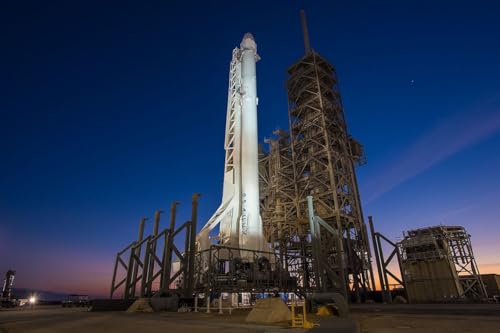 5 min
5 min 2 min
2 min Oct 18 20254 min
 Oct 16 20254 min
 Oct 15 20254 min
 4 min
4 min