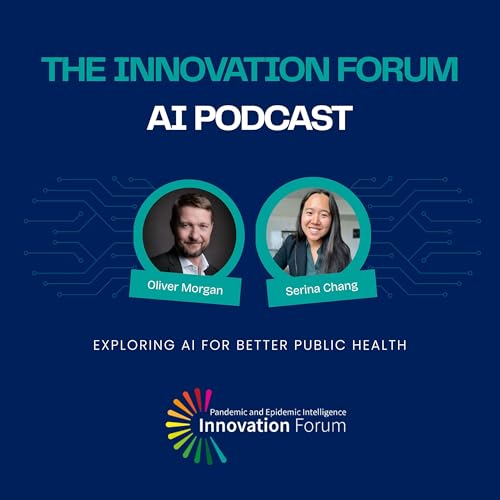
Couverture de The Innovation Forum AI Podcast

The Innovation Forum AI Podcast

The Innovation Forum AI Podcast

De : Oliver Morgan
Écouter gratuitement

À propos de ce contenu audio

The Innovation Forum AI Podcast explores how artificial intelligence is transforming public health — from early detection of outbreaks to effective health communication and smarter response strategies. Grounded in real-world practice, we highlight opportunities and challenges that matter for global preparedness. A podcast for public health professionals — from policymakers to technical specialists — who want to explore how AI tools can be applied to real-world public health challenges. Oliver Morgan is a Global Health Executive with over 25 years of experience in pandemic preparedness and response and strategic innovation. He has experience across a range of high-stakes global public health situations at country, regional, and global levels with the World Health Organization and the US Centers for Disease Control and Prevention. Oliver has led work on pandemic preparedness, global health leadership, and innovation for surveillance systems, analytics, and public health decision-making. As an executive coach, he supports senior leaders in navigating complex environments and developing leadership for impact. Hygiène et vie saine Science
Épisodes
  • Using AI to Strengthen Infectious Disease Surveillance Systems
    Mar 3 2026
    🎙️ Episode Title Using AI to Strengthen Infectious Disease Surveillance Systems --- 🧠 Episode Summary In this episode of The Innovation Forum AI Podcast, Oliver Morgan speaks with Swapnil Mishra, from the National University of Singapore (NUS). Swapnil explains how AI and infectious disease modelling can move beyond academic exercises and become embedded within real public health workflows. Drawing on examples from dengue surveillance, vector-borne disease risk assessment, mobility data integration, and behavioral modelling, he discusses how AI can help public health agencies interpret surveillance data, combine fragmented datasets, and make decisions under uncertainty. The conversation explores the trade-offs between mechanistic models, Bayesian approaches, and machine learning; the role of hierarchical modelling in understanding local heterogeneity; and why separating transmission dynamics from reporting bias is essential for responsible epidemic intelligence. Swapnil also emphasizes that AI should augment public health professionals rather than replace them, and that the real transformation lies in strengthening institutional capacity for infectious disease decision making. --- 💬 Guest Dr. Swapnil Mishra is an Assistant Professor at the Saw Swee Hock School of Public Health at the National University of Singapore (NUS) and Deputy Director of the Centre for Epidemic Research and Modelling (CERM) and the AI for Public Health programme (AI4PH). His research focuses on infectious disease modelling, Bayesian statistics, and machine learning applied to epidemic and pandemic intelligence. He previously contributed modelling advice during the COVID-19 pandemic and works at the intersection of epidemiology, data science, and public policy. --- 🌐 Resources and References - NUS Saw Swee Hock School of Public Health: https://sph.nus.edu.sg/; https://www.linkedin.com/school/saw-swee-hock-school-of-public-health/?originalSubdomain=sg - Centre for Epidemic Research and Modelling: https://cerm.nus.edu.sg/ - Artificial intelligence for public health can harness data for healthier populations: https://www.nature.com/articles/s44360-025-00005-w.pdf - Estimating dengue force of infection from age-stratified surveillance data in Java, Indonesia: https://royalsocietypublishing.org/rsif/article/22/232/20250445/356293 - Incorporating human mobility to enhance epidemic response and estimate real-time reproduction numbers: https://journals.plos.org/ploscompbiol/article?id=10.1371%2Fjournal.pcbi.1013642 - Mitigating risks of malaria and other vector-borne diseases in the new capital city of Indonesia: https://www.nature.com/articles/s41467-024-54891-x --- 🎵 Music Credits Intro and outro music from Podcastle Stock Audio. Track: ‘Nairobi Nights’. License code: XUUYW3CDJ38EEGHM. --- ⚠️ Disclaimer This podcast is produced by the World Health Organization (WHO) as part of the Pandemic and Epidemic Intelligence Innovation Forum initiative: https://pandemichub.who.int/news-room/innovation-forum. The views expressed by guests are their own and do not necessarily represent those of WHO or its affiliates. Content is intended for informational purposes only and does not constitute professional medical advice. --- 📲 Listen and Subscribe The Innovation Forum AI Podcast is available on YouTube, Spotify, Apple Podcasts, and Amazon Music. You can find a written summary of this episode here: https://substack.com/@omorgan? Follow, rate, and share to help us reach more public health professionals exploring the future of AI.
    Afficher plus Afficher moins
    41 min
  • AI, Genomics, and the Future of Public Health Surveillance
    Mar 18 2026
    🎙️ Episode Title AI, Genomics, and the Future of Public Health Surveillance --- 🧠 Episode Summary In this episode of The Innovation Forum AI Podcast, Oliver Morgan speaks with Túlio de Lima Campos, Bioinformatics Core Facility Coordinator at Fiocruz in Brazil. Túlio explains how combining genomic sequencing with artificial intelligence is transforming what public health surveillance can see and do. Drawing on his work tracing arboviral outbreaks — including dengue, Zika, chikungunya and Oropouche fever — he discusses how genomic data reveals transmission dynamics that case counts alone cannot capture, and how machine learning can be layered on top to detect anomalies, prioritize signals, and anticipate risk. The conversation covers the practical meaning of ML-driven surveillance, lessons from foundational work on essential gene prediction in model organisms, and the realistic role of large language models in public health workflows. Túlio also addresses the critical challenge of data quality, the underrepresentation of Latin America in global genomic databases and AI models, and the governance, infrastructure and workforce investments needed to build genuinely integrated epidemic intelligence systems. --- 💬 Guest Túlio de Lima Campos is a Public Health Technologist and Coordinator of the Bioinformatics Core Facility at Fiocruz, a leading public health agency in Brazil. His work focuses on developing bioinformatics solutions for public health, applying AI and machine learning to genomic surveillance, and fostering scientific collaboration across the region. He has led research on arboviral genomic epidemiology, viral computational workflows, and regional capacity building in AI for the biosciences. --- 🌐 Resources and References - Fiocruz - Oswaldo Cruz Foundation: https://portal.fiocruz.br/en - Genomics of pathogens and vectors: ****https://www.frontiersin.org/journals/genetics/articles/10.3389/fgene.2024.1483676/full - Revisiting Key Entry Routes of Human Epidemic Arboviruses into the Mainland Americas through Large-Scale Phylogenomics: https://onlinelibrary.wiley.com/doi/full/10.1155/2018/6941735 - ViralFlow v1.0—a computational workflow for streamlining viral genomic surveillance: https://academic.oup.com/nargab/article/6/2/lqae056/7682253 - Genomic and phenotypic characterization of the Oropouche virus strain implicated in the 2022–24 large-scale outbreak in Brazil: https://onlinelibrary.wiley.com/doi/full/10.1002/jmv.70012 - Harnessing model organism genomics to underpin the machine learning-based prediction of essential genes in eukaryotes – Biotechnological implications: https://www.sciencedirect.com/science/article/pii/S0734975021001282 - BiotrAIn — AI capacity building initiative for Latin America: https://www.ebi.ac.uk/training/our-partnerships/biotrain --- 🎵 Music Credits Intro and outro music from Podcastle Stock Audio. Track: ‘Nairobi Nights’. License code: KTWK5CG66SP0Q0EU. --- ⚠️ Disclaimer This podcast is produced by the World Health Organization (WHO) as part of the Pandemic and Epidemic Intelligence Innovation Forum initiative: https://pandemichub.who.int/news-room/innovation-forum. The views expressed by guests are their own and do not necessarily represent those of WHO or its affiliates. Content is intended for informational purposes only and does not constitute professional medical advice. --- 📲 Listen and Subscribe The Innovation Forum AI Podcast is available on YouTube, Spotify, Apple Podcasts, and Amazon Music. You can find a written summary of this episode here: https://substack.com/@omorgan? Follow, rate, and share to help us reach more public health professionals exploring the future of AI.
    Afficher plus Afficher moins
    44 min
  • Making Sense of AI and the Opportunities for Public Health
    Oct 24 2025
    🎙️ Episode Title Making Sense of AI and the Opportunities for Public Health --- 🧠 Episode Summary In this episode of The Innovation Forum AI Podcast, Oliver Morgan speaks with Dr. Kene David Nwosu, Epidemiologist and Data Scientist at the University of Geneva’s Institute for Global Health and co-founder of The Graph Courses, a non-profit initiative teaching AI and data science for health professionals. Together, they unpack how artificial intelligence is transforming public health — from predicting disease risk to summarizing clinical notes — and what skills practitioners need to engage with these technologies responsibly. The conversation explores data quality, ethics, and privacy challenges, while offering a hopeful vision of how AI can enhance, rather than replace, the vital role of humans in improving global health outcomes. --- 💬 Guest Dr. Kene David Nwosu Kene David Nwosu is an epidemiologist and data scientist at the University of Geneva’s Institute of Global Health. His work spans HIV cohort analyses in Nigeria and public-facing analytics for COVID-19 and influenza in Switzerland. He is also co-founder of The Graph Courses, a nonprofit education platform providing accessible training in data science and AI for the health and life sciences, where he leads an international team creating open learning resources for over 5,000 learners. --- 🌐 Resources and References - The GRAPH Courses: https://thegraphcourses.org/ - CDC AI use case inventory: https://www.hhs.gov/programs/topic-sites/ai/use-cases/index.html - WHO Guidance on AI use: https://www.who.int/publications/i/item/9789240084759 - Machine learning for HIV status prediction: https://journals.plos.org/plosone/article?id=10.1371/journal.pone.0264429 --- 🎵 Music Credits Intro and outro music from **Podcastle Stock Audio.** Track: ‘Nairobi Nights’. --- ⚠️ Disclaimer This podcast is produced by the World Health Organization (WHO) as part of the Pandemic and Epidemic Intelligence Innovation Forum initiative: https://pandemichub.who.int/news-room/innovation-forum. The views expressed by guests are their own and don’t necessarily represent those of WHO or its affiliates. Guest affiliations have been disclosed for transparency purposes. Content is intended solely for information purposes and not as professional medical advice. Listeners are advised to consult qualified professionals for specific questions. All personal data collected for feedback is handled in accordance with WHO standards. --- 📲 Listen and Subscribe The Innovation Forum AI Podcast is available on Apple Podcasts, Youtube, and Amazon Music. You can find a written summary of this episode here: https://substack.com/@omorgan? Be sure to follow, rate, and share to help us reach more public health professionals exploring the future of AI.
    Afficher plus Afficher moins
    44 min
Aucun commentaire pour le moment