Épisodes

  • The Other Seat of Power: The Presidency in a Divided Congress | Episode 10
    Sep 1 2025

    Journalist and scholar E.J. Dionne joins host Gil Troy to examine the power struggles between the president and Congress - struggles that have intensified in today’s hyper-partisan era. From George Washington’s reluctant service and the founders’ vision of checks and balances, to today’s entrenched partisan battlegrounds, they explore how political polarization has reshaped the balance of power in American government.

    Dionne and Troy consider key historical moments, from Watergate to the Clinton impeachment, and ask whether bipartisan cooperation is still possible or simply a relic of a vanished political culture and era. They also consider moments when presidents bridged divides - or failed to - and debate whether the symbolic power of the office can still unify a fractured nation; is unity a lost ideal, or a goal worth reclaiming?

    To read the texts and learn more about the manuscripts discussed in this episode, visit:

    George Washington’s Dread of Becoming the President, 1789

    James K. Polk Declares the Presidency Too Important an Office to be Sought or Declined, 1844

    Warren Harding on American Statesmanship and Lincoln, 1923


    Chapters

    (00:00) Opening

    (00:31) Introduction: The Presidency in a Divided Congress

    (03:26) George Washington’s Integrity and the Birth of Presidential Power

    (06:25) Hamilton as “Prime Minister”? Early Partisanship and Coalition Government

    (08:03) The Constitution’s Blind Spot: Ignoring Political Parties

    (11:21) The Civil War as America’s Second Founding and a New Constitution

    (14:22) Presidents as Historians, Reformers, and Problem-Solvers

    (16:41) Golden Ages in Politics? Nostalgia and Presidential Leadership

    (20:26) Great Presidents and Great Crises: Do Moments Make the Leader?

    (22:30) Warren G. Harding, Normalcy, and the Limits of Presidential Power

    (25:51) Expanding Presidential Power: Theodore Roosevelt to FDR

    (28:37) Congress vs. the Presidency: Henry Clay, LBJ, and Eisenhower

    (31:34) Nixon’s Domestic Legacy: EPA, Social Policy, and Congress

    (34:09) The Cold War, Bipartisanship, and America’s Two-Party System

    (38:25) Political Polarization, Trump, and the Decline of Cross-Party Friendships

    (42:00) Unlikely Alliances: Ted Kennedy, Orrin Hatch, and Health Care Reform

    (43:44) Clinton, Bush, Obama: Unified vs. Divided Government in Action

    (49:05) Symbolic Power of the Presidency: Oklahoma City to 9/11

    (53:09) Ronald Reagan’s “Time for Choosing” and Presidential Rhetoric

    (56:04) Presidential Evolution: JFK, Civil Rights, and Changing Leadership

    (56:55) Summary


    Stay connected with us on Facebook, Instagram, LinkedIn and by signing up for our newsletter at shapell.org/contact. For more information about this podcast, visit The Human Side of History.

    Production by docyourstory

    Music by Adam Weingrod

    The show is produced by The Shapell Manuscript Foundation. To learn more about the foundation and discover the manuscript collection visit: www.shapell.org

    Afficher plus Afficher moins
    58 min
  • Empire by Another Name: The Presidency and the Rise of Federal Power | Episode 9
    Aug 8 2025

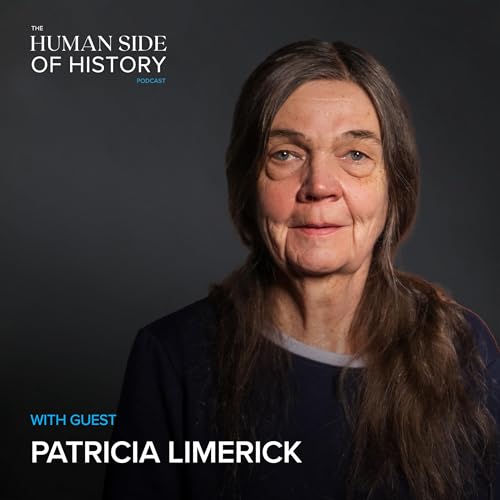
    Acclaimed historian Patricia Limerick joins host Gil Troy to explore how presidential power was reshaped by the relentless march of America’s westward expansion. Beneath the lofty rhetoric of Manifest Destiny, they uncover the practical realities of conquest, dispossession, and the explosive growth of federal authority needed to drive it forward.

    Tracing how frontier dreams gave rise to federal sprawl - and how Jeffersonian ideals collided with the machinery of land offices, standing armies, and Interior departments - Limerick brings wit and nuance to a story too often flattened into myth.This is the expansion of power - executive, federal, and destined to reshape the world.

    To read the texts and learn more about the manuscripts discussed in this episode, visit:

    President James Monroe on Purchase of Florida, 1821

    Theodore Roosevelt's Square Deal Reclamation Act in Relation to Westward Expansion

    John F. Kennedy’s New Frontier Speech, 1960


    Chapters

    (0:00) Opening

    (0:04) How America Became an Accidental Empire

    (0:38) Introducing Patricia Limerick: Historian of the American West

    (1:54) Presidential Humor and the Power of the Fool in History

    (4:11) Reagan, Roosevelt, and the Role of Humor in Leadership

    (6:40) Manifest Destiny Debunked: Land, Myth, and Migration

    (10:17) The Real Cost of Westward Expansion for Settlers

    (11:02) Conquest and Consequences: Native Displacement and Injustice

    (18:06) Nostalgia vs. Reality: Rewriting the Myth of the West

    (20:19) How 19th-Century Presidents Shaped Land Expansion

    (23:55) Land, Power, and the Birth of American Empire

    (26:51) Bureaucracy and the Federal Government’s Rise in the West

    (27:26) Debunking the Myth of Small Government in U.S. History

    (30:21) Civil War Aftermath: Army Growth and Federal Authority

    (31:20) American Individualism vs. Government Support in the West

    (33:22) Closing the Frontier: National Identity After Expansion

    (35:13) Roosevelt’s Reclamation Act and Federal Land Policy

    (39:44) JFK’s New Frontier and the Legacy of Manifest Destiny

    (43:35) Historians as Fixers: Cleaning Up the Narrative of the West

    (47:00) Harvesting Hope: What the American West Can Still Teach Us

    (49:54) Summary and Credits


    Stay connected with us on Facebook, Instagram, LinkedIn and by signing up for our newsletter at shapell.org/contact. For more information about this podcast, visit The Human Side of History.


    Production by docyourstory

    Music by Adam Weingrod


    The show is produced by The Shapell Manuscript Foundation. To learn more about the foundation and discover the manuscript collection visit: www.shapell.org

    Afficher plus Afficher moins
    51 min
  • Opponent or Enemy? Losing the Presidency: Inside the Presidential Transfer of Power | Episode 8
    Jul 22 2025

    In this episode, Professor Gil Troy speaks with Dr. Tevi Troy about the high-stakes moment when one presidency ends and another begins, and why transitions matter far beyond inauguration day. They explore how civility, partisanship, and preparation shape the handoff of power.

    Drawing on history and firsthand experience, Dr. Troy reflects on the difference between opponents and enemies, and how the tone of a transition can influence the tone of a nation and its faith in democracy itself. What does it take to lose power and pass it on - with dignity? And what can we learn from past transitions to navigate today's political divides?


    To read the texts and learn more about the manuscripts discussed in this episode, visit:

    JFK Letter Thanking Eisenhower For a Smooth Transfer of Power, January 1, 1961


    Chapters

    (0:00) Opening

    (0:34) Introduction: Presidential Transfer of Power

    (2:18) Setting the Tone with 1952 and 1960 Transitions

    (4:45) Honesty and Resentment in Presidential Handovers

    (7:26) The Club of Presidents and Symbolic Civility

    (8:08) Modeling Behavior and Respect in Office

    (10:00) Shifting Party Lines and “Barely a Democrat”

    (14:01) The Worst Transitions in History

    (16:29) Formalizing Transitions: Policy and Preparation

    (18:44) Transition vs. Brand Differentiation

    (21:25) Governing with 4,000 Appointees

    (21:49) The Gold Standard Transition: Bush to Obama

    (26:36) The Bittersweet End of a Presidency

    (28:24) Life After the White House

    (29:57) How History Judges Presidential Decisions

    (31:09) Divisive Presidents: Nixon and Wilson

    (38:47) Unifying Presidents and Leadership Skills

    (43:39) Character, Patriotism, and Presidential Legacy

    (45:15) Closing and Credits


    Stay connected with us on Facebook, Instagram, LinkedIn and by signing up for our newsletter at shapell.org/contact. For more information about this podcast, visit The Human Side of History.


    Production by docyourstory

    Music by Adam Weingrod


    The show is produced by The Shapell Manuscript Foundation. To learn more about the foundation and discover the manuscript collection visit: www.shapell.org

    Afficher plus Afficher moins
    47 min
  • Power Without Borders: U.S. Global Power & Presidential Character | Episode 7
    Jun 22 2025

    What kind of character does it take to lead the free world? In an age of global tension, where American presidents weigh alliances and warfare with the power to shape history, we explore how presidential character turned the U.S. from an isolated republic into a global superpower

    Gil Troy is joined by bestselling author and political commentator John Avlon to trace the foreign policy legacy of the American presidency - from George Washington’s warning against foreign entanglements to Ronald Reagan’s moral stand against the Soviet Union.

    Focusing on pivotal moments like World War I, FDR’s leadership before Pearl Harbor, and the Cold War consensus, they explore how values, vision, and presidential courage helped America project strength - and when it failed to live up to its ideals.


    To read the texts and learn more about the manuscripts discussed in this episode, visit:

    Ronald Reagan at the Berlin Wall, Demanding Gorbachev “Tear Down This Wall”


    Chapters

    (00:00) Opening

    (00:21) Introduction: Power Without Borders

    (02:20) Washington’s Farewell: Isolationism vs. Independence

    (07:23) Idealism and the Founders’ Foreign Policy Vision

    (09:51) Rethinking the Monroe Doctrine

    (15:27) Lincoln, Character, and Foreign Policy Foundations

    (20:51) Lincoln’s Legacy: Winning the Peace

    (23:58) U.S. Grant at Appomattox: Moral Leadership in Action

    (24:37) World War I and the Failure to Win the Peace

    (29:29) Roosevelt, Lend-Lease, and Pre-WWII Strategy

    (33:07) American Psyche in the Interwar Period

    (36:18) Democracy vs. Authoritarianism in the Great Depression

    (38:57) FDR’s Leadership: Guiding a Divided Nation

    (43:48) Roosevelt’s Letter to Harry Woodring & Leadership Nuance

    (44:58) Bipartisanship and the Cold War Consensus

    (48:19) The Greatest Generation and Their Legacy

    (51:06) Reagan’s “Evil Empire” and Moral Clarity

    (55:02) Moynihan, Reagan, and Confidence in Democracy

    (56:50) Summary


    Stay connected with us on Facebook, Instagram, LinkedIn and by signing up for our newsletter at shapell.org/contact. For more information about this podcast, visit The Human Side of History.

    Production by docyourstory

    Music by Adam Weingrod

    The show is produced by The Shapell Manuscript Foundation. To learn more about the foundation and discover the manuscript collection visit: www.shapell.org

    Afficher plus Afficher moins
    57 min
  • The Art of Presidential Leadership, With Guest David Greenberg | Episode 6
    Jun 4 2025

    We say we want authenticity in a president, but how much are we really entitled to know, and who gets to draw that line? Historian David Greenberg joins host Gil Troy to examine how the presidency has become, in part, a public relations performance shaped by evolving media, shifting expectations, and the public’s growing appetite for access. From George Washington’s measured gravitas to Barack Obama’s strategic self-presentation, Greenberg and Troy trace how image, communications, mass media, and executive control have defined, and sometimes distorted, the office.

    In an age of nonstop coverage, viral speculation, and questions about presidential health and candor, this episode asks: where’s the line between necessary transparency and the illusion of total access? How have changing norms around privacy and scrutiny reshaped what we expect and want in a president? What gets lost in a democracy when we expect presidents to be both powerful leaders and fully public figures? And what do we lose when the performance overtakes the substance?

    This is a conversation about the high-stakes theater of leadership, and how every president, whatever their ideology, must navigate the conflicting demands of democracy, power, and public life.


    To read the texts and learn more about the manuscripts discussed in this episode, visit:

    Signed Photograph of Pres. Ronald Reagan at 1987 Speech Demanding, “Mr. Gorbachev, Tear Down This Wall!”


    Chapters

    (0:00) Opening

    (0:26) Introduction: The Art of Presidential Leadership

    (1:38) Guest Introduction: David Greenberg

    (1:41) Nixon’s Shadow and the Power of Presidential Image

    (4:05) Public vs. Private: The Blurred Lines of the Presidency

    (6:56) Privacy, Press, and Democratic Tensions

    (8:05) Image, Character, and the Leadership Paradox

    (11:15) Spin and the Language of Politics

    (15:17) The Founding Vision and the Presidency’s Design

    (18:05) The Presidency’s Shift from Congress to Executive Power

    (20:19) George Washington’s Legacy and Presidential Restraint

    (23:59) Communicating Unity in the Early Republic

    (25:40) Coolidge and the Power of Persona

    (27:15) Jefferson’s Burden and the Glorious Cost of Power

    (30:38) Leadership, Compromise, and Real-World Politics

    (36:49) The Expanding Scope of Presidential Responsibility

    (41:16) Institutions, Infrastructure, and Executive Complexity

    (44:41) The Personal Toll of the Presidency

    (53:58) What Makes a Great President?

    (56:02) Summary


    Stay connected with us on Facebook, Instagram, LinkedIn and by signing up for our newsletter at shapell.org/contact. For more information about this podcast, visit The Human Side of History.


    Production by docyourstory

    Music by Adam Weingrod


    The show is produced by The Shapell Manuscript Foundation. To learn more about the foundation and discover the manuscript collection visit: www.shapell.org

    Afficher plus Afficher moins
    57 min
  • An "Unbreakable Bond” - Understanding the Enduring US-Israel Alliance, With Guest Yitz Greenberg | Episode 5
    Nov 19 2024

    What are the historical, cultural, strategic, and values-based foundations that sustain the enduring US-Israel alliance? Host Gil Troy and historian and theologian R. Yitz Greenberg discuss the key factors that underpin, and the historic moments that have shaped the partnership between the United States and Israel.

    R. Yitz Greenberg is an American historian, author, and theologian. Known for promoting understanding between Judaism and Christianity, he earned a PhD in American history from Harvard University, was an associate professor of history at Yeshiva University, and a founder, chairman, and professor in the Department of Jewish Studies of the City College of New York . He is currently the Senior Scholar in Residence at Yeshivat Hadar.

    (0:00) Opening

    (0:44) Introduction

    (5:39) Truman Letter

    (7:39) Ben-Gurion Letter

    (9:13) Interview with Yitz Greenberg

    (36:40) Summary

    To read the texts and learn more about the manuscripts discussed in this episode, visit:

    • President Harry Truman On The Situation In 1948 At The Outbreak Of The Arab-Israeli War https://www.shapell.org/manuscript/truman-israel-independence-war/
    • David Ben-Gurion on President Dwight D. Eisenhower ⁠https://www.shapell.org/manuscript/david-ben-gurion-on-eisenhower/⁠


    Check out Yitz Greenberg’s 5 favorite books:

    1. Daniel Ross Goodman, Soloveitchik's Children
    2. Jacob Milgrom, Leviticus, volume 1
    3. Gil Troy, Why I Am a Zionist
    4. Daniel Kahnemann,Thinking ,Fast and Slow
    5. Daniel Gordis, Impossible Takes Longer


    Stay connected with us on Facebook, Instagram, LinkedIn and by signing up for our newsletter at shapell.org/contact. For more information about this podcast, visit The Human Side of History.

    Production by docyourstory

    Music by Adam Weingrod

    The show is produced by The Shapell Manuscript Foundation. To learn more about the foundation and discover the manuscript collection visit: www.shapell.org

    Afficher plus Afficher moins
    39 min
  • The Origins Of The Rise Of Antisemitism On American Campuses, With Guest Dr. Rachel Fish | Episode 4
    Sep 30 2024

    How did a shift in educational philosophy in the 1960s pave the way not only for contemporary social justice movements but for today’s neo-antisemitism? Host Gil Troy and Dr. Rachel Fish discuss the identity of Jews as an ethnoreligious minority group, the confusion surrounding the recent and ongoing campus antisemitism, the centrality of critical thinking skills in early and continuing education, and the crisis of meaning and transcendence in today’s society, and finally, how to take steps towards positive change.

    Dr. Rachel Fish is Special Advisor to The Brandeis University Presidential Initiative to Counter Antisemitism in Higher Education, a Visiting Assistant Professor at The George Washington University, and co-founder of the non-profit Boundless.

    (0:00) Opening

    (0:30) Introduction

    (3:22) Bialik Letter

    (5:50) Ben-Gurion Letter

    (7:36) Interview with Rachel Fish

    (39:56) Summary

    To read the texts and learn more about the manuscripts discussed in this episode, visit:

    • Chaim Bialik On Jewish Refugees And Nationalism, 1934
    • David Ben-Guron On The Significance Of The Peel Commision, Genocide, And A Refuge For The Jewish People In The State Of Israel, 1956

    Check out Rachel Fish’s 5 favorite books:

    • My Life by Golda Meir
    • Why We Can't Wait by Martin Luth King, Jr.
    • The Zionist Idea by Arthur Hertzberg
    • Shira by S.Y. Agnon
    • Look Homeward, Angel by Thomas Wolfe

    Stay connected with us on Facebook, Instagram, LinkedIn and by signing up for our newsletter at shapell.org/contact. For more information about this podcast, visit The Human Side of History.

    Production by docyourstory

    Music by Adam Weingrod

    The show is produced by The Shapell Manuscript Foundation. To learn more about the foundation and discover the manuscript collection visit: www.shapell.org

    Afficher plus Afficher moins
    42 min
  • Resilience And Meaning For Soldiers And Their Families: The Israel-Hamas War, With Guest Akiva Harrow | Episode 3
    Aug 6 2024

    How do soldiers find the resilience to enter war and how can society support them when they return or their families when they do not? Host Gil Troy and IDF Bereavement Officer & Clinical Advisor Akiva Harrow discuss how the Israeli Defense Forces supports families who have lost loved ones in service and how October 7th changed the debriefing process for combat soldiers who have returned from the warfront.

    This episode explores questions of individual and collective meaning, resilience, bereavement, and psychological health during wars, pasts and present.

    (0:00) Opening

    (0:24) Introduction

    (9:32) Interview with Akiva Harrow

    (31:44) Summary

    To read the texts and learn more about the manuscripts discussed in this episode, visit:

    Letter From Sgt. First Class Ben Zussman To His Parents, On His Way To War, In The Event Of His Death Published December 11, 2023

    US Civil War Soldier Describes The Chaos Of War During The Bermuda Hundred Campaign June 2, 1864


    Check out Akiva Harrow’s 5 favorite books:

    1. Man in Search of Meaning by Viktor Frankel.

    2. Growth Mindset by Carol Dweck

    3. ⁠The Righteous Mind by Jonathan Haidt

    4. ⁠Homo Sapiens by Yuval Noah Harrari.

    5. ⁠Benjamin Franklin autobiography


    Stay connected with us on Facebook, Instagram, LinkedIn and by signing up for our newsletter at shapell.org/contact. For more information about this podcast, visit The Human Side of History.

    Production by docyourstory

    Music by Adam Weingrod

    The show is produced by The Shapell Manuscript Foundation. To learn more about the foundation and discover the manuscript collection visit: www.shapell.org

    Afficher plus Afficher moins
    34 min