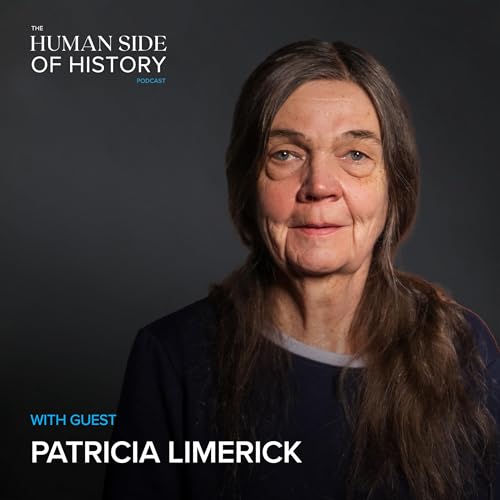
Couverture de The Human Side of History

The Human Side of History

The Human Side of History

De : Shapell Manuscript Foundation
Écouter gratuitement

À propos de ce contenu audio

The Human Side of History explores how the unfiltered, intimate perspectives of yesterday resonate and inform us today. Hosted by Gil Troy, the show combines historical texts and interviews with historians, politicians, and other experts in various fields. Join us as we engage in insightful discussions and reveal the intricate connections between history and our world today.Shapell Manuscript Foundation
Épisodes
  • The Other Seat of Power: The Presidency in a Divided Congress | Episode 10
    Sep 1 2025

    Journalist and scholar E.J. Dionne joins host Gil Troy to examine the power struggles between the president and Congress - struggles that have intensified in today’s hyper-partisan era. From George Washington’s reluctant service and the founders’ vision of checks and balances, to today’s entrenched partisan battlegrounds, they explore how political polarization has reshaped the balance of power in American government.

    Dionne and Troy consider key historical moments, from Watergate to the Clinton impeachment, and ask whether bipartisan cooperation is still possible or simply a relic of a vanished political culture and era. They also consider moments when presidents bridged divides - or failed to - and debate whether the symbolic power of the office can still unify a fractured nation; is unity a lost ideal, or a goal worth reclaiming?

    To read the texts and learn more about the manuscripts discussed in this episode, visit:

    George Washington’s Dread of Becoming the President, 1789

    James K. Polk Declares the Presidency Too Important an Office to be Sought or Declined, 1844

    Warren Harding on American Statesmanship and Lincoln, 1923


    Chapters

    (00:00) Opening

    (00:31) Introduction: The Presidency in a Divided Congress

    (03:26) George Washington’s Integrity and the Birth of Presidential Power

    (06:25) Hamilton as “Prime Minister”? Early Partisanship and Coalition Government

    (08:03) The Constitution’s Blind Spot: Ignoring Political Parties

    (11:21) The Civil War as America’s Second Founding and a New Constitution

    (14:22) Presidents as Historians, Reformers, and Problem-Solvers

    (16:41) Golden Ages in Politics? Nostalgia and Presidential Leadership

    (20:26) Great Presidents and Great Crises: Do Moments Make the Leader?

    (22:30) Warren G. Harding, Normalcy, and the Limits of Presidential Power

    (25:51) Expanding Presidential Power: Theodore Roosevelt to FDR

    (28:37) Congress vs. the Presidency: Henry Clay, LBJ, and Eisenhower

    (31:34) Nixon’s Domestic Legacy: EPA, Social Policy, and Congress

    (34:09) The Cold War, Bipartisanship, and America’s Two-Party System

    (38:25) Political Polarization, Trump, and the Decline of Cross-Party Friendships

    (42:00) Unlikely Alliances: Ted Kennedy, Orrin Hatch, and Health Care Reform

    (43:44) Clinton, Bush, Obama: Unified vs. Divided Government in Action

    (49:05) Symbolic Power of the Presidency: Oklahoma City to 9/11

    (53:09) Ronald Reagan’s “Time for Choosing” and Presidential Rhetoric

    (56:04) Presidential Evolution: JFK, Civil Rights, and Changing Leadership

    (56:55) Summary


    Stay connected with us on Facebook, Instagram, LinkedIn and by signing up for our newsletter at shapell.org/contact. For more information about this podcast, visit The Human Side of History.

    Production by docyourstory

    Music by Adam Weingrod

    The show is produced by The Shapell Manuscript Foundation. To learn more about the foundation and discover the manuscript collection visit: www.shapell.org

    Afficher plus Afficher moins
    58 min
  • Empire by Another Name: The Presidency and the Rise of Federal Power | Episode 9
    Aug 8 2025

    Acclaimed historian Patricia Limerick joins host Gil Troy to explore how presidential power was reshaped by the relentless march of America’s westward expansion. Beneath the lofty rhetoric of Manifest Destiny, they uncover the practical realities of conquest, dispossession, and the explosive growth of federal authority needed to drive it forward.

    Tracing how frontier dreams gave rise to federal sprawl - and how Jeffersonian ideals collided with the machinery of land offices, standing armies, and Interior departments - Limerick brings wit and nuance to a story too often flattened into myth.This is the expansion of power - executive, federal, and destined to reshape the world.

    To read the texts and learn more about the manuscripts discussed in this episode, visit:

    President James Monroe on Purchase of Florida, 1821

    Theodore Roosevelt's Square Deal Reclamation Act in Relation to Westward Expansion

    John F. Kennedy’s New Frontier Speech, 1960


    Chapters

    (0:00) Opening

    (0:04) How America Became an Accidental Empire

    (0:38) Introducing Patricia Limerick: Historian of the American West

    (1:54) Presidential Humor and the Power of the Fool in History

    (4:11) Reagan, Roosevelt, and the Role of Humor in Leadership

    (6:40) Manifest Destiny Debunked: Land, Myth, and Migration

    (10:17) The Real Cost of Westward Expansion for Settlers

    (11:02) Conquest and Consequences: Native Displacement and Injustice

    (18:06) Nostalgia vs. Reality: Rewriting the Myth of the West

    (20:19) How 19th-Century Presidents Shaped Land Expansion

    (23:55) Land, Power, and the Birth of American Empire

    (26:51) Bureaucracy and the Federal Government’s Rise in the West

    (27:26) Debunking the Myth of Small Government in U.S. History

    (30:21) Civil War Aftermath: Army Growth and Federal Authority

    (31:20) American Individualism vs. Government Support in the West

    (33:22) Closing the Frontier: National Identity After Expansion

    (35:13) Roosevelt’s Reclamation Act and Federal Land Policy

    (39:44) JFK’s New Frontier and the Legacy of Manifest Destiny

    (43:35) Historians as Fixers: Cleaning Up the Narrative of the West

    (47:00) Harvesting Hope: What the American West Can Still Teach Us

    (49:54) Summary and Credits


    Stay connected with us on Facebook, Instagram, LinkedIn and by signing up for our newsletter at shapell.org/contact. For more information about this podcast, visit The Human Side of History.


    Production by docyourstory

    Music by Adam Weingrod


    The show is produced by The Shapell Manuscript Foundation. To learn more about the foundation and discover the manuscript collection visit: www.shapell.org

    Afficher plus Afficher moins
    51 min
  • Opponent or Enemy? Losing the Presidency: Inside the Presidential Transfer of Power | Episode 8
    Jul 22 2025

    In this episode, Professor Gil Troy speaks with Dr. Tevi Troy about the high-stakes moment when one presidency ends and another begins, and why transitions matter far beyond inauguration day. They explore how civility, partisanship, and preparation shape the handoff of power.

    Drawing on history and firsthand experience, Dr. Troy reflects on the difference between opponents and enemies, and how the tone of a transition can influence the tone of a nation and its faith in democracy itself. What does it take to lose power and pass it on - with dignity? And what can we learn from past transitions to navigate today's political divides?


    To read the texts and learn more about the manuscripts discussed in this episode, visit:

    JFK Letter Thanking Eisenhower For a Smooth Transfer of Power, January 1, 1961


    Chapters

    (0:00) Opening

    (0:34) Introduction: Presidential Transfer of Power

    (2:18) Setting the Tone with 1952 and 1960 Transitions

    (4:45) Honesty and Resentment in Presidential Handovers

    (7:26) The Club of Presidents and Symbolic Civility

    (8:08) Modeling Behavior and Respect in Office

    (10:00) Shifting Party Lines and “Barely a Democrat”

    (14:01) The Worst Transitions in History

    (16:29) Formalizing Transitions: Policy and Preparation

    (18:44) Transition vs. Brand Differentiation

    (21:25) Governing with 4,000 Appointees

    (21:49) The Gold Standard Transition: Bush to Obama

    (26:36) The Bittersweet End of a Presidency

    (28:24) Life After the White House

    (29:57) How History Judges Presidential Decisions

    (31:09) Divisive Presidents: Nixon and Wilson

    (38:47) Unifying Presidents and Leadership Skills

    (43:39) Character, Patriotism, and Presidential Legacy

    (45:15) Closing and Credits


    Stay connected with us on Facebook, Instagram, LinkedIn and by signing up for our newsletter at shapell.org/contact. For more information about this podcast, visit The Human Side of History.


    Production by docyourstory

    Music by Adam Weingrod


    The show is produced by The Shapell Manuscript Foundation. To learn more about the foundation and discover the manuscript collection visit: www.shapell.org

    Afficher plus Afficher moins
    47 min
Aucun commentaire pour le moment