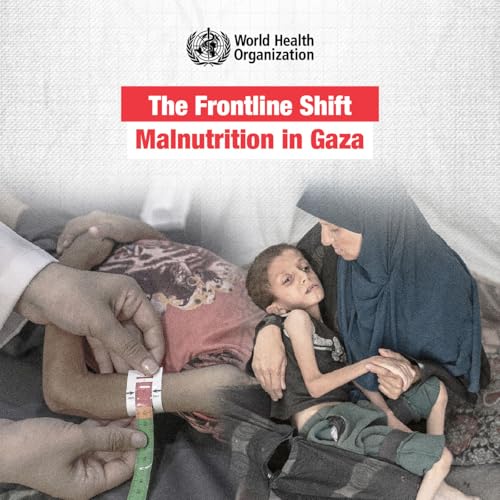
Couverture de The Frontline Shift

The Frontline Shift

The Frontline Shift

De : WHO office for the occupied Palestinian territory
Écouter gratuitement

À propos de ce contenu audio

The Frontline Shift is a podcast by the World Health Organization in the occupied Palestinian territory (oPt) that examines one of the most complex emergency health responses in the world: Gaza. Through firsthand accounts from emergency medical teams (EMTs), coordinated and deployed by WHO, the short series revisits key moments from the two-year conflict between October 2023 and October 2025. Each episode explores how health workers delivered care amid access constrains, power outages, severe shortages of medical supplies, and hostilities, while working to maintain essential services. Focused on operational realities and lessons learned, The Frontline Shift offers insight into what it takes to sustain a health system under extreme pressure. The podcast is intended for medical and humanitarian professionals, as well as listeners seeking a deeper understanding of health response challenges on the ground in Gaza.2026 Hygiène et vie saine Maladie et pathologies physiques Politique et gouvernement
Épisodes
  • Trauma Care During the Conflict
    Apr 16 2026

    When conflict overwhelmed Gaza's health system, the pressure on trauma care became almost unimaginable. In this episode, three experts who were on the ground speak with WHO: a national emergency medical team leader, a WHO EMT coordinator, and a WHO trauma surgeon. Together, they recount what it took to treat the injured — triaging patients amidst insecurity, transferring them from hospitals that were near active conflict, making impossible decisions in real time, and keeping care going when supplies, staff, and safety were all running out. From the story of one patient moved three times across a collapsing health system, to the role of the national emergency medical team in keeping Shifa Hospital functioning, this episode is human account of resilience to keep health care going.

    Hosted by:

    • Dr Egmond Evers, Health Emergencies Team Lead, WHO occupied Palestinian territory
    • Dr Luca Pigozzi, Acting In Charge Gaza, WHO occupied Palestinian territory

    Production:

    • Bisma Akbar, Team Lead Communications, WHO occupied Palestinian territory
    • Qasem Tobal, Communications Officer, WHO occupied Palestinian territory
    Afficher plus Afficher moins
    23 min
  • Delivering Primary Healthcare in Gaza
    Mar 27 2026

    After two years of conflict, only half of Gaza's primary health care centres remain functional. In this episode of the Frontline Shift, health workers from UKMed — an Emergency Medical Team working in coordination with WHO in Gaza since January 2024 — share what it has taken to keep primary health care going under relentless pressure. They discuss the immense challenges of operating with critical supply shortages, maintaining continuity of care for displaced populations, and reaching communities in areas with little to no functioning health infrastructure.


    Primary health care is the entry point into the health system. Keeping it functioning is not just about treating illness, it is about restoring trust, dignity, and the foundations of a resilient health system for the people of Gaza.

    Afficher plus Afficher moins
    Indisponible
  • Supporting Rehabilitation Needs
    Feb 23 2026

    After two years of conflict, more than 42,000 people in Gaza are living with potentially life-changing injuries, including over 5,000 amputations and thousands of spinal cord injuries, burns, and complex limb injuries.


    In this episode of Frontline Shift, health workers from NORWAC — an emergency medical team working in coordination with WHO in the Gaza Strip since February 2024 — alongside a WHO rehabilitation specialist, discuss the urgent needs, gaps, and challenges in expanding access to physical rehabilitation services. They share how the lack of functioning services and essential assistive devices is affecting patients' recovery, independence, and quality of life.


    While some progress is underway, with WHO and Emergency Medical Teams working to restore and expand rehabilitation services, strengthen referral pathways, and train and support the health workforce, the scale of needs remains immense.


    With much of Gaza's rehabilitation infrastructure damaged or non-operational, and many professionals killed or displaced, rebuilding services requires coordination, sustained investment, and reliable access to supplies.


    Rehabilitation is not a luxury — it is essential to recovery, dignity, and long-term resilience.

    Afficher plus Afficher moins
    25 min
Aucun commentaire pour le moment