Couverture de The EthnoMed Podcast

The EthnoMed Podcast

The EthnoMed Podcast

De : Dr. Duncan Reid MD @ EthnoMed.org
Écouter gratuitement

À propos de ce contenu audio

The official podcast of EthnoMed.org, a website based in the Interpreter Services Department at Harborview Medical Center which serves as a cultural bridge connecting providers and patients with resources for cross-cultural medicine. The podcast features provider interviews, community highlights, and topical episodes related to cross-cultural medicine.

© 2026 The EthnoMed Podcast

Hygiène et vie saine Maladie et pathologies physiques Sciences sociales
Les membres Amazon Prime bénéficient automatiquement de 2 livres audio offerts chez Audible.

Vous êtes membre Amazon Prime ?

Bénéficiez automatiquement de 2 livres audio offerts.
Bonne écoute !
    Épisodes
    • Provider Pulse Ep. 30: Dr. Anuj Khattar, MD (Part 2) - Medicine, Burnout, and Finding Balance
      Jan 5 2026

      Send us a text

      "The medical system we have is very oppressive in this country. It doesn't primarily value humanity and the human experience and the health of human beings."

      In Part 2 of our conversation with family physician Dr. Anuj Khattar, the idealism we traced in Part 1 collides with the realities of the American healthcare system. This episode isn't comfortable—it's not meant to be.

      Dr. Khattar walks us through what happens when a values-driven physician enters a system designed around different priorities. From 30-hour shifts in residency to patients unable to afford care, from the loss of continuity in family medicine to the question of whether doctors are actually happy—this is a frank conversation about a physician's assessment of his path and the state of medicine.

      In Part 2, we explore:

      • How witnessing child abuse during pediatrics rotations sparked his passion for reproductive healthcare and patient choice
      • The moral distress in residency when he realized "this isn't what I signed up for"
      • The painful reality of insurance barriers preventing patients from getting necessary care
      • Taking six months after fellowship to reclaim his identity beyond medicine
      • The honest answer to "Do you know anyone who's really happy being a doctor?" (Spoiler: "Really happy is a stretch.")
      • Why six jobs isn't just burnout—it's an intentional design for maintaining agency within system constraints
      • The loss of continuity that drew him to family medicine in the first place: "I get more lost in novels these days because I want to know those things about people's lives"

      This isn't a warning to avoid medicine—it's an invitation to enter with clear sight. The healthcare system has real problems. It prioritizes profit over patients. It creates barriers to care. It burns out providers who entered with the best intentions.

      But Dr. Khattar hasn't given up. He's created a sustainable practice across multiple settings, refuses to stop advocating for patients, and continues teaching the next generation. He shows up—even in 15-minute appointments—and still cares.

      For pre-med students: Better to question now than after medical school. Channel your anger about the system into motivation to change it.

      For medical students: You're not alone in the frustration. The gap between what you hoped medicine would be and what it is—that's real, and it's okay to name it.

      For anyone in healthcare: This conversation validates what many feel but don't say out loud.

      Dr. Khattar's story doesn't end with easy answers. What it offers is honesty, agency within constraints, and the refusal to look away.

      Visit EthnoMed.org for additional resources. Follow us on YouTube and Instagram @EthnoMedUW

      Afficher plus Afficher moins
      32 min
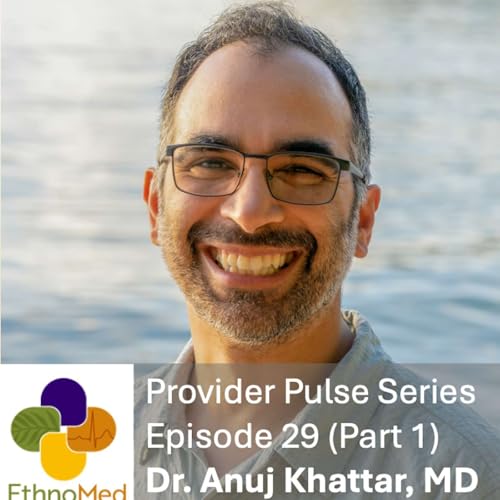
    • Provider Pulse Ep. 29: Dr. Anuj Khattar, MD (Part 1) - The Making of a Community Doctor
      Dec 21 2025

      Send us a text

      What happens when an idealistic pre-med student becomes a physician and discovers the healthcare system isn't quite what they expected? In this first part of our conversation with Dr. Anuj Khattar, we trace the path from a diverse San Jose childhood to six different healthcare jobs across Seattle.

      Dr. Khattar currently works as medical director at Cedar River Clinics, teaches at Swedish Family Medicine and ICHS, provides care at Planned Parenthood, runs a ketamine-assisted therapy practice, and works urgent care—a portfolio that reflects both passion and the complex realities of modern medicine.

      In Part 1, we explore:

      • Growing up in 1990s San Jose during the tech boom, where white students in his school were the minority and diversity was the norm
      • The mobile clinic experience at UCLA that cemented his commitment to serving underserved communities and taught him to see systems of power and inequality
      • Undergraduate research experience and his realization that this was not his path
      • The challenging first two years of medical school at OHSU— endless exams and questioning his path
      • Finding redemption in third-year clinical rotations and discovering his mentor in family medicine

      This episode is essential listening for anyone considering medical school. It's honest about the challenges—the grind, the depression, the culture shock—while showing why some people persist. Anuj's story isn't a warning to stay away from medicine; it's an invitation to enter with eyes wide open.

      Coming in Part 2: What happens when idealism meets the constraints of the American healthcare system.

      Visit EthnoMed.org for additional resources. Follow us on YouTube and Instagram @EthnoMedUW

      Afficher plus Afficher moins
      32 min
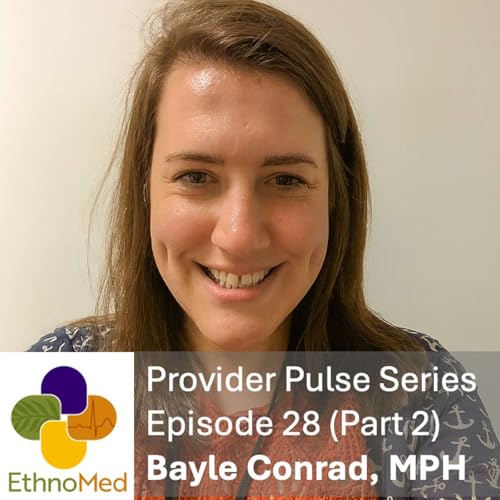
    • Provider Pulse Ep. 28: Bayle Conrad, MPH (Part 2) - Finding Agency in the Work
      Dec 15 2025

      Send us a text

      After her crisis of conscience in Kenya, Bayle Conrad made a decision: no more international work. But finding her place in global health wasn't that simple.

      In this second part of our conversation, Bayle returns to Seattle with an MPH degree and more questions than answers. She turns down international jobs she's qualified for, takes a microfinance position that still involves those same power dynamics, and eventually stumbles into refugee resettlement work at the International Rescue Committee—a job she wasn't sure she could do.

      What follows is six years of transformation. The anxious teenager who couldn't speak up becomes a caseworker handling crisis interventions. The student who questioned her right to help finds meaningful work here in Seattle. And the questions that nearly made her quit? They become her greatest asset.

      This episode tackles the practical realities of refugee healthcare: Why "just pick up your prescription" isn't simple. How systemic barriers compound trauma. What happens when a care conference becomes an exercise in power dynamics. And most importantly, how providers can create space for agency rather than accidentally undermining it.

      We end with Bayle's hard-won advice for students navigating uncertainty, anxiety, and the messy path toward meaningful work.

      Topics covered:

      • Transitioning from international to domestic work
      • Refugee resettlement and casework at the IRC
      • Navigating power dynamics in helping professions
      • Barriers to healthcare for refugee populations
      • Working with interpreters and cultural brokers
      • Practical guidance for providers
      • Advice for anxious, shy, or questioning students
      • Finding your strengths in unexpected places

      Perfect for: Healthcare providers working with refugees, public health professionals, students questioning their career path, anyone navigating the tension between helping and perpetuating harm, and those learning that their sensitivity might actually be their strength.


      Visit EthnoMed.org for additional resources. Follow us on YouTube and Instagram @EthnoMedUW

      Afficher plus Afficher moins
      40 min
    Aucun commentaire pour le moment