Couverture de The Daniel Stih Podcast

The Daniel Stih Podcast

The Daniel Stih Podcast

De : Daniel Stih
Écouter gratuitement

3 mois pour 0,99 €/mois

Après 3 mois, 9.95 €/mois. Offre soumise à conditions.

À propos de ce contenu audio

Understand What's Really Going On. Logic, science, and solutions—to help you think clearly and talk about the world rationally. Hosted by modern-day Renaissance man and thought partner, Daniel Stih (aerospace engineer, mountain climber, songwriter) we explore bold ideas that challenge the status quo and embrace critical thinking and innovation. Think differently, act boldly, transform yourself and the world. Because you can. Visit: https://www.danielstih.com2024 Développement personnel Réussite personnelle
Les membres Amazon Prime bénéficient automatiquement de 2 livres audio offerts chez Audible.

Vous êtes membre Amazon Prime ?

Bénéficiez automatiquement de 2 livres audio offerts.
Bonne écoute !
    Épisodes
    • The Interstate Highway Model for the Arctic: How the U.S. Can Compete Without War
      Jan 14 2026

      The United States keeps running into the same strategic problem.

      We say we want to compete with China without going to war.
      We say we want to support allies without dominating them.
      We say places like Greenland and the Arctic matter strategically.

      And yet, when it comes to non-military power, the U.S. has almost nothing credible to offer.

      In this solo episode, Daniel Stih breaks down why Greenland exposes a deeper flaw in U.S. strategy — not a failure of leadership, but a failure of available tools. When the only funded options are military force, sanctions, or profit-seeking private investment, even reasonable leaders are forced into bad choices.

      This episode introduces a missing alternative:
      a Federal Highway Act–style model for allied strategic infrastructure.

      Instead of coercion or transactional deals, what if the U.S. built shared, civilian infrastructure as a long-term public good — the same way it once built the interstate highway system at home?

      You'll hear:
      • Why military power alone can't compete with long-term infrastructure investment
      • Why Greenland isn't "broken" — it's underbuilt
      • Why private markets can't justify highways, ports, or Arctic resilience
      • How the interstate highway system solved a similar problem in 1956
      • What a non-war U.S. power model could actually look like
      • Why real leadership sometimes means inventing the option that doesn't exist yet

      This is not an argument about politics.
      It's a conversation about systems, incentives, and missing institutions.

      Greenland is not the story.
      Greenland is the test case.

      If the U.S. wants influence without force, alignment without coercion, and competition without war — it needs a civilian strategic infrastructure model that matches the world we actually live in.

      Subscribe for more solo episodes on thinking clearly, systems design, and solving hard problems without noise.

      Afficher plus Afficher moins
      11 min
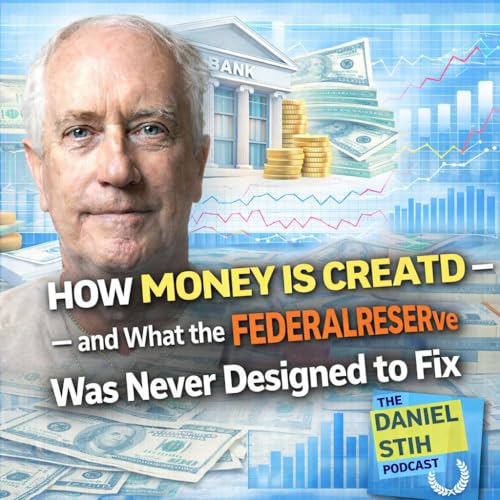
    • Steve Keen: How Money Is Created & The Federal Reserve
      Jan 7 2026

      Most people think banks lend money.
      They don't. They create it.

      I sit down with economist Steve Keen to explain how money, banking, and the Federal Reserve actually work. Our conversation tackles one of the biggest sources of confusion in economics:
      where money comes from, what the Federal Reserve was designed to do, and why financial crises keep repeating—even when the tools change.

      This episode is about mechanics, incentives, and systems.

      We cover:
      • Where money really comes from
      • Why banks don't lend existing money
      • How money is created when a loan is approved
      • How this explains booms, crashes, and sudden financial collapses
      • What the Federal Reserve is—and what it isn't
      • Is the Federal Reserve public or private?
      • Why it wasn't designed as a normal government agency
      • What the Fed was never meant to fix
      • Why stabilizing panic ≠ fixing incentives
      • How boom–bust cycles really work
      • Quantitative Easing explained without jargon

      SHOW NOTES:

      Steve Keen

      Substack - Building a New Economics: https://profstevekeen.substack.com/

      Website: https://www.stevekeen.com/
      Invite-Only: Dr. Steve Keen's Private 7-Week 'Rebel Economist Challenge'

      Patreon: https://www.patreon.com/ProfSteveKeen

      YouTube: https://www.youtube.com/ProfSteveKeen

      Books:

      Money and Macroeconomics from First Principles for Elon Musk and Other Engineers.: https://www.amazon.com/Money-Macroeconomics-First-Principles-Engineers-ebook/dp/B0FLWJ8LXY

      Debunking Economics (Digital Edition - Revised, Expanded and Integrated): The Naked Emperor Dethroned: https://www.amazon.com/Debunking-Economics-Digital-Integrated-Dethroned-ebook/dp/B09LQ9JJYP

      • USA: https://www.amazon.com/dp/B0FLWJ8LXY
      • UK: https://www.amazon.co.uk/dp/B0FLWJ8LXY
      • Germany: https://www.amazon.de/dp/B0FLWJ8LXY
      • FR ; ES ; IT ; NL ;JP ; BR ; CA ; MX ; AU

      Forbes Articles: https://www.forbes.com/sites/stevekeen/?utm_source=chatgpt.com

      Afficher plus Afficher moins
      1 h et 16 min
    • Why Venezuela Doesn't Make Sense (Oil, Gas Prices, and Geopolitics Explained)
      Jan 4 2026

      Most explanations about Venezuela fall into two simple stories:

      "They removed a bad guy."
      "This will lead to cheaper gas."

      Both sound plausible. Neither survive with how oil markets, geopolitics, and incentives work. Examine the mechanics underneath the story:

      • How "bad actor" narratives simplify a complex structural conflict
      • How oil prices are set and why Venezuela's oil won't lower gas prices
      • Why strategic alignment, precedent, and rule-setting matter more than bad actor behavior and pump prices

      This is not a defense of any government or leader, and it does not minimize real abuses or governance failures. This is an exercise in thinking clearly.

      Afficher plus Afficher moins
      9 min
    Aucun commentaire pour le moment